

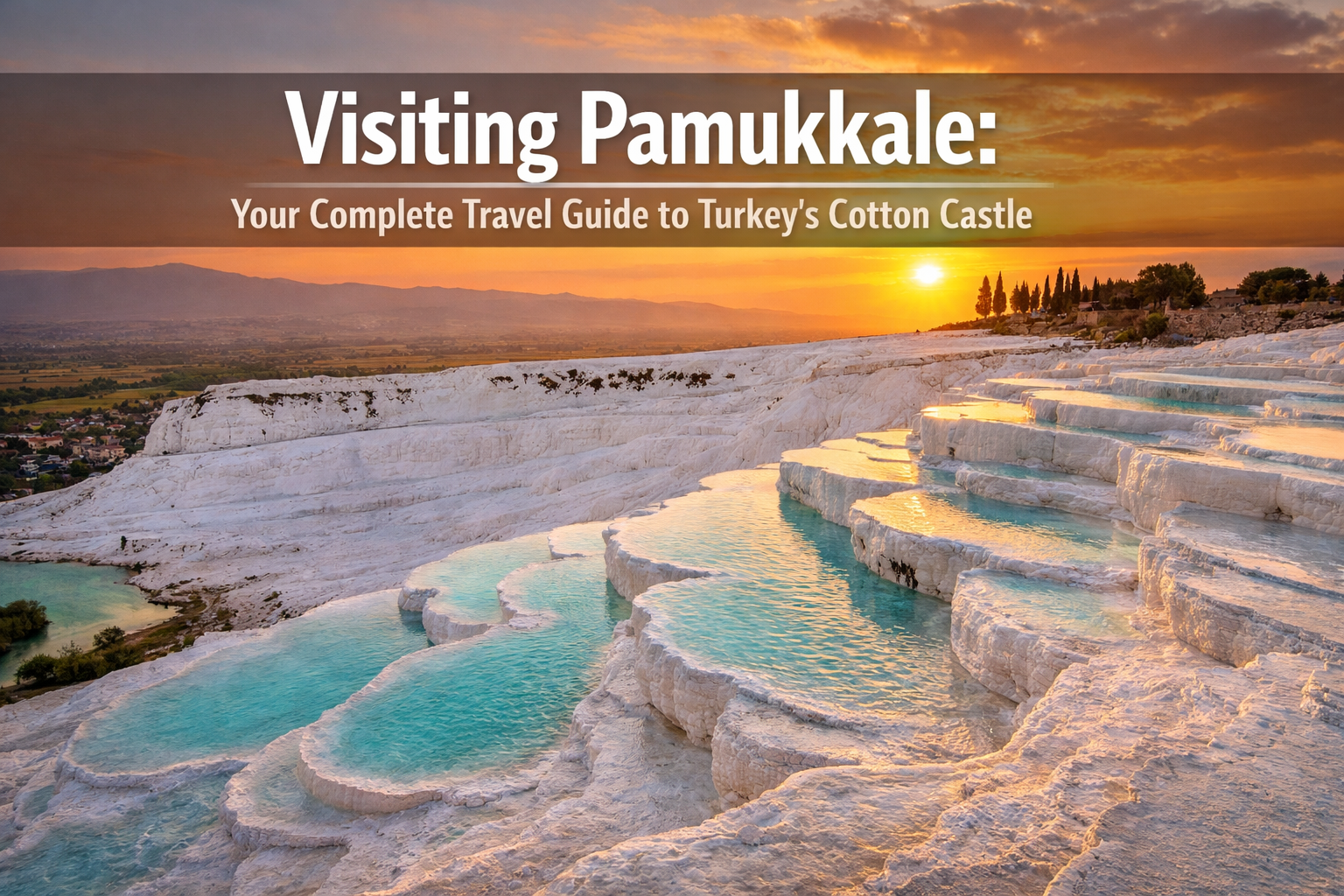

Every year, roughly 2 million visitors remove their shoes at the base of a snow-white hillside in south-western Turkey and wade through warm, mineral-rich pools that look like something from another planet. That hillside is Pamukkale — literally “Cotton Castle” in Turkish — and it is one of the most visually striking natural wonders on Earth. If you are planning a trip and want to know exactly how to make the most of it, this guide to Visiting Pamukkale: The Complete Travel Guide to Turkey’s Cotton Castle covers everything from the best time to go to the ancient ruins waiting at the top.
Key Takeaways 🏔️
- Pamukkale’s terraces are a UNESCO World Heritage Site — strict rules protect them, including a no-shoes policy on the white slopes.
- Spring (April–June) and autumn (September–October) offer the best combination of comfortable temperatures and smaller crowds.
- Hierapolis, the ancient Greco-Roman city on the plateau above, is equally unmissable and included in your entry ticket.
- A full day is the minimum recommended time; staying overnight lets you see the site at its quietest.
- A local guide or travel specialist can unlock historical context and save hours of planning.
Visiting Pamukkale: What Makes Turkey’s Cotton Castle So Special?
Pamukkale sits in the Denizli Province of south-western Turkey, about 250 km (155 miles) from İzmir. Hot spring water, rich in calcium bicarbonate, flows down a 160-metre-high cliff face. As the water cools and carbon dioxide evaporates, calcium carbonate is deposited, building up the brilliant white travertine terraces and shallow thermal pools the site is famous for.
“Pamukkale is not just a landscape — it is a living geological process you can step into.”
The site has been valued for thousands of years. The ancient city of Hierapolis was founded directly above the springs around 190 BCE, and its residents believed the thermal waters had healing powers. UNESCO recognised the combined natural and cultural significance by listing Pamukkale-Hierapolis as a World Heritage Site in 1988.
To understand just how unique this destination is, read our dedicated article on what makes Pamukkale a unique travel destination.
When Is the Best Time to Visit Pamukkale?
| Season | Temperatures | Crowds | Notes |
|---|---|---|---|
| Spring (Apr–Jun) | 18–28 °C | Moderate | 🌸 Ideal — pools full, wildflowers bloom |
| Summer (Jul–Aug) | 30–38 °C | Very High | ☀️ Hot but vibrant; book ahead |
| Autumn (Sep–Oct) | 20–30 °C | Moderate | 🍂 Best overall balance |
| Winter (Nov–Mar) | 5–15 °C | Low | ❄️ Quieter; some pools may be reduced |
Spring and autumn are the sweet spots. The pools are well-filled, the light is superb for photography, and the heat is manageable. Summer is perfectly enjoyable but expect larger crowds and higher accommodation prices.
For broader timing advice across Turkey, check our guide on the best time of year to visit Turkey.
How to Get to Pamukkale
By Plane ✈️
The nearest airport is Denizli Çardak Airport (DNZ), roughly 65 km from Pamukkale. Direct flights operate from Istanbul and several European cities. From the airport, take a shuttle bus or taxi to Denizli city centre, then a dolmuş (shared minibus) to Pamukkale village (about 20 minutes, very cheap).
By Bus 🚌
Long-distance buses from Istanbul, İzmir, Antalya, and Ankara serve Denizli’s main otogar (bus terminal). Pamukkale Tourism and other operators run direct services from İzmir in under 3 hours.
By Train 🚂
A scenic train runs between İzmir (Basmane) and Denizli, taking around 3–4 hours. From Denizli, connect by dolmuş to Pamukkale.
Pamukkale Day Trip 🚗
A Pamukkale day trip from İzmir or Antalya is popular but demanding. Guided day tours depart early (around 06:00) and return late evening, giving you roughly 5–6 hours on site. If your schedule allows, staying one night in Pamukkale village is far more rewarding.
Visiting Pamukkale: The Complete Travel Guide to Turkey’s Cotton Castle — Exploring the Site
The Travertine Terraces
Shoes must be removed before stepping onto the white terraces — this is strictly enforced and genuinely important for preservation. Carry a small bag for your footwear. The path is well-marked, and the warm water (around 35 °C / 95 °F) is surprisingly comfortable even on cooler days.
Tips for the terraces:
- 🕗 Arrive early (opening time is 06:30) or late afternoon to avoid peak crowds.
- 📷 The best photography light is in the morning or the golden hour before closing.
- 💧 Water levels vary by season; spring typically offers the fullest pools.
- 🧴 Apply sunscreen before entering — the white surface reflects UV intensely.
Hierapolis: The Ancient City Above
Perched on the plateau directly above the terraces, Pamukkale Hierapolis is a remarkably well-preserved Greco-Roman city. Allow at least 2–3 hours here. Key highlights include:
- The Theatre — a 2nd-century Roman theatre seating 12,000, with stunning views over the valley.
- The Necropolis — one of the largest ancient cemeteries in Anatolia, stretching over 2 km.
- The Martyrium of St Philip — an early Christian octagonal monument.
- The Antique Pool (Cleopatra’s Pool) — a thermal swimming pool filled with ancient column fragments; entry costs extra but is a memorable experience.
- The Hierapolis Archaeology Museum — housed in the restored Roman baths, displaying exceptional sculptures and sarcophagi.
Hierapolis is just one of Turkey’s extraordinary ancient sites. Our guide to archaeological sites in Turkey highlights many more worth adding to your itinerary.
Practical Information: Tickets, Rules & Getting Around
Entry Fees (2026 Approximate Prices)
| Ticket Type | Price (TRY) |
|---|---|
| Pamukkale & Hierapolis combined | ~600–700 TRY |
| Antique Pool (Cleopatra’s Pool) | ~500 TRY extra |
| Children under 8 | Free |
Prices are subject to change. Always verify current fees at the official site or with your accommodation.
Opening Hours
The site is generally open 06:30–21:00 in summer and 08:00–19:00 in winter, though hours can vary. Check locally before your visit.
Key Rules to Follow ✅
- No shoes on the white terraces (enforced at entry points).
- No littering — bins are provided throughout.
- No drones without a special permit.
- Respect the ruins — do not climb on fragile structures.
For broader guidance on respecting Turkey’s natural and cultural sites, see our article on how to ensure you’re respecting wildlife and natural sites in Turkey.
Where to Stay Near Pamukkale
Pamukkale village sits right at the base of the terraces and offers everything from budget guesthouses to comfortable mid-range hotels, many with their own thermal pools. Staying in the village means you can visit the terraces at dawn or dusk — the two most magical times — when day-trippers have gone.
Denizli city (20 minutes away) has a wider range of hotels and better transport links if you prefer a larger town base.
For help finding the right option for your budget, our guide on how to find accommodation that fits your budget in Turkey is a great starting point.
The Value of a Local Guide or Travel Specialist
Pamukkale’s layers — geology, ancient history, early Christianity, Roman engineering — are far richer with expert interpretation. A knowledgeable local guide can bring Hierapolis to life, point out details you would otherwise miss, and help you navigate the site efficiently. A travel specialist can also build a seamless itinerary combining Pamukkale with nearby destinations like Butterfly Valley in Fethiye or the natural wonders of Cappadocia.
If you are weighing up guided versus independent travel, our article on how to choose between guided tours or independent travel in Turkey offers balanced advice.
Visiting Pamukkale: The Complete Travel Guide to Turkey’s Cotton Castle — Quick Itinerary
One Day (Day Trip)
- 06:30 — Enter terraces at south gate; walk up to Hierapolis plateau
- 09:00 — Explore Hierapolis theatre, necropolis, and museum
- 12:00 — Swim in the Antique Pool
- 14:00 — Walk back down the terraces in afternoon light
- 16:00 — Depart
Two Days (Recommended)
- Day 1: Arrive, settle in, explore terraces at golden hour
- Day 2: Full Hierapolis exploration + Antique Pool; depart refreshed
Conclusion: Plan Your Pamukkale Visit with Confidence
Pamukkale is genuinely one of those places that exceeds expectations in person. The combination of surreal white terraces, warm thermal pools, and a sprawling ancient city on the plateau above makes it unlike anywhere else on the planet. Whether you are planning a quick Pamukkale day trip or building it into a longer Turkey adventure, the effort is absolutely worth it.
Your actionable next steps:
- ✅ Decide on your travel window — aim for April–June or September–October.
- ✅ Book accommodation in Pamukkale village at least 4–6 weeks ahead in peak season.
- ✅ Consider a local guide for Hierapolis to get the most from the ruins.
- ✅ Check current entry fees and opening hours before you travel.
- ✅ Read our full guide on the thermal wonders of Pamukkale for even more detail on the geology and spa experiences.
Turkey has extraordinary destinations at every turn — from Cappadocia’s natural wonders to hidden coastal towns — but Pamukkale holds a special place. Once you have stood barefoot in those warm turquoise pools with ancient ruins above you and a valley stretching to the horizon below, you will understand why.
References
- UNESCO World Heritage Centre. (1988). Hierapolis-Pamukkale. Retrieved from https://whc.unesco.org/en/list/485
- Turkish Ministry of Culture and Tourism. (2023). Pamukkale official visitor statistics. Ankara: Republic of Turkey.
- Altunel, E., & Hancock, P. L. (1993). Morphology and structural setting of Quaternary travertines at Pamukkale, Turkey. Geological Journal, 28(3–4), 335–346.
- Özkul, M., Varol, B., & Alçiçek, M. C. (2002). Depositional environments and petrography of Denizli travertines. Bulletin of the Mineral Research and Exploration, 125, 13–29.
Related Turkey destination guides: If Pamukkale is on your route, also see our 7-day Turkey itinerary, 10-day Turkey itinerary, best time to visit Turkey guide, and must-do Turkey experiences.