

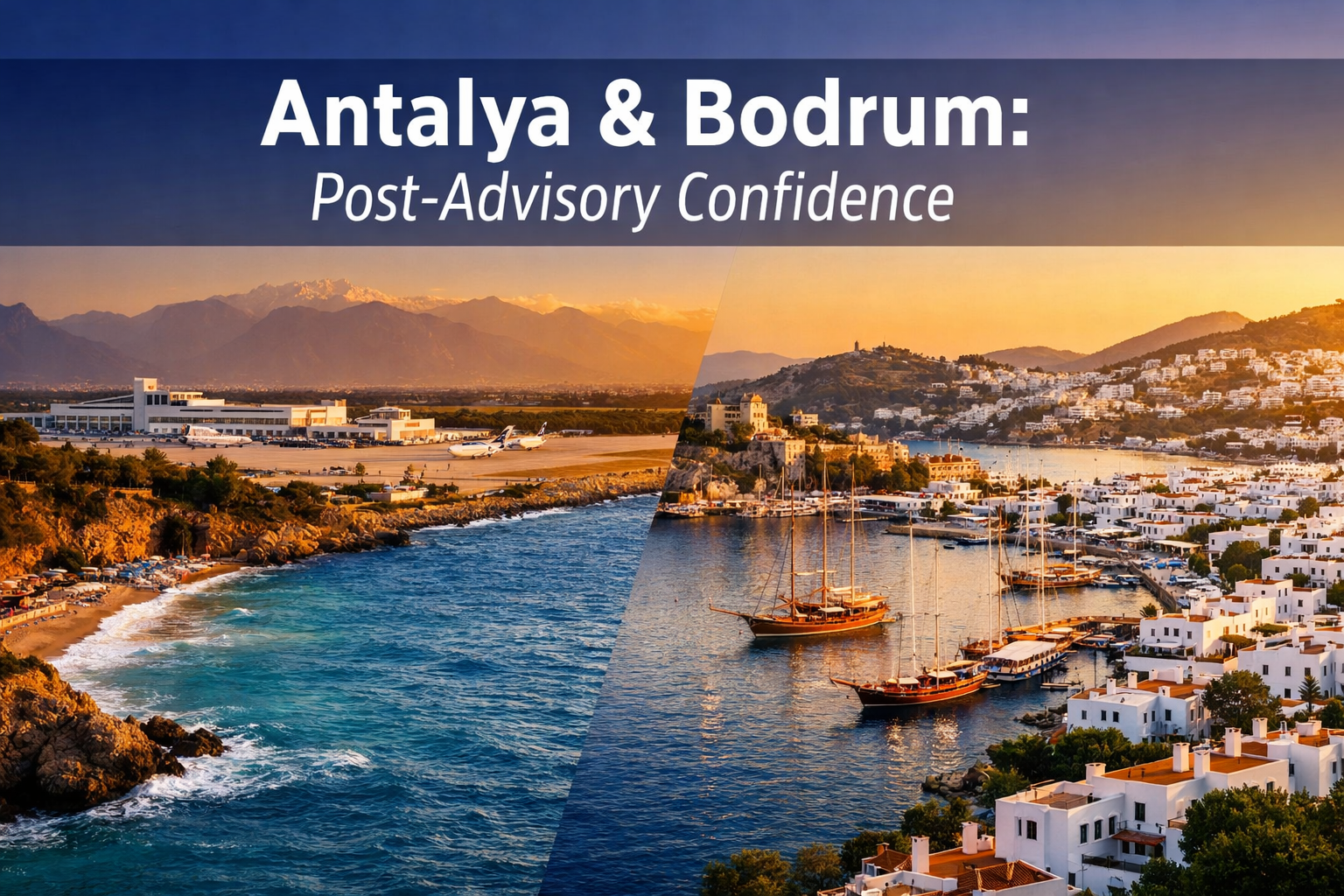

Last March, UK visitor arrivals to Turkey surged 16% year-over-year—and in the final week of the month alone, that number spiked a jaw-dropping 64%, with the lion’s share of bookings pointed squarely at Antalya and Bodrum. That’s not the behavior of travelers running scared. That’s the behavior of travelers who’ve done their homework. And here’s the thing about Antalya and Bodrum’s post-advisory confidence: what travelers need to know about safety, new infrastructure, and booking trends boils down to a surprisingly simple plot twist—the headlines and the reality on the ground are telling two very different stories.
When the US State Department updated its Turkey advisory on March 9, 2026, ordering non-emergency staff departure from the Adana Consulate due to security concerns in the southeast [2][3], the internet predictably erupted. But buried in that same advisory? A crucial detail: no changes whatsoever for tourist areas like Antalya and Bodrum, which continue normal operations [2]. The southeastern border region and the Mediterranean resort coast are separated by roughly 600 kilometers of mountains, farmland, and an entirely different security landscape. (That’s like canceling your trip to Barcelona because of a travel warning for a region near the French-Spanish border. Context matters.)
So let’s dig into what’s actually happening in Turkey’s two most beloved coastal destinations—because future you will thank us for this one.
Key Takeaways
- 🛡️ The 2026 advisory targets southeastern Turkey only—Antalya and Bodrum operate normally with no restrictions on tourist areas [2][3]
- ✈️ Antalya’s €850 million airport expansion is now welcoming passengers, boosting capacity to 65 million annually ahead of summer 2026
- 📈 Booking trends are surging, with UK arrivals up 16% YoY and German early bookings climbing several points, focused on Aegean and Mediterranean coasts
- 💰 Turkey remains the Mediterranean’s best value play, with packages running £400–600pp compared to pricier Greek and Spanish alternatives
- 🏗️ Major infrastructure investments totaling €1.4 billion include the Antalya-Alanya Motorway and Bodrum transport upgrades

Safety in Antalya and Bodrum: What the Advisory Actually Says (and Doesn’t)
Separating Geography from Headlines
Here’s what nobody tells you about travel advisories: they’re blunt instruments applied to entire countries, and Turkey is a big country. The Level 4 “Do Not Travel” designation applies specifically to areas near the Syrian border and parts of southeastern Turkey [2][3]. Meanwhile, Antalya sits on the Mediterranean’s southern coast, and Bodrum perches on the Aegean peninsula—both hundreds of kilometers from any advisory zone.
Chris Bazos of Travelous put it plainly in March 2026: “The consensus on the ground in Türkiye aligns with Egypt and Jordan—everything is functioning normally” in Antalya, Bodrum, and other tourist hubs [6]. The Turkey Tourism Promotion & Development Agency confirmed the same, noting strong in-resort feedback from major properties across both destinations.
What Safety Actually Looks Like on the Ground
Turkey’s tourism infrastructure has become, frankly, ridiculously good at managing security. Both Antalya and Bodrum feature:
- Enhanced airport screening with modern detection systems at both Antalya (AYT) and Milas-Bodrum (BJV) airports
- Tourist police units operating in multiple languages throughout resort zones
- 24/7 CCTV monitoring across major tourist corridors and beach areas
- Dedicated emergency hotlines for international visitors (dial 153 for tourist police)
Tourism Investors Association President Ülke Ersoy described the sector as “crisis-resistant” in February 2026, and the numbers back that claim—Turkey welcomed 64 million visitors in 2025, generating $65.2 billion in revenue, with 2026 targets set at an ambitious $68 billion.
Pro move: Before any international trip, check your country’s specific advisory page rather than relying on social media summaries. The US State Department page [2] and the UK FCDO site both break Turkey down by region—and the distinction matters enormously.
For travelers wanting a deeper dive into staying safe during Turkish adventures, our guide to safety during adventure travel in Turkey covers everything from hiking precautions to water sports protocols.
New Infrastructure Transforming Antalya and Bodrum: What Travelers Need to Know
Here’s the magic: while headlines focused on advisories, Turkey quietly poured billions into making these destinations better than ever. Consider this your sign to pay attention to what’s being built.

Antalya’s €850 Million Airport Glow-Up
The single biggest total game-changer for 2026? Antalya Airport’s brand-new international terminal. Part of an €850 million first-phase expansion that began welcoming passengers in early 2026, this upgrade pushes annual capacity to a staggering 65 million passengers. To put that in perspective, that’s more than many European capital city airports handle.
What does this mean for actual humans trying to catch a flight?
| Feature | Before Expansion | After Expansion (2026) |
|---|---|---|
| Annual Passenger Capacity | ~35 million | 65 million |
| Immigration Processing | Standard queues | Expanded e-gate systems |
| Terminal Space | Crowded peak-season | Significantly expanded |
| Retail & Dining | Limited options | Modern food court + shopping |
| Connection to City | Existing roads | Improved motorway links |
Fair warning: early-phase operations always have a few growing pains. But by peak summer 2026, full operations should be humming along beautifully.
The Antalya-Alanya Motorway: A Seriously Underrated Upgrade
The Turkish Transport Minister’s February 2026 infrastructure announcement included approval for the Antalya-Alanya Motorway, financed through the Asian Infrastructure Investment Bank as part of a €1.4 billion investment package [7]. This motorway will slash travel times between Antalya city center and the increasingly popular Alanya coast—a route that currently involves a sometimes white-knuckle drive along the D400 highway.
For travelers planning to explore beyond their resort (and trust us on this, you absolutely should), this means easier access to ancient sites like Aspendos, the dramatic coastline of Side, and Alanya’s iconic Red Tower. Check out the most efficient ways to travel between cities in Turkey for more route-planning tips.
Bodrum’s Transport Growing Pains (and Solutions)
Bodrum’s story is a little different—and honestly, more relatable. The peninsula’s popularity has outpaced its road infrastructure, leading to pre-summer traffic congestion that prompted urgent calls in February 2026 for ring roads, smart junctions, and high-capacity public transport connecting Milas-Bodrum Airport to the city center.
Steal this tip: If visiting Bodrum in peak season (June–August), consider:
- 🚐 Pre-arranged hotel transfers rather than rental cars
- ⛵ Water taxis between peninsula towns (Yalıkavak to Gümüşlük by boat is chef’s kiss)
- 🌙 Arriving on evening flights when road traffic thins considerably
- 📅 Or better yet, visiting in off-peak seasons when Bodrum transforms into a quieter, more intimate version of itself
Booking Trends and Travel Confidence: Why Travelers Are Choosing Turkey in 2026
The Numbers Don’t Lie
Let’s talk about what travelers are actually doing with their wallets—because booking data tells a more honest story than any headline.

UK Market: That 16% year-over-year jump in March 2026 arrivals, with a 64% surge in the final week, signals something important. British travelers—famously cautious and well-informed—are voting with their credit cards. Antalya and Bodrum remain the primary beneficiaries.
German Market: The German Travel Association reported early 2026 bookings for Turkey climbing several points year-over-year, with Aegean destinations like Bodrum seeing active capacity expansions from major tour operators.
Overall Trajectory: After welcoming 64 million visitors in 2025 and generating $65.2 billion in tourism revenue, Turkey’s 2026 target of $68 billion looks not just ambitious but achievable [9].
The Value Equation: Turkey vs. Mediterranean Competitors
Here’s where things get interesting. Turkey isn’t just competing on beauty (though, prepare to be obsessed with that Aegean blue)—it’s winning on value.
| Destination | Avg. Package Cost (pp) | Flight Time (UK) | Luxury Options | Value Rating |
|---|---|---|---|---|
| Antalya | £400–550 | 4 hours | ⭐⭐⭐⭐⭐ | Exceptional |
| Bodrum | £450–600 | 4 hours | ⭐⭐⭐⭐⭐ | Excellent |
| Greece (islands) | £600–900 | 3.5–4 hours | ⭐⭐⭐⭐ | Good |
| Spain (costas) | £500–750 | 2.5–3 hours | ⭐⭐⭐⭐ | Good |
| Cyprus | £500–700 | 4.5 hours | ⭐⭐⭐⭐ | Good |
Travel + Leisure named Bodrum a top 2026 destination in January, specifically highlighting its luxury lifestyle appeal beyond mass tourism. This isn’t just about all-inclusive resorts anymore (though those are absolutely worth it too). Bodrum’s boutique hotel scene, farm-to-table dining movement, and Aegean culinary traditions have elevated it into a different category entirely.
Who’s Booking and Why
The 2026 traveler profile for both destinations has diversified beautifully:
- Families drawn to Antalya’s all-inclusive resorts with kids’ clubs and waterparks—check out family-friendly activities across Turkey for inspiration
- Luxury seekers flocking to Bodrum’s Yalıkavak Marina district and hillside boutique hotels
- Wellness travelers combining beach holidays with Turkey’s growing health tourism sector, including thermal springs and spa retreats
- Cultural explorers using coastal bases to visit ancient ruins, from Ephesus to Perge
- Digital nomads taking advantage of Turkey’s excellent Wi-Fi infrastructure and café culture
Story time: A recurring theme in traveler forums throughout early 2026 has been the “I was nervous, then I arrived” narrative [4]. Visitors consistently report that the gap between media perception and on-the-ground reality is enormous. Turkish hospitality is no joke—and it has a way of dissolving anxiety approximately three sips into your first complimentary çay.
Smart Booking Strategies for 2026
Given surging demand, here are some genuinely useful tips:
- Book early for peak season (June–September)—capacity is expanding but so is demand
- Consider shoulder months (May and October) for the secret sauce of perfect weather minus crowds
- Check visa requirements well in advance via our visa requirements guide—most nationalities can get e-visas online in minutes
- Monitor flight routes—new connections to both AYT and BJV airports are launching throughout 2026
- Compare packages vs. independent booking—Turkey’s value proposition often makes packages surprisingly competitive
For the fuller regional safety picture, see Is Turkey Safe to Visit in 2026? A Region-by-Region Guide.
Conclusion
The story of Antalya and Bodrum’s post-advisory confidence is ultimately a story about travelers being smarter than headlines give them credit for. The data is unambiguous: bookings are surging, infrastructure is transforming, and the on-the-ground experience in these Mediterranean and Aegean gems remains as spectacular—and safe—as ever [6][9].
Here’s what to do next:
- ✅ Read the actual advisory for your country—note the regional specifics [2]
- ✅ Start researching dates—the best time to visit Turkey depends on your priorities
- ✅ Book with confidence but book soon—demand is climbing and the best properties fill fast
- ✅ Get excited—between the new airport terminal, improved roads, and Turkey’s legendary hospitality, 2026 is shaping up to be a ridiculously good year for these destinations
Bookmark this, share it with your travel-nervous friends, and start planning. The turquoise coast is calling, the çay is brewing, and Antalya and Bodrum are more ready for visitors than they’ve ever been. 🇹🇷✈️
References
[1] Is Turkey Safe To Visit Right Now 2026 Travel Safety Guide – https://www.turkeytravel.com/en/blog/turkey-travel-blog/is-turkey-safe-to-visit-right-now-2026-travel-safety-guide
[2] Turkey Travel Advisory – https://travel.state.gov/content/travel/en/traveladvisories/traveladvisories/turkey-travel-advisory.html
[3] New Travel Alert Turkey Level 4 – https://parade.com/news/new-travel-alert-turkey-level-4
[4] facebook – https://www.facebook.com/groups/kalkangroup/posts/5255650977992563/
[6] Is It Safe To Travel To Turkiye What To Know Amid The Conflict In Iran – https://www.cntraveler.com/story/is-it-safe-to-travel-to-turkiye-what-to-know-amid-the-conflict-in-iran
[7] Turkey Construction Industry Databook Report 160900842 – https://finance.yahoo.com/news/turkey-construction-industry-databook-report-160900842.html
[9] Antalya January Tourism Record 2026 – https://restproperty.com/news-en/antalya-january-tourism-record-2026/