
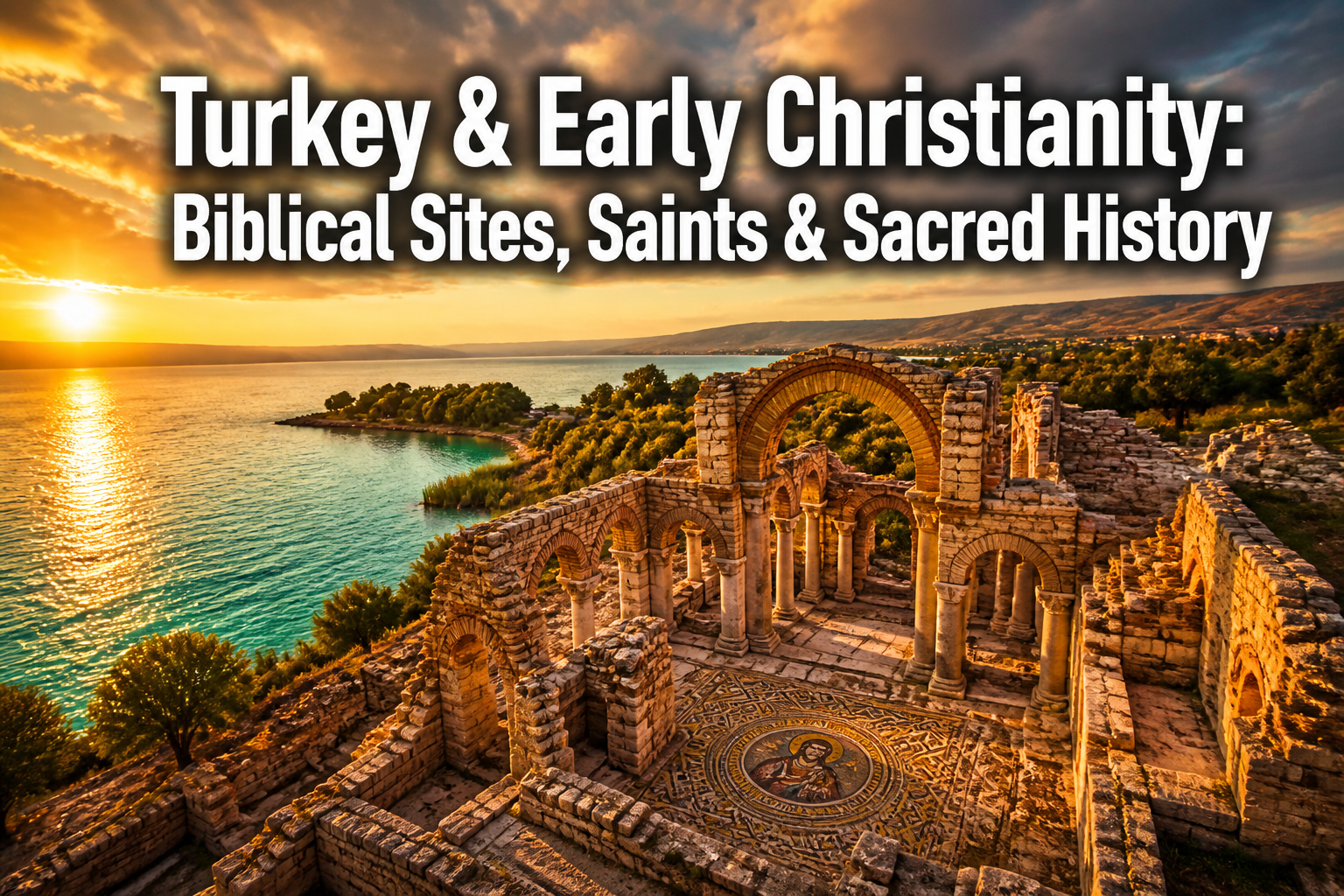

Turkey holds an extraordinary place in early Christianity, preserving ancient churches, pilgrimage routes, and sites where apostles once walked. Last updated: May 3, 2026
Quick Answer: Turkey holds more early Christian sites than almost any other country on Earth. From the Seven Churches of Revelation to the birthplace of Saint Paul, the land now called Turkey was the geographic heart of early Christianity. In 2026, ongoing excavations keep revealing new evidence — submerged basilicas, ancient murals, and churches built over Roman ruins — that deepen our understanding of how the faith spread and took root.
Key Takeaways
- 🏛️ Seven of the churches addressed in the Book of Revelation were located in what is now western Turkey (Ephesus, Smyrna, Pergamon, Thyatira, Sardis, Philadelphia, Laodicea).
- 🌊 A 4th-century basilica submerged in Lake Iznik is directly tied to the First Council of Nicaea, where over 300 bishops helped define Christian doctrine around 325 CE. [1]
- 🎨 A 3rd-century “Good Shepherd” mural of Jesus found at the Hisardere Necropolis in Iznik is described as the only early Christian example of its type found outside Italy. [4]
- ⛪ A 6th-century church was recently discovered in Kaunos built directly on top of a Roman military hospital — a striking example of how early Christians repurposed pagan infrastructure. [3]
- 📜 A 5th-century church at Olympus (Antalya province) contained an inscription unseen for over 1,000 years, along with mosaic floors still being documented today. [2]
- 🗺️ Saint Paul was born in Tarsus (modern Turkey) and conducted three major missionary journeys through Anatolia.
- 🕊️ Turkey is sometimes called “the forgotten Holy Land” because its Christian heritage is vastly underappreciated compared to Israel and Rome. [5]
- 🔍 Archaeological discoveries in Turkey are accelerating — multiple major finds have emerged in just the past few years alone.
Why Does Turkey Matter So Much to Early Christianity?
Turkey is ground zero for early Christian history. The Apostle Paul was born in Tarsus. The Virgin Mary is said to have spent her final years near Ephesus. The first seven ecumenical councils of the Christian church were all held on what is now Turkish soil.
Most people associate the Holy Land with Israel, but a strong case can be made that the land now called Turkey shaped Christian theology, organization, and culture more directly than almost anywhere else. Church historian Philip Jenkins has described Anatolia as the heartland of early Christianity — a region where the faith moved from a persecuted minority religion to the official faith of the Roman Empire.
The numbers are striking: of the 27 books in the New Testament, scholars estimate that a significant portion were written to communities located in present-day Turkey, including all seven letters in Revelation chapters 2–3.
What Early Christianity Biblical Sites Can You Visit in Turkey Today?
Turkey & Early Christianity: Biblical Sites, Saints & Sacred History overlap most visibly at a handful of major pilgrimage destinations. These are the sites with the strongest biblical and historical documentation.
The Seven Churches of Revelation
All seven churches addressed in the Book of Revelation are in western Turkey. Here’s a quick reference:
| Church (Ancient Name) | Modern Location | Key Feature |
|---|---|---|
| Ephesus | Selçuk, Izmir Province | Temple of Artemis, Library of Celsus |
| Smyrna | Izmir (city center) | Active city; ancient agora remains |
| Pergamon | Bergama, Izmir Province | Acropolis, Red Basilica |
| Thyatira | Akhisar, Manisa Province | Early Christian community site |
| Sardis | Sart, Manisa Province | Synagogue, gymnasium complex |
| Philadelphia | Alaşehir, Manisa Province | Byzantine church ruins |
| Laodicea | Near Denizli | Ongoing excavations; stadium, church |
Ephesus is the most visited. The site includes the remains of a large early Christian basilica dedicated to Saint John, and tradition holds that the Apostle John and Mary both lived here. The House of the Virgin Mary (Meryemana) sits on a hillside nearby and attracts both Christian pilgrims and Muslim visitors.
Tarsus — Birthplace of Saint Paul
Located in southern Turkey’s Mersin province, Tarsus is where the Apostle Paul was born. The city has a well (traditionally called “St. Paul’s Well”), a Roman road, and a small church museum. It’s not as grand as Ephesus, but for anyone tracing Paul’s life, it’s a meaningful stop.
Antioch on the Orontes (Antakya)
The city of Antioch (modern Antakya, Hatay province) is where followers of Jesus were first called “Christians” (Acts 11:26). The Cave Church of Saint Peter — one of the oldest known Christian worship spaces — is carved directly into a hillside here and is now a UNESCO-listed site.

What Recent Archaeological Discoveries Are Reshaping Our Understanding?
Turkey & Early Christianity: Biblical Sites, Saints & Sacred History is not just a story of the past — it’s being actively rewritten by archaeologists right now.
The Submerged Basilica at Lake Iznik
Since aerial spotting in 2014, a 4th-century basilica has been progressively uncovered from Lake Iznik (ancient Nicaea) at a depth of roughly 2 meters. The site contains mosaics, tombs, and pilgrim seals. [1]
What makes it extraordinary is the location: Nicaea is where the First Council of Christianity was held around 325 CE. Over 300 bishops from across the known world gathered there to settle disputes about the nature of Christ and establish the Nicene Creed. [1] This basilica may have served that very community.
The Good Shepherd Mural at Hisardere Necropolis
A vibrant 3rd-century mural depicting Jesus as the “Good Shepherd” — carrying a sheep on his shoulders — was found at the Hisardere Necropolis in the Iznik district. Turkish authorities described it as the only early Christian-era example of its type found outside Italian borders. [4]
“Before the cross became Christianity’s dominant symbol, the Good Shepherd image was how early believers represented protection, salvation, and divine guidance.” [4]
This matters historically because it shows how early Christians in Anatolia were using the same visual language as their counterparts in Rome — suggesting a connected, coherent visual culture across the early church.
A Church Built Over a Roman Military Hospital at Kaunos
In Kaunos (Mugla province), archaeologists working for three years within a Late Antique complex discovered a 6th-century church built directly on top of a 2nd–3rd century Roman military hospital (valetudinarium). [3]
Researchers called it “one of the most significant archaeological finds of recent months in Asia Minor.” [3] A coin from the 13th–14th century Aydinid principality era was also found there, suggesting the site remained in religious use for over 1,000 years after its Christian conversion. [3]
The 5th-Century Church at Olympus
The ancient Lycian port city of Olympus (Antalya province) has been under continuous excavation since 2006. Recent work uncovered a 5th-century church containing an inscription that hadn’t been seen in over 1,000 years, along with multiple mosaic floors and large storage jars. [2]
Excavators noted the site “continues to surprise us with its mosaics.” [2] Recent finds also include a Bishop’s Palace and a monumental tomb, suggesting Olympus was a significant regional Christian center.
Who Were the Key Saints Connected to Turkey?
Several foundational figures of Christianity lived, worked, or died in Anatolia.
- Saint Paul (Tarsus) — Born in Tarsus, conducted three missionary journeys through Anatolia, wrote letters to churches in Galatia, Ephesus, Colossae, and Philippi.
- Saint John the Apostle — Traditionally believed to have lived in Ephesus and written the Gospel of John, his letters, and Revelation there.
- Saint Nicholas of Myra — The historical bishop behind the Santa Claus legend was born and served in Myra (modern Demre, Antalya). His tomb is in the Church of Saint Nicholas there.
- Saint Polycarp of Smyrna — Bishop of Smyrna (modern Izmir), a direct disciple of John the Apostle, martyred around 155 CE.
- Saint Ignatius of Antioch — Bishop of Antioch (modern Antakya), wrote influential letters to early churches while being transported to Rome for execution around 108 CE.

What Was the Role of Turkey in Early Church Councils?
All seven of the first ecumenical councils of Christianity were held in cities located in present-day Turkey. This is a fact that surprises most people.
| Council | Year | Location (Modern Turkey) | Key Decision |
|---|---|---|---|
| First Council of Nicaea | 325 CE | Iznik | Nicene Creed; nature of Christ |
| First Council of Constantinople | 381 CE | Istanbul | Divinity of the Holy Spirit |
| Council of Ephesus | 431 CE | Selçuk | Mary as “Theotokos” (God-bearer) |
| Council of Chalcedon | 451 CE | Kadıköy, Istanbul | Two natures of Christ |
| Second Council of Constantinople | 553 CE | Istanbul | Condemnation of Nestorianism |
| Third Council of Constantinople | 680–681 CE | Istanbul | Two wills of Christ |
| Second Council of Nicaea | 787 CE | Iznik | Restoration of icon veneration |
The fact that Nicaea (Iznik) hosted both the 1st and 7th councils underlines just how central this region was to Christian theological development.
Is Turkey Still a Place of Christian Pilgrimage Today?
Yes, though the experience is very different from Israel or Rome. Turkey maintains a small contemporary Christian community, and the country actively promotes its Christian heritage as a tourism draw. [5]
Key pilgrimage routes include:
- The Path of Saint Paul — A long-distance walking trail through southern Turkey tracing Paul’s missionary journeys.
- The Seven Churches Tour — Popular with organized tour groups; covers all seven Revelation churches in western Turkey.
- The Marian Route — Connects sites associated with the Virgin Mary, including Ephesus and the House of Mary.
Practical note for 2026 visitors: Most major sites charge admission fees. Ephesus and Pergamon are well-developed for tourism. Smaller sites like Kaunos or the Hisardere Necropolis area may require advance research to access. The Antakya region (Hatay province) was severely affected by the 2023 earthquake, so check current access conditions before planning a visit.
FAQ: Turkey & Early Christianity
Q: Was Turkey part of the Holy Land in biblical times?
A: Not in the traditional sense — “Holy Land” usually refers to Israel/Palestine. But Anatolia (modern Turkey) was central to the New Testament world, hosting Paul’s missionary journeys, the Seven Churches of Revelation, and all seven early church councils.
Q: Where was the First Council of Nicaea held?
A: In Nicaea, which is modern-day Iznik in northwestern Turkey. The council met around 325 CE and produced the Nicene Creed. A 4th-century basilica linked to this council has been found submerged in Lake Iznik. [1]
Q: Can you visit the submerged basilica at Lake Iznik?
A: Not as a standard tourist activity. The site is an active archaeological excavation at about 2 meters depth. Follow Turkish archaeology news for updates on public access. [1]
Q: Where is Saint Nicholas buried?
A: The Church of Saint Nicholas in Demre (ancient Myra), Antalya province, Turkey. His remains were partially taken to Bari, Italy in 1087, but the church and some relics remain in Demre.
Q: What is the oldest Christian church in Turkey?
A: The Cave Church of Saint Peter in Antakya (ancient Antioch) is one of the oldest known Christian worship spaces in the world, traditionally dating to the 1st century CE.
Q: Why is Turkey called “the forgotten Holy Land”?
A: Because despite hosting more early Christian sites than almost anywhere else, Turkey is rarely framed as a Christian pilgrimage destination. Church in Need and other organizations have used this phrase to highlight the gap between Turkey’s Christian heritage and its public recognition. [5]
Q: What does the Good Shepherd mural found in Turkey show?
A: A 3rd-century image of Jesus carrying a sheep on his shoulders — a common early Christian symbol for salvation and protection used before the cross became the dominant Christian symbol. It was found at the Hisardere Necropolis in Iznik and is described as unique outside Italy. [4]
Q: What church was built over a Roman hospital in Turkey?
A: A 6th-century church in Kaunos (Mugla province) was built on the site of a 2nd–3rd century Roman military hospital. The site remained in use for over 1,000 years. [3]
Q: Is Ephesus worth visiting for Christian pilgrims?
A: Absolutely. Ephesus has the Basilica of Saint John, the House of the Virgin Mary, and extensive ruins of the city Paul addressed in his letter to the Ephesians. It’s one of the best-preserved ancient cities in the world.
Q: Did the Virgin Mary live in Turkey?
A: According to Catholic and some Orthodox tradition, Mary spent her final years near Ephesus. The House of the Virgin Mary (Meryemana) is a recognized pilgrimage site visited by Pope John Paul II in 1979 and Pope Benedict XVI in 2006.
Conclusion: What to Do With All of This
Turkey’s role in early Christianity is not a footnote — it’s a central chapter. The land where Paul preached, where church doctrine was hammered out, and where new archaeological finds keep emerging is one of the most historically rich places a Christian (or history enthusiast) can visit.
Here’s how to act on what you’ve learned:
- Plan a visit to at least one major site: Ephesus, Iznik, Antakya, or Demre are all accessible and rewarding.
- Follow Turkish archaeological news — sites like the Lake Iznik basilica and Olympus are producing new findings regularly.
- Read the Seven Letters in Revelation 2–3 before visiting western Turkey. The text hits differently when you’re standing in the actual cities.
- Consider the Path of Saint Paul if you want a walking pilgrimage experience that connects multiple sites across southern Turkey.
- Check current travel conditions for Hatay province (Antakya area) before booking, given ongoing post-earthquake recovery.
Turkey & Early Christianity: Biblical Sites, Saints & Sacred History is a living subject. Every excavation season brings new discoveries, and the story is far from complete.
References
[1] Watch (Turkish archaeologists uncover ancient Christian basilica) – https://www.youtube.com/watch?v=5a87jhoNg9Q
[2] Ancient Christian Church Reveals Mysterious 1500 Year Old Warning Against Nonbelievers Righteous – https://www.foxnews.com/travel/ancient-christian-church-reveals-mysterious-1500-year-old-warning-against-nonbelievers-righteous
[3] 88867 In Turkey 6th Century Church Discovered On Site Of Ancient Roman Hospital – https://spzh.eu/en/news/88867-in-turkey-6th-century-church-discovered-on-site-of-ancient-roman-hospital
[4] Archaeology Breakthrough Jesus Mural Discovered Turkey Proving Biblical Verse True – https://www.gbnews.com/science/archaeology-breakthrough-jesus-mural-discovered-turkey-proving-biblical-verse-true
[5] Turkey The Forgotten Holy Land – https://www.churchinneed.org/turkey-the-forgotten-holy-land/
[6] Basilica Emerges From Turkish Lake Offering Clues To Early Church Life – https://www.turkishminute.com/2025/11/24/basilica-emerges-from-turkish-lake-offering-clues-to-early-church-life/
Meta Title: Turkey & Early Christianity: Biblical Sites & Sacred History
Meta Description: Discover Turkey’s role in early Christianity — from the Seven Churches of Revelation to submerged basilicas and ancient murals. Your 2026 guide to biblical sites and saints.
Tags: Turkey early Christianity, biblical sites Turkey, Seven Churches of Revelation, Saint Paul Tarsus, Ephesus pilgrimage, Council of Nicaea Iznik, early Christian archaeology, Turkey sacred history, Lake Iznik basilica, Good Shepherd mural, Christian pilgrimage Turkey, Antakya Saint Peter church