
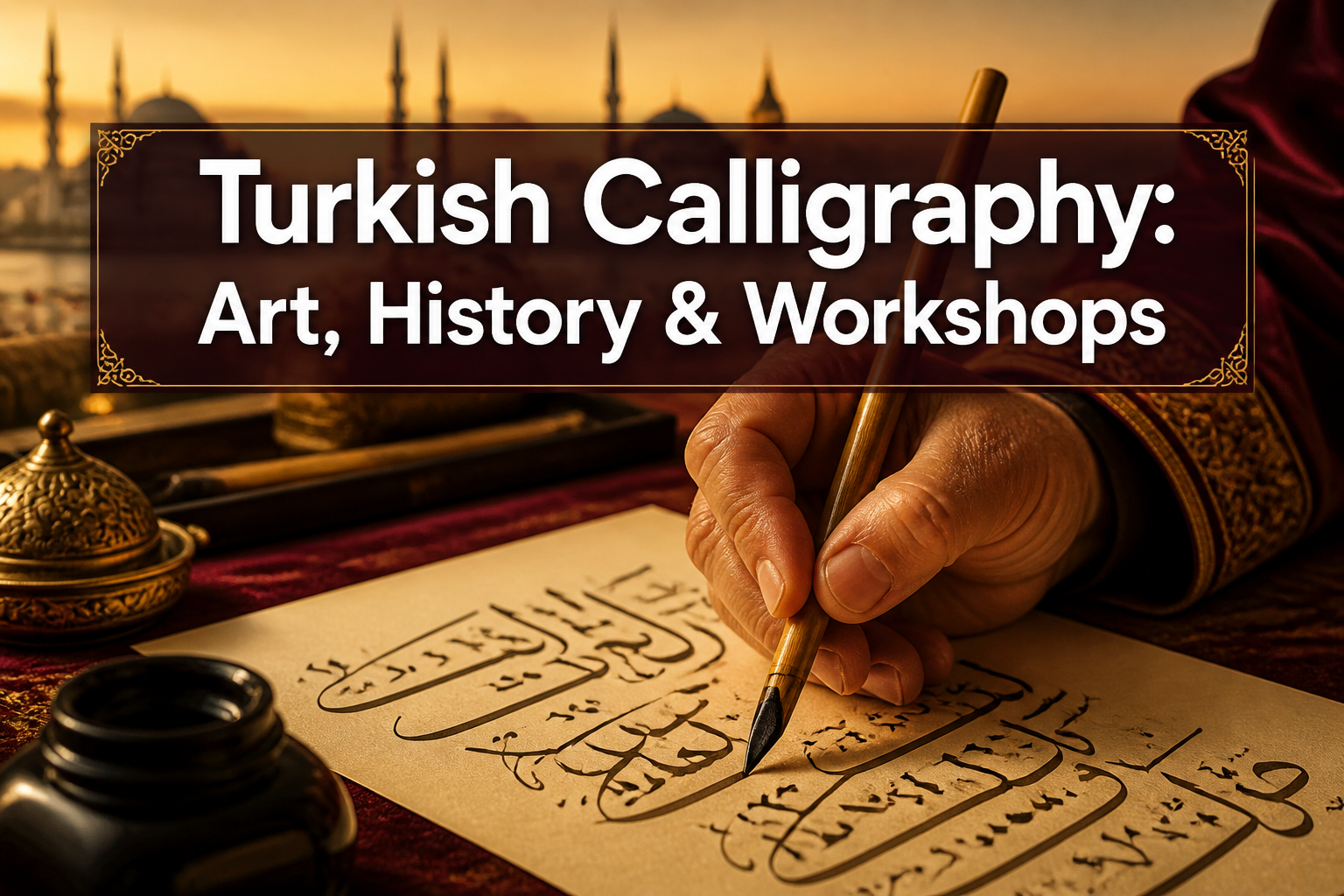

Ancient Ottoman scribes once filled Istanbul workshops with the rhythmic scratching of reed pens creating elegant Arabic calligraphy. Last updated: May 3, 2026
Quick Answer: Turkish calligraphy (known as hat in Turkish, literally meaning “line” or “way”) is a centuries-old Islamic art form that uses a bamboo reed pen to create beautifully scripted Arabic-Ottoman text. It grew from the need to preserve the Qur’an, was shaped by Ottoman masters into a distinct national style, and today you can learn it in Istanbul workshops that run as short as two hours, year-round. [1]
Key Takeaways
- The Turkish word for calligraphy, hat, literally means “line” or “way,” and the full term Husn-i Hat means “beautiful lines.” [1]
- Calligraphy is one of the most revered Islamic arts because it was the primary tool for preserving the Qur’an. [3]
- The Kufic script was the first widely used calligraphy style, known for its angular, compact design. [2]
- In the 13th century, Yakut-ul-Mustasimi from Amasya revolutionized the craft by mixing nib widths in a single composition. [1]
- Ottoman master Sheyh Hamdullah gave Turkish calligraphy its distinct national identity during the reign of Sultan Mehmet the Conqueror. [1]
- Istanbul workshops run daily, accept all skill levels, and cap groups at 8 people for personalized instruction. [3]
- You can choose between Ottoman/Arabic style or Latin style calligraphy in most workshops. [2]
- Lessons are taught in English, French, Russian, and Turkish, making them accessible to international visitors. [1]
- A summer intensive program runs June 28 – July 10, 2026 in Üsküdar, Istanbul, led by a master instructor. [6]
- You take your finished artwork home at the end of the session. [3]
What Is Turkish Calligraphy and What Does It Mean?
Turkish calligraphy is a visual art form where skilled practitioners use a reed pen to write Arabic-Ottoman script in a way that’s both linguistically meaningful and aesthetically beautiful. It’s not just fancy handwriting — it’s a spiritual practice with deep roots in Islamic culture.
The Turkish word hat means “line” or “way.” The fuller phrase, Husn-i Hat, translates to “beautiful lines.” These lines are inscribed with a kalem (bamboo reed pen) on paper using ink traditionally made from soot. [1] The result is something that sits between writing and painting — every stroke carries intention.
“Calligraphy is especially revered among Islamic arts because it served as the primary means for preserving the Qur’an.” [3]
This connection to sacred text is why Turkish calligraphy carries so much cultural weight. It wasn’t decorative to begin with — it was functional and holy. That origin story still shapes how practitioners approach the craft today.
A Brief History of Turkish Calligraphy: From Kufic Script to Ottoman Masters
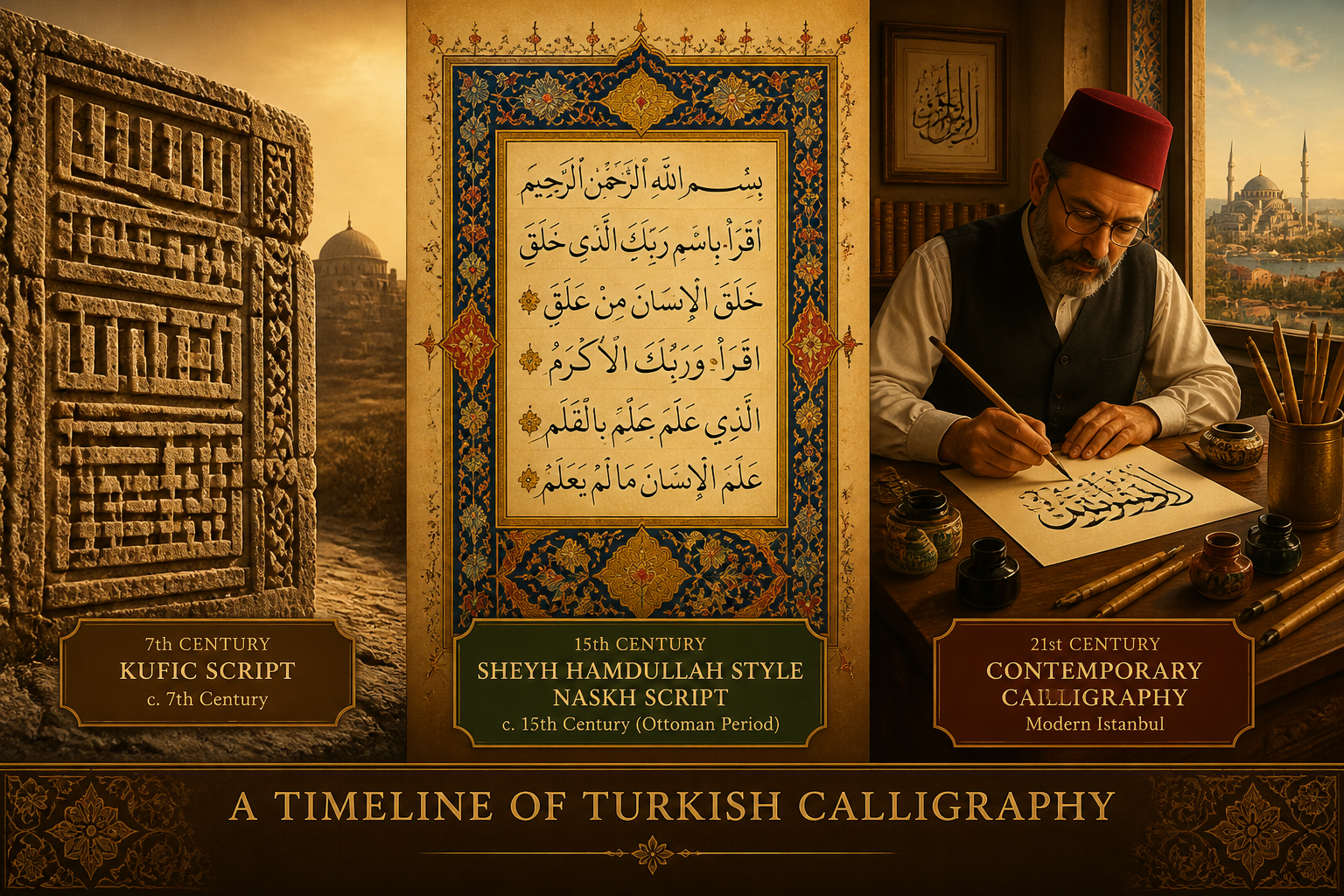
Turkish calligraphy has a layered history that spans more than a thousand years, with several key turning points that shaped the art into what it is today.
The Kufic Script: Where It All Started
The first calligraphy script to gain wide popularity was Kufic, named after the city of Kufa in modern Iraq. Kufic is easy to recognize: it uses angular designs made of square and short horizontal strokes, long verticals, and bold, compact circles. [2] It was the dominant script for early Qur’anic manuscripts and mosque inscriptions.
The 13th-Century Breakthrough
In the 13th century, a calligraphist named Yakut-ul-Mustasimi from Amasya (a city in northern Turkey) made a significant technical advance. He began using nibs of various widths and sizes within a single composition — something earlier calligraphers hadn’t done. Later practitioners built directly on this technique, and it became a foundational principle of the craft. [1]
Sheyh Hamdullah and the Ottoman Stamp
The biggest shift toward a distinctly Turkish identity came during the reign of Sultan Mehmet the Conqueror. Master calligraphist Sheyh Hamdullah introduced major changes to the traditional seven writing styles and, in doing so, placed the mark of Turkish national character on Islamic writing. [1] This was a cultural declaration as much as an artistic one — Ottoman calligraphy was no longer just a regional variation of Arabic script. It was its own thing.
Modern Masters Keeping the Tradition Alive
Contemporary calligraphers like Mustafa Cemil Efe carry this lineage forward. Efe studied traditional arts at Selçuk University, earned his graduate degree from Mimar Sinan Fine Art University, and began his calligraphy studies in 2004 under the late professor Fevzi Günüç. [8] His work shows how the Ottoman tradition continues to evolve without losing its roots.
What Are the Main Styles Taught in Istanbul Workshops?
Most workshops and historical references focus on a handful of core scripts. Here’s a quick comparison:
| Script Style | Visual Character | Common Use |
|---|---|---|
| Kufic | Angular, geometric, compact | Early Qur’anic manuscripts, mosque inscriptions |
| Naskh | Rounded, clear, readable | Books, everyday religious texts |
| Thuluth | Large, flowing, decorative | Mosque domes, headings, official documents |
| Diwani | Highly cursive, ornate | Ottoman imperial decrees |
| Latin Style | Roman alphabet adapted | Modern workshops, contemporary art |
Most beginner workshops in Istanbul offer a choice between Traditional Ottoman & Arabic Style or Latin Style Calligraphy, each as a two-hour session. [2] If you’re visiting Istanbul and want a taste of the authentic Ottoman tradition, go with the Ottoman/Arabic option. If you’d prefer to work with the Roman alphabet, the Latin style is a solid entry point.
Why Does Turkish Calligraphy Matter Culturally?
Turkish calligraphy reflects a whole civilization’s values — patience, precision, and reverence for language. It’s not a hobby that emerged from leisure. It grew from necessity: the need to copy sacred texts accurately and beautifully. [3]
Over centuries, it became a marker of education and refinement. Ottoman officials, scholars, and artists all practiced hat. Mosques were decorated with calligraphic inscriptions. Imperial decrees were written in elaborate Diwani script. The art form was woven into daily life at every level of Ottoman society.
Today, Turkish calligraphy is recognized as part of the country’s intangible cultural heritage. It’s taught in art schools, practiced in private studios, and increasingly offered to tourists as a hands-on cultural experience. [10]
Turkish Calligraphy: History, Meaning & Where to Take a Workshop in Istanbul
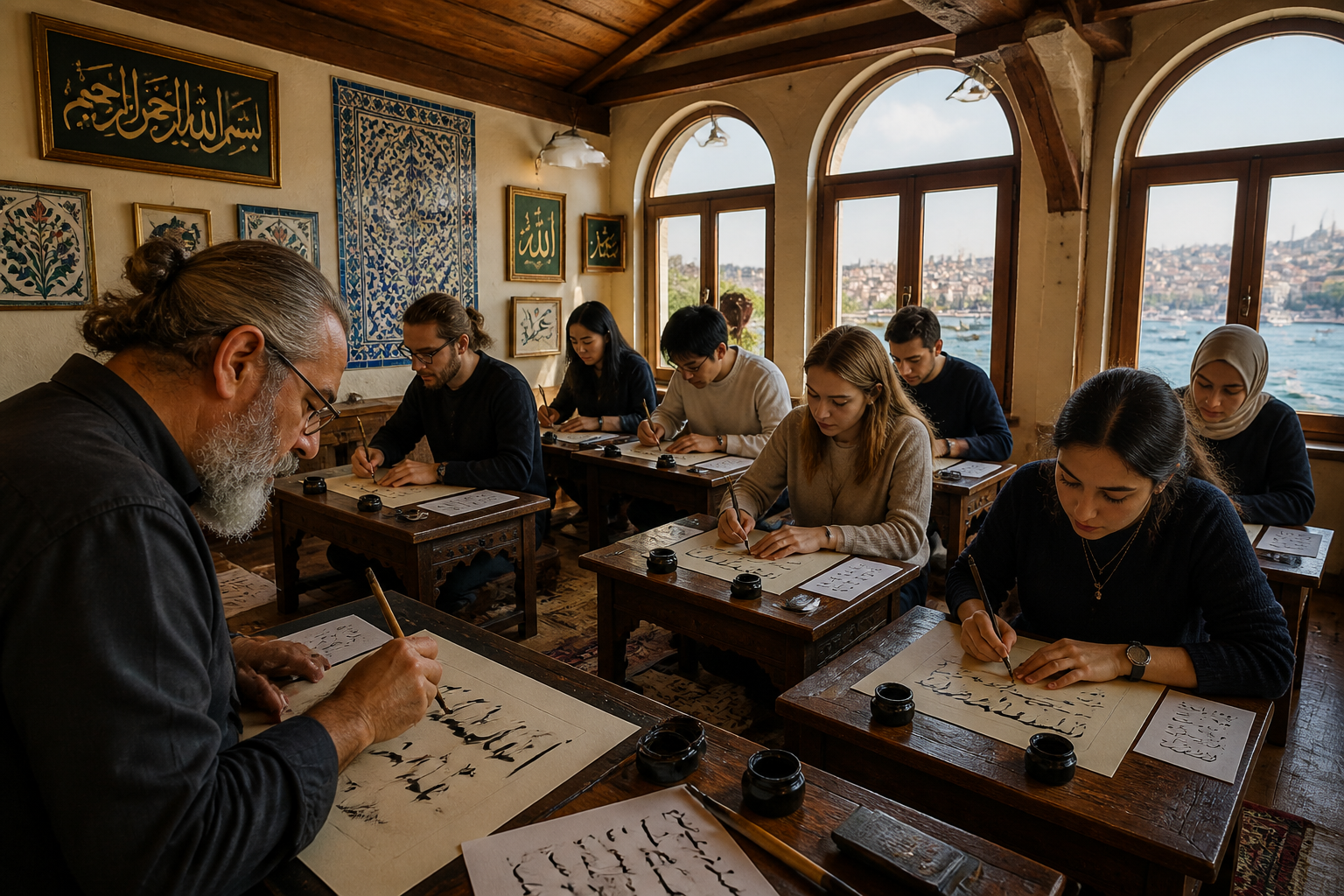
Istanbul is the best place in the world to take a Turkish calligraphy workshop, and the options in 2026 range from quick two-hour sessions to multi-week intensives.
Option 1: Daily Drop-In Workshops (Sultanahmet)
These are the most accessible option for travelers. Key details:
- Duration: 2 hours per session [1]
- Schedule: Daily at 11:00 AM and 4:00 PM [1]
- Location: Sultanahmet district, Istanbul
- Group size: Maximum 8 participants [3]
- Languages: English, French, Russian, and Turkish [1]
- Skill level: Beginner to advanced — all welcome [3]
- What you’ll use: Traditional kalem (bamboo reed pen), ink, and paper [3]
- What you take home: Your finished calligraphy artwork [3]
Choose this if you’re a tourist with limited time and want a genuine hands-on experience without committing to a longer program.
Option 2: Istanbul Summer Intensive 2026
For serious learners, the Deen Arts Foundation is running a dedicated Islamic Calligraphy intensive program:
- Dates: June 28 – July 10, 2026 [6]
- Schedule: Mondays and Thursdays, 10:00 AM – 4:00 PM (with Friday tour days included) [6]
- Location: Klasik Türk Sanatlar Vakfı, Üsküdar, Istanbul [6]
- Instructor: Master Shahryanshah Sirajuddin [6]
Choose this if you want deep immersion, structured progression, and the chance to study under a recognized master in a dedicated arts foundation setting.
Option 3: Private and Small-Group Sessions
Several Istanbul-based providers (including those listed on Viator and TripAdvisor) offer private bookings for individuals or small groups. [5] These are ideal for corporate groups, special occasions, or anyone who wants a fully customized experience.
What Happens in a Typical Turkish Calligraphy Workshop?
A standard two-hour workshop follows a fairly consistent structure across most Istanbul providers:
- Introduction — The instructor explains the history and cultural significance of hat (usually 10–15 minutes).
- Tool familiarization — You learn how to hold and use the kalem (bamboo reed pen) and how ink consistency affects your strokes.
- Basic strokes — You practice the foundational lines and curves that form the building blocks of the script.
- Guided composition — The instructor walks you through writing a word, phrase, or short sentence in your chosen style.
- Free practice — You refine your piece and personalize it.
- Finishing — Your artwork dries, gets signed, and you take it home.
Common mistake: Gripping the reed pen too tightly. The kalem requires a relaxed hold — similar to how you’d hold a brush rather than a ballpoint pen. Most instructors will correct this early, but it’s worth knowing in advance.
How Much Do Turkish Calligraphy Workshops Cost?
Prices vary by provider and format, but here’s a general picture for 2026:
- Standard 2-hour group workshop: Roughly $30–$60 USD per person (estimates based on typical Istanbul workshop pricing; confirm directly with providers)
- Private sessions: Higher, depending on group size and duration
- Summer intensive programs: Varies significantly — check the Deen Arts Foundation directly for the 2026 program fee [6]
Most workshop fees include all materials: paper, ink, and the use of a kalem. Some providers let you purchase your own reed pen to take home as a souvenir.
Turkish Calligraphy: History, Meaning & Where to Take a Workshop — FAQ
What does “hat” mean in Turkish calligraphy?
Hat is the Turkish word for calligraphy and literally means “line” or “way.” The full term Husn-i Hat means “beautiful lines.” [1]
Do I need any experience to join a workshop?
No. Istanbul workshops explicitly welcome all skill levels, from complete beginners to advanced practitioners. [3]
How long does a typical workshop last?
Most standard sessions are two hours. The summer intensive runs full days across multiple weeks. [1][6]
What tools will I use?
You’ll use a kalem (traditional bamboo reed pen) with black ink on paper — the same tools Ottoman calligraphers used for centuries. [3]
Can I take my artwork home?
Yes. You leave with your finished calligraphy piece. [3]
What languages are workshops taught in?
English, French, Russian, and Turkish are all available. [1]
Is Turkish calligraphy the same as Arabic calligraphy?
They share the same script and historical roots, but Turkish calligraphy developed its own distinct style — particularly after Sheyh Hamdullah’s reforms during the Ottoman period. [1]
What’s the best time of year to take a workshop in Istanbul?
Workshops run year-round, so any time works. If you want the summer intensive experience, plan for late June to early July 2026. [1][6]
How many people are in a typical workshop?
Groups are capped at 8 participants to ensure personalized instruction. [3]
Can children participate?
Most providers welcome older children and teenagers, but it’s best to confirm with the specific workshop provider before booking.
What’s the difference between Kufic and Naskh script?
Kufic is angular and geometric — the oldest major style. Naskh is rounder and more readable, and became the standard for books and manuscripts. [2]
Is there a difference between Ottoman-style and Latin-style calligraphy workshops?
Yes. Ottoman/Arabic style uses Arabic script with traditional Ottoman aesthetics. Latin style applies calligraphic principles to the Roman alphabet. Both are offered as two-hour sessions. [2]
Conclusion
Turkish calligraphy is one of those rare art forms where history, spirituality, and craft all meet in a single ink stroke. From the angular Kufic script of early Islamic manuscripts to the Ottoman refinements of Sheyh Hamdullah, the tradition has always been about more than beautiful writing — it’s about meaning, patience, and cultural identity.
If you’re visiting Istanbul in 2026, a calligraphy workshop is one of the most authentic cultural experiences you can have. Here’s what to do next:
- For a quick experience: Book a daily drop-in session in Sultanahmet (11:00 AM or 4:00 PM, max 8 people). [1][3]
- For deep immersion: Apply for the Deen Arts Foundation summer intensive, June 28 – July 10, 2026, in Üsküdar. [6]
- For research: Check out Scripts n Scribes for a deeper look at the philosophy behind the craft through the lens of contemporary masters like Mustafa Cemil Efe. [8]
Whether you’re a curious traveler or a committed student of Islamic art, Turkish calligraphy offers something genuinely worth your time — and a piece of artwork you made yourself to prove it.
References
[1] Calligraphy Lesson Masterclass Workshop In Istanbul – https://eventsofistanbul.com/calligraphy-lesson-masterclass-workshop-in-istanbul/
[2] Calligraphy Classes – https://bazaarturkey.com/calligraphy-classes/
[3] Turkish Calligraphy Workshop In Istanbul (TripAdvisor) – https://www.tripadvisor.com/AttractionProductReview-g293974-d11459986-Turkish_Calligraphy_Workshop_in_Istanbul-Istanbul.html
[5] Turkish Calligraphy Workshop in Istanbul (Viator) – https://www.viator.com/en-HK/tours/Istanbul/Turkish-Calligraphy-Workshop-in-Istanbul/d585-8275CALWRKSHP
[6] Calligraphy Istanbul Summer Intensive 2026 – https://deenartsfoundation.org/program/calligraphy-istanbul-summer-intensive-2026/
[8] Meaning And Calligraphy: A Conversation With Turkish Master Mustafa Cemil Efe – https://www.scriptsnscribes.com/blogs/2019/9/13/meaning-and-calligraphy-a-conversation-with-turkish-master-mustafa-cemil-efe
[10] Turkish Calligraphy Reflects A Civilization – https://anascreccatravel.com/turkish-calligraphy-reflects-a-civilization/
Tags: Turkish calligraphy, hat calligraphy, Istanbul workshops, Ottoman calligraphy, Islamic calligraphy, Husn-i Hat, calligraphy history, Kufic script, Sheyh Hamdullah, Istanbul cultural experiences, calligraphy for beginners, Turkish arts