

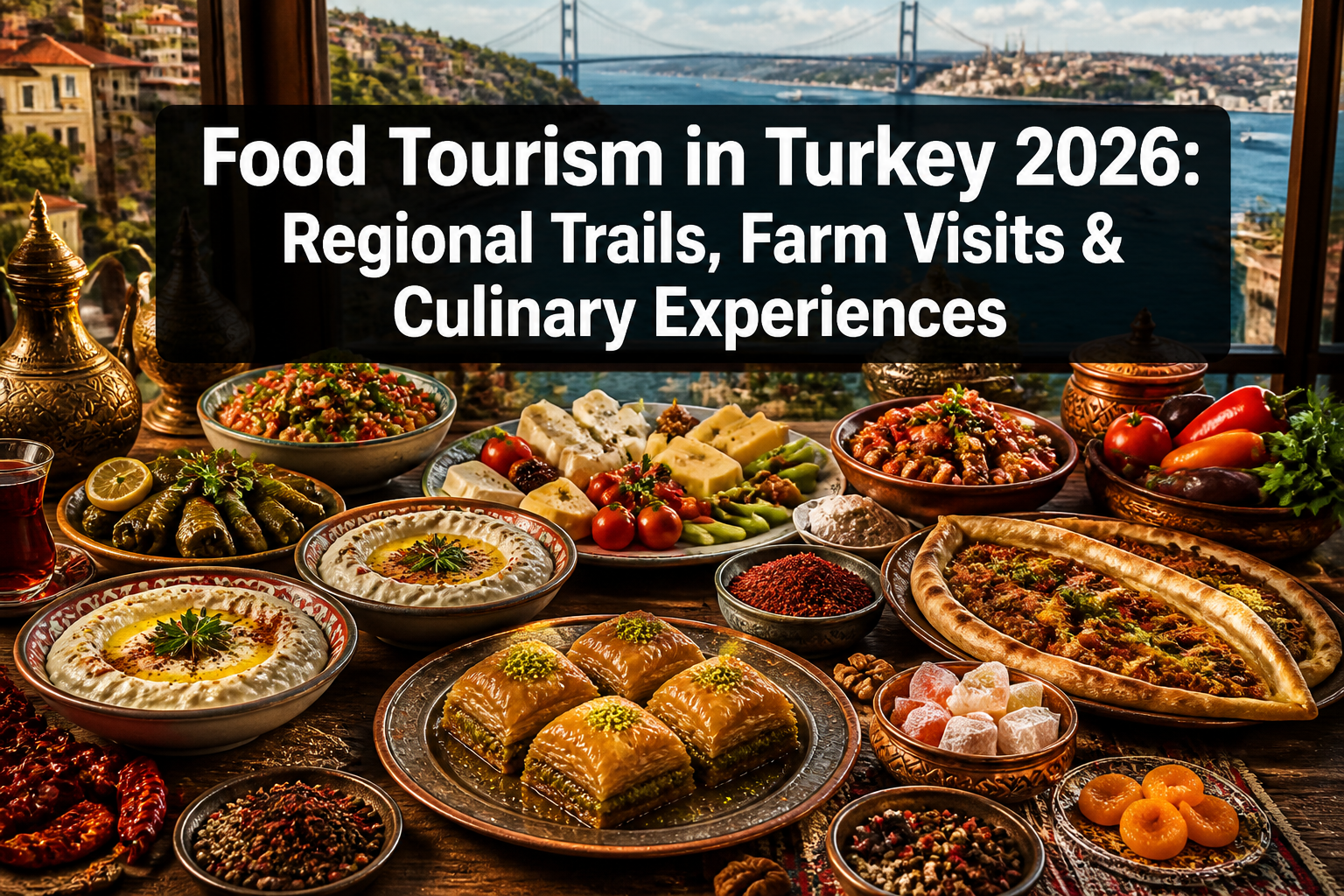

Food tourism in Turkey has evolved beyond Istanbul’s street food to embrace immersive regional experiences across Anatolia’s diverse landscapes. Last updated: May 3, 2026
Quick Answer: Turkey is one of the world’s top food tourism destinations in 2026, with organized culinary trails spanning Istanbul’s street food scene, Gaziantep’s spice-driven southeast cuisine, and the Aegean coast’s farm-fresh flavors. Travelers can choose from guided urban food walks, multi-region agricultural tours, and hands-on farm visits that connect directly with local producers. Whether you have four hours or two weeks, there’s a structured food experience that fits.
Key Takeaways
- 🌶️ Gaziantep is widely considered Turkey’s culinary capital, famous for baklava, kebabs, and over 400 registered dishes.
- 🚌 Multi-region culinary tours now cover routes from Istanbul through the southeast (Mardin, Urfa, Diyarbakır) to the Aegean (Izmir, Urla, Bodrum). [1]
- 🕌 Istanbul’s Afternoon Foodie Trail is a popular 4-hour experience starting at the Spice Market and ending on Istiklal Caddesi. [3]
- 🌿 Farm visits in the Antalya province and Aegean region let travelers pick produce, press olive oil, and eat directly with farming families. [6]
- 🗺️ Organized tours are bookable on Viator, Klook, and GetYourGuide, with options updated for 2026. [4][8][6]
- 🏺 The Eastern Türkiye Agricultural Focus Tour (April–May 2026) traces the origins of human agriculture through Cappadocia, Konya, and Urfa. [2]
- 💡 Southeast Turkish cuisine is spicier and richer than Aegean food, so choose your region based on your flavor preferences.
- 🍷 Urla, near Izmir, has become a serious wine and food destination, combining boutique wineries with local seafood and olive oil farms.
What Makes Food Tourism in Turkey 2026 Worth the Trip?
Turkey sits at the crossroads of three continents, and that geography shows up directly on the plate. The country’s food culture isn’t one thing — it’s dozens of regional traditions that barely resemble each other.
From the cosmopolitan street food of Istanbul to the spice and heat of the southeast and the fresh, herb-forward flavors of the Aegean coast, every region tells a different story through its food. [1] In 2026, organized culinary experiences have made it easier than ever to access these traditions in a structured, meaningful way — not just eating at restaurants, but meeting the people who grow, cook, and preserve these foods.
Who this is for: Food tourists who want more than a restaurant meal. This guide covers trails, farm visits, and multi-day culinary tours across Turkey’s main food regions.

How Do Regional Culinary Trails Work for Food Tourism in Turkey?
Regional culinary trails in Turkey are pre-mapped routes (either self-guided or guided) that move through a city or region, stopping at markets, producers, street vendors, and local restaurants. Most organized trails last between 3 and 8 hours for urban experiences, or 7 to 14 days for multi-region tours.
The Main Regional Food Zones
| Region | Key Flavors | Must-Try Foods |
|---|---|---|
| Istanbul | Diverse, cosmopolitan | Simit, balık ekmek, baklava, islak hamburger |
| Gaziantep | Spicy, rich, nutty | Lahmacun, katmer, pistachio baklava, beyran |
| Mardin & Urfa | Earthy, smoky, intense | Çiğ köfte, içli köfte, mırra coffee |
| Izmir & Urla | Fresh, herby, light | Boyoz, kumru, olive oil mezze, local wine |
| Cappadocia | Rustic, hearty | Testi kebabı, pottery-baked dishes, local wine |
| Antalya Coast | Mediterranean, citrus-bright | Fresh fish, pomegranate molasses dishes, citrus |
Multi-region tours offered by operators like Roots Adventure Travel cover southeast and Aegean destinations together, giving travelers a real contrast between the two flavor profiles. [1] The Eastern Türkiye Agricultural Focus Tour (April 23 – May 2, 2026) adds an archaeological layer, tracing the origins of human agriculture through sites in Urfa, Diyarbakır, Cappadocia, and Konya. [2]
Choose a regional trail if: You want to understand how geography and history shaped a specific cuisine. Choose a multi-region tour if you want contrast and variety across Turkey’s food map.
What Happens on Istanbul’s Food Trails?
Istanbul’s food trails are the most accessible entry point into Turkish food tourism, and the city rewards walkers who know where to go.
The well-documented Afternoon Foodie Trail is a 4-hour guided walk that starts at Mısır Çarşısı (the Spice Market), crosses the Galata Bridge to Karaköy for street food, stops at Mandabatmaz for traditional Turkish coffee and içli köfte, then continues along Istiklal Caddesi for islak hamburger (a steamed, garlicky burger) and fresh baklava. [3] Vendors along this route often have generational expertise — families who have been making the same product for 50 or 100 years.
What makes this trail work:
- It covers both the historic peninsula and the modern Beyoğlu district
- Each stop is timed so you’re hungry but not stuffed
- Guides explain the cultural context, not just the food
- Small group sizes (usually 6–12 people) keep it personal
“The Spice Market isn’t just a shopping stop — it’s the starting gun for understanding how Istanbul’s food culture was built on trade routes.” — A common framing from local food guides
For a deeper Istanbul experience, the Istanbul Food Journey offers a more immersive route through neighborhood markets and family-run meyhanes (taverns). [7]
Common mistake: Booking a food tour right after a big hotel breakfast. Go hungry. Seriously.
What Farm Visits and Agricultural Experiences Are Available?
Farm visits in Turkey connect food tourists directly with producers, and they’re most concentrated in the Antalya province, the Aegean region (especially Urla and Bodrum), and the fertile plains around Konya.
GetYourGuide lists plantation and farm tours in the Antalya province where visitors can pick citrus, tour greenhouse operations, and eat with farming families. [6] These aren’t staged photo-ops — they’re working farms that open their doors to small groups.
Types of Farm Experiences in 2026
- Olive oil farms (Aegean coast): Press olives, taste fresh oil, learn about varietals. Best in October–November harvest season.
- Pistachio orchards (Gaziantep region): Walk the orchards, meet producers, and understand why Gaziantep pistachios are protected by geographic indication.
- Vineyard visits (Urla, Cappadocia): Boutique wineries offer tastings paired with local food. Cappadocia’s volcanic soil produces distinctive wines.
- Herb and spice farms (Southeastern Anatolia): Visit farms growing sumac, isot pepper, and pomegranate. Many are family-run and offer cooking demonstrations.
- Citrus and greenhouse farms (Antalya): Hands-on picking, farm meals, and tours of modern agricultural operations. [6]
Edge case: Some farm experiences are seasonal. Olive harvest (Oct–Nov), grape harvest (Aug–Sept), and pistachio season (Sept–Oct) are the best windows. If you’re traveling in winter or spring, focus on cooking classes and market tours instead.

How Do You Plan a Food Tourism Trip to Turkey in 2026?
Planning a food-focused trip to Turkey in 2026 is straightforward if you organize it around regions and seasons rather than just cities.
A Simple Planning Framework
- Pick your flavor profile. Spicy and rich? Go southeast (Gaziantep, Urfa, Mardin). Light and fresh? Go Aegean (Izmir, Urla, Bodrum). Mixed? Start in Istanbul, then branch out.
- Decide on tour style. Guided multi-region tours (7–14 days) vs. self-guided city trails (half-day to full day) vs. farm visits (half-day add-ons).
- Book through a verified platform. Viator’s Top 20 Turkey Culinary Tours [4], Klook’s Top 10 Turkey Food Tours [8], and GetYourGuide’s farm tours [6] are all updated for 2026 and include verified reviews.
- Check seasonality. Spring (April–June) and autumn (September–November) are the best times for farm visits and outdoor trails. Summer is hot but good for coastal food experiences.
- Layer in cooking classes. Most regions offer half-day cooking classes that pair well with a morning market visit.
Estimated costs (rough guide, 2026):
- Half-day city food trail: $40–$90 USD per person
- Full-day regional food tour: $90–$180 USD per person
- Multi-day culinary tour (7–14 days, guided): $1,500–$4,000 USD per person depending on accommodation level
- Farm visit (half-day): $30–$70 USD per person
What Are the Best Food Tourism Experiences in Turkey for First-Timers?
For first-time food tourists in Turkey, the best starting point is a guided half-day trail in Istanbul, followed by at least one regional day trip or overnight to Gaziantep.
Top picks for first-timers:
- Istanbul Afternoon Foodie Trail — 4 hours, covers the Spice Market, Karaköy, and Istiklal Caddesi. Bookable on TripAdvisor and local operators. [3]
- Gaziantep food day trip — Even a single day in Gaziantep will change how you think about Turkish food. The city has more UNESCO-recognized culinary heritage than almost anywhere else in the country.
- Aegean food and wine route — Urla and the Izmir coast are ideal for travelers who prefer lighter, Mediterranean-style food with local wine pairings.
- Eastern Türkiye Agricultural Focus Tour — For travelers who want history and food combined, this April–May 2026 tour through Urfa, Diyarbakır, and Cappadocia is a strong choice. [2]
Not a good fit for: Travelers with very limited time (less than 3 days) who want to cover multiple regions. You’ll end up rushing. Better to go deep in one city than skim three.
FAQ: Food Tourism in Turkey 2026
Q: Is food tourism in Turkey expensive?
Half-day city food trails typically run $40–$90 USD per person. Multi-day guided culinary tours range from $1,500 to $4,000 USD depending on accommodation and group size.
Q: What is the best city for food tourism in Turkey?
Gaziantep is widely considered Turkey’s top food city, with over 400 registered local dishes. Istanbul is the best starting point for first-timers due to its variety and accessibility.
Q: Can I do food tourism in Turkey independently without a guide?
Yes. Istanbul’s Spice Market, Karaköy street food scene, and Istiklal Caddesi are easy to navigate solo. For smaller cities like Mardin or Urfa, a local guide adds significant context.
Q: Are farm visits in Turkey family-friendly?
Most farm visits in the Antalya province and Aegean region welcome families. Hands-on activities like fruit picking and bread baking work well for children. [6]
Q: When is the best time to visit Turkey for food tourism?
April–June and September–November are ideal. Harvest seasons (olive oil in October–November, grapes in August–September) align with the best farm visit opportunities.
Q: What food should I not miss in Gaziantep?
Pistachio baklava, beyran soup, katmer (a flaky pastry with cream and pistachios), and lahmacun are essential. Gaziantep’s pistachios have geographic indication status, so what you eat here is the real thing.
Q: Are culinary tours in Turkey available in English?
Yes. Most organized tours on Viator [4], Klook [8], and GetYourGuide [6] offer English-language guides. Local operators in Istanbul and Gaziantep also commonly offer English tours.
Q: What’s the difference between Aegean and southeastern Turkish food?
Aegean food is lighter, herb-forward, and olive oil-based. Southeastern food (Gaziantep, Urfa, Mardin) is richer, spicier, and built around lamb, bulgur, and dried peppers. Both are excellent — they’re just very different flavor worlds.
Q: Do I need to book food tours in advance?
For popular Istanbul trails and multi-day tours, yes — book at least 2–4 weeks ahead in peak season (April–June, September–October). Farm visits in Antalya can often be booked a few days out. [6]
Q: Is vegetarian food easy to find on Turkish culinary tours?
The Aegean region and Istanbul have strong vegetarian options. Southeastern cuisine is more meat-heavy, but mezze spreads, stuffed vegetables (dolma), and legume dishes are widely available.
Conclusion: Your Next Steps for Food Tourism in Turkey 2026
Turkey’s food scene in 2026 is more organized and accessible than ever, but it still rewards travelers who go beyond the obvious. The real experiences — pressing olive oil on an Aegean farm, eating beyran soup at 7am in Gaziantep, or tracing the origins of agriculture through Cappadocia — don’t happen by accident. They happen when you plan with intention.
Actionable next steps:
- Decide your region first. Use the flavor profile table above to match your preferences to a destination.
- Book a structured trail for day one. Istanbul’s Afternoon Foodie Trail [3] is a reliable, low-risk way to orient yourself before going deeper.
- Add at least one farm visit. GetYourGuide’s Antalya farm tours [6] or Aegean olive oil experiences give you a producer-level perspective you won’t get in a restaurant.
- Consider a multi-region tour if you have 7+ days. Operators like Roots Adventure Travel [1] and Unison Travel Events [2] offer well-structured routes that handle logistics so you can focus on eating.
- Check seasonal timing. If you can travel in October, the olive harvest season across the Aegean is one of the best food tourism windows in the entire country.
Food Tourism in Turkey 2026 isn’t just a trend — it’s a direct line into one of the world’s oldest and most complex culinary cultures. Go hungry, go curious, and go with a plan.
References
[1] Taste Of Turkey – https://www.rootsadventuretravel.com/taste-of-turkey/
[2] Eastern Turkiye Tour – https://www.unisontravelevents.com/tours/eastern-turkiye-tour
[3] Attractionproductreview G293974 D19645683 Afternoon Foodie Trail In Istanbul Istanbul – https://www.tripadvisor.com/AttractionProductReview-g293974-d19645683-Afternoon_Foodie_Trail_in_Istanbul-Istanbul.html
[4] D70 Tag12053 – https://www.viator.com/Turkey-tours/Food-Tours-Attraction-Product-Category/d70-tag12053
[6] Plantation Farm Tours Tc971 – https://www.getyourguide.com/antalya-province-l855/plantation-farm-tours-tc971/
[7] Istanbul Food Journey – https://www.foodtrailistanbul.com/tours/istanbul-food-journey
[8] G50 Cate29 – https://www.klook.com/en-US/experiences/list/turkey-food-wine-tours/g50-cate29/
Tags: food tourism Turkey, Turkish culinary tours, Gaziantep food trail, Istanbul food walk, farm visits Turkey, Aegean food experiences, Turkey travel 2026, regional Turkish cuisine, Turkish cooking classes, spice market Istanbul, culinary travel guide, Turkey food and wine tours
Related Turkey planning guides: Food trips are easier with a good route, so compare our 7-day Turkey itinerary, 10-day Turkey itinerary, Istanbul travel guide, and Turkey budget guide.