

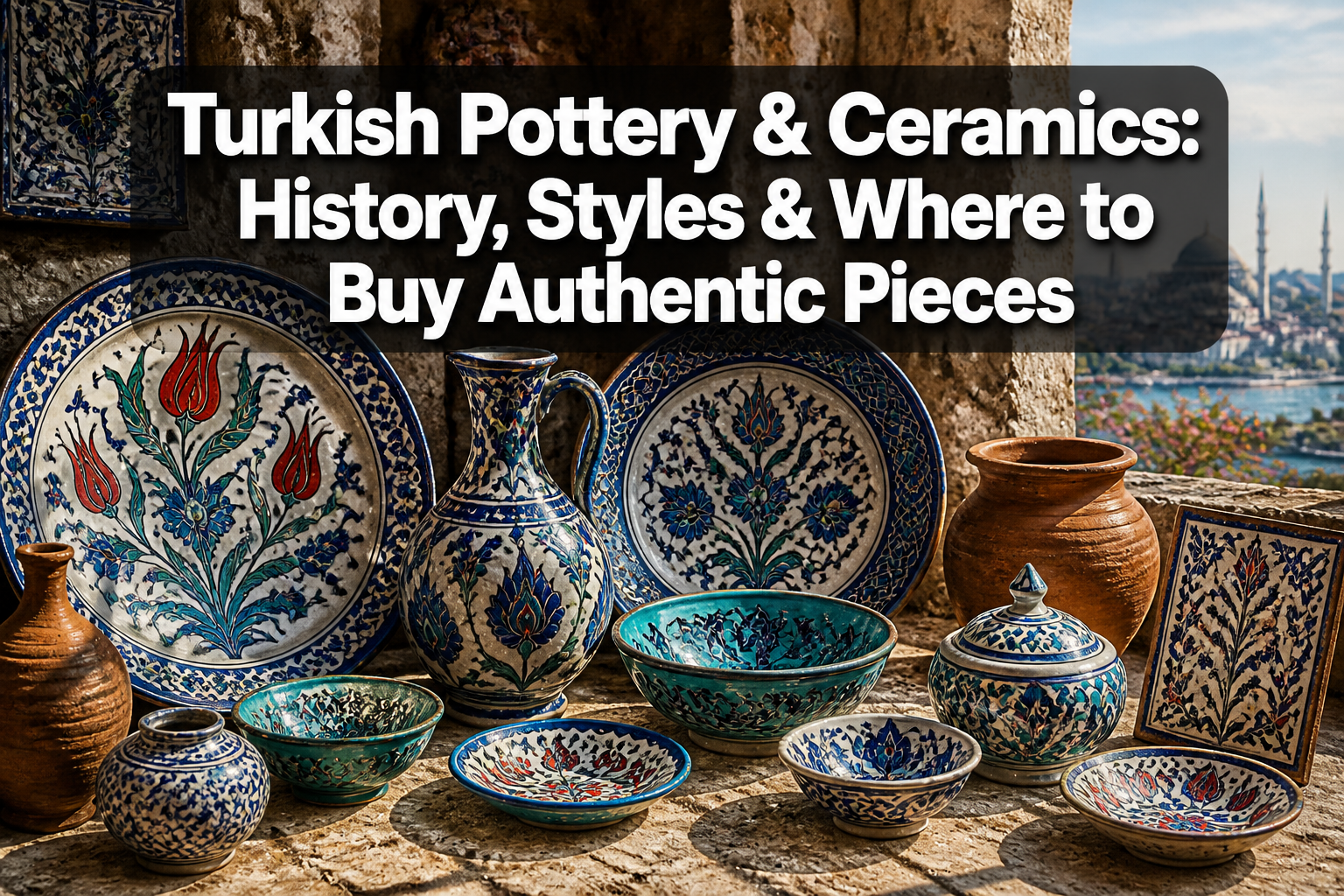

The vibrant colors and intricate patterns of Turkish pottery have captivated travelers and collectors for centuries. Last updated: May 3, 2026
Quick Answer: Turkish pottery and ceramics span over 900 years of continuous craft tradition, from Seljuk geometric earthenware to the world-famous cobalt-and-crimson Iznik tiles of the Ottoman golden age. Today, the best places to buy authentic pieces are the workshops of Kütahya and Iznik, Istanbul’s Grand Bazaar, and reputable online dealers. Knowing how to spot the real thing — versus a mass-produced souvenir — makes all the difference.
Key Takeaways
- 🏺 Turkish ceramics trace back to the 12th-century Seljuk period, blending Central Asian, Persian, and Islamic artistic traditions
- ✨ The Ottoman golden age (16th century) produced Iznik pottery, still considered among the finest decorative ceramics ever made
- 🎨 Signature Iznik colors are cobalt blue, turquoise, tomato red, and emerald green, featuring tulips, carnations, and arabesque patterns [1]
- 🏙️ Kütahya is Turkey’s leading contemporary ceramics production hub; Iznik remains the spiritual home of the tile-making tradition [4]
- 🛒 Authentic pieces can be found in artisan workshops, reputable bazaar shops, specialist dealers like 1stDibs, and curated platforms like Etsy [3][7]
- 🔍 Genuine handmade ceramics show slight irregularities in glaze, brushwork, and form — that’s a feature, not a flaw
- 💰 Prices range from a few dollars for small decorative tiles to thousands for museum-quality antique pieces
- 🎁 Ceramics make one of the most culturally meaningful souvenirs from Turkey — and they’re surprisingly durable in carry-on luggage (wrap them well!)

What Is the History Behind Turkish Pottery & Ceramics?
Turkish ceramics didn’t appear overnight. The tradition built slowly, layer by layer, like glaze on a kiln-fired bowl — each civilization adding its own color to the mix.
The story of Turkish pottery and ceramics: history, styles & where to buy authentic pieces begins in the 12th century with the Seljuk Turks, who brought with them a rich visual vocabulary from Central Asia and Persia. Their pottery featured bold geometric patterns, stylized calligraphy, and floral motifs — all deeply rooted in Islamic artistic principles [1]. (If you want to understand how deeply Persian aesthetics shaped Turkish culture, the influence of Persian culture in Turkish traditions is a genuinely fascinating read.)
Then came the Ottoman Empire, and with it, the plot twist that changed everything.
The Ottoman Golden Age: Iznik Takes Center Stage
Under Ottoman patronage — especially during the reign of Sultan Suleiman the Magnificent in the 16th century — the town of Iznik (ancient Nicaea, about 90 kilometers southeast of Istanbul) became the ceramics capital of the known world. Iznik tiles and pottery were commissioned for the grandest mosques, palaces, and public buildings of the empire, including the Topkapı Palace and the Süleymaniye Mosque [2].
Here’s what nobody tells you about Iznik’s rise: it wasn’t just artistic genius at work. It was also imperial demand. The Ottoman court needed extraordinary quantities of tiles for its building projects, and Iznik’s craftsmen — working with a unique quartz-rich white clay body — were the only ones who could deliver the quality the sultans expected.
“Iznik pottery at its peak combined technical mastery with visual poetry — a combination that European collectors were willing to pay extraordinary sums to acquire.”
By the late 16th century, Iznik wares were being exported across Europe and Asia, where they were collected by royalty and aristocracy. The tradition of Turkish tile art is so deeply embedded in the country’s identity that it’s practically inseparable from the architecture itself. After the 17th century, Iznik’s production declined as the Ottoman court shifted patronage elsewhere, and Kütahya gradually absorbed much of the craft tradition — which is where the story picks up today [4].
What Are the Main Styles of Turkish Ceramics?
Turkish ceramics aren’t one monolithic style. Think of them more like a family — related, recognizable, but each with a distinct personality.
| Style | Origin Period | Key Features | Colors |
|---|---|---|---|
| Seljuk Pottery | 12th–13th century | Geometric, calligraphic, earthenware | Earthy browns, turquoise |
| Iznik Ware | 15th–17th century | Floral motifs, quartz-body, high gloss | Cobalt blue, tomato red, turquoise, green |
| Kütahya Ware | 17th century–present | More colorful, folk-influenced, figurative | Multicolor, yellow prominent |
| Çanakkale Pottery | 18th–19th century | Rustic, asymmetric, folk art style | Terracotta, green, brown |
| Contemporary Studio Ceramics | 20th century–present | Artist-led, experimental, mixed influences | Varies widely |
Iznik Style: The One Everyone Recognizes
Iznik ceramics are defined by their white ground, their extraordinary cobalt blue, and the iconic motifs: tulips, carnations, hyacinths, and intricate arabesques. The famous “Iznik red” — a raised, sealing-wax red that only appeared around 1550 — is one of the most technically difficult glazes in ceramic history and remains a benchmark of authenticity [2][5].
Prepare to be obsessed: the tulip wasn’t just decorative. In Ottoman culture, the tulip (lale) was a symbol of paradise and divine perfection. Turkey actually gave the tulip to Europe, not the other way around — which makes every tulip-motif Iznik plate a small piece of cultural history you can eat breakfast off.
Kütahya Style: The Everyday Genius
Kütahya ceramics are warmer, more playful, and more accessible than Iznik’s aristocratic precision. Located in western Turkey on the Porsuk River, Kütahya became the dominant ceramics center after Iznik’s decline and remains so today [4]. Kütahya pieces often incorporate figurative elements — birds, fish, human figures — that you’d rarely see in strictly orthodox Iznik work. The color palette is broader, with yellows and oranges joining the classic blues and greens.
For a broader look at how Turkish crafts vary by region, this guide to traditional Turkish crafts by region is absolutely worth bookmarking.
How Is Authentic Turkish Pottery Made?
Authentic handmade Turkish ceramics follow a process that hasn’t changed dramatically in centuries — and that’s precisely the point.
The traditional process:
- Clay preparation — Iznik-style pieces use a quartz-rich white clay body (up to 80% quartz), giving them their distinctive weight and translucency
- Shaping — Wheel-throwing or hand-building, depending on the piece
- First firing — Bisque firing to harden the clay
- Underglaze painting — All decoration is applied before the final glaze coat, using metal oxide pigments (cobalt for blue, copper for green, iron for red)
- Glazing — A clear lead-free glaze is applied over the painted surface
- Final firing — Typically at around 900–1000°C, which fuses glaze and pigments permanently
The result? Colors that don’t fade, chip, or dull with age — which is why 500-year-old Iznik tiles in Istanbul’s mosques still look startlingly vivid today.
Istanbul’s specialist studios like QArts focus specifically on handmade ceramics that emphasize artistry, quality, and unique design [6], keeping these techniques alive for contemporary collectors and travelers alike.

Where to Buy Authentic Turkish Pottery & Ceramics: History, Styles & Where to Buy Authentic Pieces
This is where the research really pays off. The difference between a genuine handmade piece and a factory-produced imitation can be significant — in quality, in meaning, and sometimes in price.
In Turkey: The Best Places to Shop
🏺 Kütahya The pro move for serious buyers. Visiting Kütahya’s workshops directly means watching artisans paint in real time, understanding the process, and buying at source. Many workshops welcome visitors and offer pieces across all price points. Fair warning: you will want to buy everything.
🏺 Iznik The spiritual home of the tradition. The Iznik Foundation operates workshops that revive classical Ottoman techniques with museum-level precision. Pieces here are investment-grade — priced accordingly, but genuinely extraordinary [2].
🏺 Istanbul’s Grand Bazaar & Arasta Bazaar The Grand Bazaar has ceramics sellers ranging from tourist-grade to genuinely excellent. The Arasta Bazaar, just behind the Blue Mosque, tends to have higher-quality artisan pieces with less pressure. Pro tip: look for shops that can tell you exactly where their pieces are made. If the answer is vague, keep walking.
🏺 Istanbul Ceramic Ateliers Studios like QArts offer handmade pieces with a contemporary design sensibility — perfect for buyers who love the tradition but want something that fits a modern home [6]. For a shopaholic’s complete Istanbul strategy, this guide to shopping in Istanbul has the details.
Online: Buying Authentic Turkish Ceramics from Abroad
- 1stDibs — Curated antique and vintage Turkish pottery from specialist dealers. Prices are higher, but provenance is generally solid [3]
- Etsy — A genuinely good source for vintage and handmade Turkish ceramics, particularly from small Kütahya and Istanbul workshops that sell directly [7]
- Direct from workshops — Many Kütahya and Iznik workshops now ship internationally; buying direct supports artisans and usually offers better pricing than resellers
How to Spot Authentic Handmade Pieces
Look for these signs of genuine handcraft:
- Slight variations in pattern (no two brushstrokes are identical)
- A small amount of “wobble” in wheel-thrown forms
- Glaze pooling slightly at the base
- Weight that feels substantial, not hollow-light
- A maker’s mark or workshop stamp on the base
Red flags for mass-produced pieces:
- Perfectly identical patterns (printed, not painted)
- Unusually light weight
- Uniform, machine-smooth glaze
- No visible brushwork texture under the glaze
How Much Do Authentic Turkish Ceramics Cost?
Prices vary enormously depending on age, maker, size, and where you buy.
| Type | Price Range (USD, estimate) |
|---|---|
| Small decorative tile (handmade, new) | $10–$50 |
| Decorative plate, Kütahya workshop | $30–$150 |
| Iznik Foundation reproduction piece | $100–$500+ |
| Vintage Kütahya piece (20th century) | $50–$300 |
| Antique Ottoman-era piece | $500–$10,000+ |
| Museum-quality Iznik antique | $5,000–$50,000+ |
Note: Prices are estimates based on current market ranges and may vary. Always buy antiques from reputable dealers with clear provenance documentation [3].
Knowing how to negotiate respectfully is a genuine skill in Turkish markets — this guide to navigating Turkish market negotiations will serve you well before you walk into any bazaar.
What Should Travelers Know Before Buying Turkish Ceramics?
A few practical points that future you will genuinely thank us for:
- Export rules: Genuine antiques (over 100 years old) require official documentation to export legally. Reputable dealers handle this; anyone who waves it off is a red flag.
- Packing: Bubble wrap is your best friend. Most ceramics shops in Turkey will wrap pieces for travel, but bring extra padding for carry-on transport.
- Fakes are common: Especially in high-tourist areas. The “hand-painted” label means nothing without visible evidence of actual handwork.
- Bargaining: Expected in bazaars for decorative items. Not appropriate in fixed-price workshops or established gallery shops.
- VAT refund: Turkey offers VAT refunds for purchases over a certain threshold — ask for a tax-free receipt (fatura) at the time of purchase.
For a broader look at how Turkish art has evolved across centuries — context that genuinely enriches any ceramics purchase — this overview of how Turkish art has evolved is seriously underrated reading.
FAQ: Turkish Pottery & Ceramics
Q: What makes Iznik ceramics different from other Turkish pottery? Iznik ceramics use a unique quartz-rich white clay body, underglaze painting with metal oxide pigments, and a clear glaze — producing colors of exceptional vibrancy and durability. The raised tomato-red glaze, developed around 1550, is a defining feature found only in genuine Iznik work [2][5].
Q: Is Kütahya or Iznik better for buying ceramics? Kütahya offers more variety and better prices for everyday handmade pieces. Iznik is the choice for high-precision reproductions of classical Ottoman designs. Both are worth visiting if you’re serious about ceramics.
Q: Can I bring Turkish ceramics home on a plane? Yes, with careful packing. Wrap each piece individually in bubble wrap, pad the box thoroughly, and consider carry-on for valuable items. Checked luggage is riskier for fragile pieces.
Q: How do I know if a Turkish ceramic piece is genuinely handmade? Look for slight variations in the pattern, visible brushwork texture under the glaze, and minor asymmetry in the form. Machine-printed pieces have perfectly identical repeating patterns with no brushwork texture [4].
Q: Are Turkish ceramics dishwasher safe? Most contemporary handmade Turkish ceramics are food-safe but best hand-washed to preserve the glaze and painted decoration. Always check with the seller.
Q: What are the most popular motifs on Turkish ceramics? Tulips, carnations, hyacinths, pomegranates, and arabesque scrollwork are the most iconic. Each carries symbolic meaning rooted in Ottoman court culture [1].
Q: Where can I buy authentic Turkish ceramics online? 1stDibs for antiques and vintage pieces [3], Etsy for handmade contemporary pieces from Turkish workshops [7], and directly from Kütahya and Iznik workshop websites for new production.
Q: What is the difference between Turkish ceramics and Turkish tiles? Turkish tiles (çini) are flat, fired ceramic pieces designed for architectural use — walls, floors, fountains. Turkish ceramics (seramik) refers to functional or decorative three-dimensional objects like plates, bowls, and vases. Both traditions overlap significantly in technique and motif.
Q: How old does a piece need to be to be considered an antique? Generally 100 years or older. Pieces from the Ottoman period (pre-1923) are considered antiques and require export documentation [3].
Q: Is it worth visiting a ceramics workshop in Turkey? Absolutely worth it. Watching an artisan paint a tulip motif in real time — with a brush made from a single cat hair — is one of those travel experiences that genuinely reframes how you see the finished object.
Conclusion: Your Turkish Ceramics Adventure Starts Now
Here’s the magic of Turkish pottery and ceramics: every piece carries a story that’s older than most countries. A cobalt tulip on a Kütahya plate connects you to a 16th-century Ottoman court, a Seljuk geometric tradition, and a craftsperson who spent years mastering a brush technique that hasn’t changed in centuries. That’s a lot of history to bring home in your carry-on.
Actionable next steps:
- If you’re planning a trip: Add Kütahya or Iznik to your itinerary — even a half-day visit to a working workshop is a total game-changer for understanding what you’re buying
- If you’re shopping in Istanbul: Head to the Arasta Bazaar first, ask where pieces are made, and look for visible brushwork before you buy
- If you’re shopping online: Start with 1stDibs for antiques [3] or Etsy for handmade contemporary pieces [7] — both have enough genuine sellers to make the search worthwhile
- Before you buy anything valuable: Read up on export documentation requirements and buy only from dealers who provide proper receipts
- To go deeper: Explore the art of Turkish pottery and ceramics for even more detail on specific techniques and regional variations
Consider this your sign to stop admiring Turkish ceramics in museum photos and start actually owning one. A hand-painted Iznik-style bowl on your kitchen shelf is, genuinely, one of the best souvenirs a traveler can bring home — beautiful, durable, and absolutely dripping with history.
References
[1] Turkish Ceramic Home Decor – https://selcukceramic.com/turkish-ceramic-home-decor.html [2] iznikcini – https://www.iznikcini.com [3] Antique Turkish Pottery – https://www.1stdibs.com/buy/antique-turkish-pottery/ [4] Howitsmade Turkish Ceramics – https://2nds.biz/blog/howitsmade-Turkish-ceramics.blog [5] Traditional Turkish Ceramics For Decoration S90 – http://www.iznikclassics.com/en/content/traditional-turkish-ceramics-for-decoration-s90 [6] qartsceramic – https://www.qartsceramic.com [7] Vintage Turkish Ceramics – https://www.etsy.com/market/vintage_turkish_ceramics
Related Turkey culture and planning guides: To add ceramics and craft traditions into a wider route, see our 7-day Turkey itinerary, 10-day Turkey itinerary, must-do Turkey experiences, and best time to visit Turkey guide.