

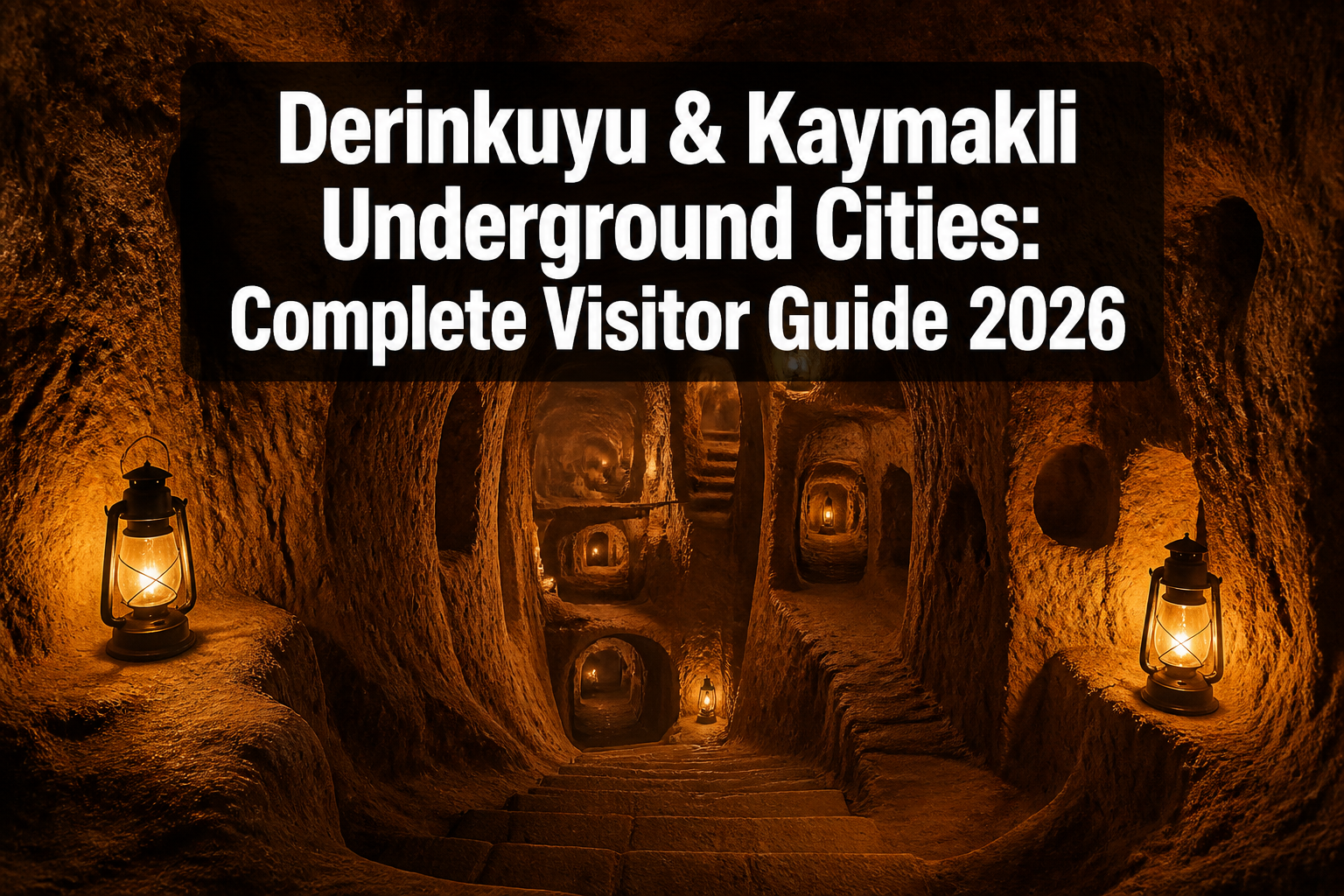

Deep beneath the fairy chimneys of Cappadocia lie two ancient marvels that have sheltered civilizations for over two millennia. Last updated: May 3, 2026
Quick Answer: Derinkuyu and Kaymakli are two of Cappadocia’s most extraordinary underground cities, carved into volcanic rock thousands of years ago and open to visitors year-round. Derinkuyu descends 85 meters across 11 levels (the deepest underground city open to the public in the world), while Kaymakli spreads wider across 4 publicly accessible levels. Both charge around 300 TL entry and can be visited together in a single day trip from Göreme.
Key Takeaways
- 🏛️ Derinkuyu is the world’s deepest underground city open to visitors — 11 levels, 85 meters deep, capacity for an estimated 20,000 people [3]
- 🏛️ Kaymakli is the widest underground city by area — 8 levels total, 4 open to the public, capacity for roughly 3,500 people [2]
- 💰 Entry fee for both: approximately 300 TL (~€13); covered by the Türkiye Museum Pass and Cappadocia Pass [2]
- 🕗 Opening hours: Daily 8:00–19:00, year-round (including winter) [2]
- 📍 Kaymakli sits 26 km south of Göreme; Derinkuyu is a further 10 km south of Kaymakli [3]
- ⏱️ Allow 45–60 minutes for Derinkuyu, 1–1.5 hours for Kaymakli (30–45 min on guided tours) [2][3]
- 🚌 Both cities are included on the popular Cappadocia Green Tour (7–8 hours, includes Ihlara Valley and Selime Monastery) [3]
- ⚠️ Claustrophobic travelers should note: Kaymakli has notably narrower, lower passageways; Derinkuyu’s chambers are wider [1]
- 🎟️ The Türkiye Museum Pass covers entry to both — buy it before you go if visiting multiple sites
- 🌡️ Underground temperature stays around 13°C (55°F) year-round — bring a light layer regardless of the season
Why Do These Underground Cities Exist at All?
Cappadocia’s underground cities weren’t built on a whim. They were survival infrastructure — carved into the soft volcanic tuff (called “ignimbrite”) over centuries, likely beginning as early as the Phrygian period (around 800–700 BCE) and expanded significantly during the Byzantine era when Christian communities needed refuge from Arab raids [3][6].
Cappadocia contains 25–30 documented underground cities in total, but Derinkuyu and Kaymakli are the two most developed and accessible. Think of them less as “caves” and more as fully engineered underground towns — complete with ventilation shafts disguised as wells, massive rolling stone doors that could be sealed from the inside, stables, kitchens, wine cellars, churches, and even schools [2][3].
The volcanic rock was soft enough to carve with basic tools but hardened on contact with air — nature’s own slow-cure concrete. It’s genuinely one of the cleverest geological coincidences in human history.
What’s the Difference Between Derinkuyu and Kaymakli?
The short version: Derinkuyu goes deeper and feels more dramatic; Kaymakli spreads wider and feels more intimate (sometimes uncomfortably so). They’re different experiences, and visiting both is absolutely worth it if time allows.

Here’s a side-by-side breakdown:
| Feature | Derinkuyu | Kaymakli |
|---|---|---|
| Total levels | 11 | 8 |
| Levels open to public | ~8 (to 85m depth) | 4 |
| Estimated capacity | ~20,000 people | ~3,500 people |
| Passageway width | Wider, taller | Narrower, lower ceilings |
| Standout feature | Cruciform church, missionary school | Animal stables, storage rooms |
| Distance from Göreme | ~36 km south | ~26 km south |
| Crowd level | Moderate–busy | Generally quieter |
| Best for | Drama-seekers, history lovers | First-timers, those short on time |
| Recommended visit time | 45–60 min | 1–1.5 hours (self-guided) |
Choose Derinkuyu if you want the full vertical descent experience and don’t mind tighter spots on the lower levels. Choose Kaymakli if you’re pressed for time or prefer a slightly less intense introduction to underground cities — though fair warning, the low ceilings on some levels will still give claustrophobic travelers a workout [1][7].
Pro move: visit Kaymakli first (it’s closer to Göreme), then continue south to Derinkuyu. You’ll have the context from Kaymakli to fully appreciate how much more ambitious Derinkuyu’s construction was.
What Will You Actually See Inside?
Both cities are genuinely mind-bending, but each has its own personality underground.
At Derinkuyu, the highlight is the sheer scale of the descent. The city’s infrastructure included schools, wineries, oil presses, a missionary school, and a cruciform-shaped (cross-shaped) church on the lowest accessible level [3]. The ventilation system — a single main shaft running the full 85-meter depth — supplied fresh air to every level. Rolling stone doors, some weighing several tons, could seal individual sections from the inside. Nobody was getting through those uninvited.
At Kaymakli, the layout feels more like a neighborhood than a fortress. The four open levels feature animal stables (the smell of ancient hay is, remarkably, still faintly present in some accounts), storage rooms, kitchens, wineries, and latrines [2]. Air shafts disguised as wells dot the surface above — a detail that’s equal parts practical genius and spy-thriller energy. The passageways are narrower here, which means you’ll be crouching and shuffling in single file through some sections. It’s an experience, let’s put it that way.
Both cities are lit with electric lighting today, and signage in English helps orient visitors. Neither requires a guide, though having one adds considerable depth — particularly for understanding which room served which purpose [4].
How Do You Get There From Göreme?
Getting to both underground cities from Göreme is straightforward, with a few options depending on budget and preference.
Option 1: Cappadocia Green Tour (most popular) This full-day guided tour (7–8 hours) includes both Kaymakli and Derinkuyu, plus the 3 km Ihlara Valley hike and Selime Monastery. It’s the most efficient way to see southern Cappadocia in one shot and is widely available through Göreme tour operators [3]. For help weighing up guided vs. independent travel, check out this guide on how to choose between guided tours or independent travel in Turkey.
Option 2: Rent a car or scooter The most flexible option. Kaymakli is about 26 km south of Göreme on a well-signed main road; Derinkuyu is another 10 km south. The drive takes 30–40 minutes each way. Parking is available at both sites.
Option 3: Dolmuş (shared minibus) Dolmuş services run from Nevşehir (the regional hub) toward Derinkuyu and stop at Kaymakli en route. It’s the budget option, but schedules can be infrequent — check locally before committing. For navigating public transport across Turkey, this guide to public transportation in Turkey is genuinely useful.
Option 4: Taxi A private taxi from Göreme to both sites and back costs roughly 800–1,200 TL (estimate, 2026 rates) depending on negotiation and waiting time. Ask your accommodation to arrange one — Turkish hospitality is no joke, and most guesthouses will sort this happily.
When Is the Best Time to Visit?

The honest answer: any time of year works, because the underground temperature stays around 13°C (55°F) regardless of what’s happening above ground. That said, timing still matters for crowd management.
- April–June and September–October: Ideal. Comfortable surface temperatures, manageable crowds, and the surrounding Cappadocian landscape is stunning.
- July–August: Peak tourist season. Both sites get crowded, and the narrow passageways at Kaymakli in particular become genuinely uncomfortable with large tour groups. Visit early (doors open at 8:00) to beat the rush.
- November–March: Surprisingly good. Crowds thin dramatically, prices drop, and there’s something atmospheric about descending into a 2,000-year-old underground city while snow dusts the fairy chimneys above. The sites stay open year-round [2].
For broader timing advice on visiting Cappadocia and the rest of Turkey, see the best time of year to visit Turkey.
Steal this tip: arrive at opening time (8:00am) on any day. The first hour is noticeably quieter, the lighting feels more atmospheric with fewer headlamps bobbing around, and you’ll get photos without strangers in every shot.
What Should You Know Before Visiting Cappadocia? (Practical Tips)
Here’s what nobody tells you until you’re already underground and mildly panicking:
Physical preparation:
- Wear comfortable, closed-toe shoes with grip — the floors are uneven and occasionally slippery
- Bring a light jacket or layer; 13°C feels cold after 30 minutes, especially if you’ve been sweating in Cappadocian summer heat
- If you have knee issues, the descending staircases (some very steep) at Derinkuyu will be challenging; Kaymakli’s layout is less vertical but requires more crouching
Claustrophobia check:
- Kaymakli’s lower levels have passageways where average-height adults must bend significantly. If enclosed spaces make you anxious, start with Derinkuyu’s wider chambers and see how you feel [1][7]
- Both sites have exit points at multiple levels — you’re never trapped
Photography:
- No flash required; the amber lighting actually photographs beautifully with a phone camera
- Tripods aren’t practical in the narrow passages
Accessibility:
- Neither site is wheelchair accessible due to the nature of the tunnels and staircases
- For accessibility information across Turkish attractions, see Turkey’s accessibility guide for disabled travelers
Tickets and passes:
- The Türkiye Museum Pass covers entry to both sites — if you’re visiting multiple historical sites across Turkey, this pass pays for itself quickly [2]
- Buy tickets at the entrance; no advance booking required for individual visits (tours may be pre-booked)
What Else Is Nearby? (Making a Full Day of It)
Southern Cappadocia is seriously underrated compared to the Göreme/Uçhisar cluster, and the underground cities are just the headline act.
Ihlara Valley: A 14 km canyon with a river running through it and Byzantine rock churches carved into the walls. The standard 3 km section is included in the Green Tour and takes about 1.5 hours. Genuinely one of the most beautiful walks in Turkey.
Selime Monastery: A massive rock-cut monastery complex at the northern end of Ihlara Valley — one of the largest in Cappadocia. The views from the top are spectacular.
Soğanlı Valley: A quieter, less-visited alternative to Göreme’s open-air museum, with rock churches and a village that feels genuinely off the tourist trail. Combine it with Kaymakli for a full southeastern Cappadocia day [8].
And of course, if you’re basing yourself in Göreme for the week, the famous hot air balloon rides at dawn deserve their own morning — find everything you need in this comprehensive guide to balloon rides in Cappadocia.
For the full picture of Turkey’s extraordinary archaeological sites (Derinkuyu and Kaymakli are just two of many), browse Turkey’s most important archaeological discoveries.
Derinkuyu & Kaymakli Underground Cities FAQ
Q: Can I visit both Derinkuyu and Kaymakli in one day? Yes, easily. They’re 10 km apart, and each takes under 1.5 hours to explore. Most visitors combine them on the Cappadocia Green Tour or a self-driven day trip from Göreme. [3]
Q: Which underground city is better — Derinkuyu or Kaymakli? Derinkuyu offers a more dramatic experience with its 85-meter depth and wider chambers. Kaymakli is better for first-timers or those with limited time. Visiting both gives the fullest picture. [7]
Q: Is the Türkiye Museum Pass accepted at both sites? Yes. The Türkiye Museum Pass and the Cappadocia Pass both cover entry to Kaymakli and Derinkuyu, making them excellent value if you’re visiting multiple sites. [2]
Q: Are the underground cities suitable for children? Generally yes, though very young children may find the dark, enclosed spaces unsettling. The crouching required in Kaymakli’s lower levels can be tiring for small legs. Kids who enjoy adventure and history typically love it.
Q: Is it cold inside the underground cities? Yes — around 13°C (55°F) year-round. Bring a light layer regardless of the season, especially if visiting in summer when the temperature contrast with the surface is significant.
Q: Do I need a guide, or can I explore independently? Both sites can be explored independently with the English signage provided. A guide adds historical context and helps identify room functions that aren’t always obvious. Many visitors find the Green Tour’s included guide genuinely enhances the experience. [4]
Q: How deep does Derinkuyu go? Derinkuyu descends 85 meters across 11 levels, making it the deepest underground city open to the public in the world. [3]
Q: Is there parking at both sites? Yes, both Derinkuyu and Kaymakli have parking areas near the entrances, suitable for rental cars and tour vehicles.
Q: What’s the best time of day to visit? Opening time (8:00am) is consistently the quietest period. Avoid midday in peak summer months (July–August) when tour groups arrive in large numbers.
Q: Are there food options near the sites? Small cafes and restaurants operate near both entrances, particularly at Kaymakli village. Don’t expect gourmet dining, but tea, gözleme, and simple meals are available.
Q: How many underground cities are there in Cappadocia? Cappadocia has 25–30 documented underground cities in total, but only a handful are open to the public. Derinkuyu and Kaymakli are the two most developed and accessible. [3]
Q: Can I visit in winter? Absolutely. Both sites are open year-round (daily 8:00–19:00), and winter visits come with significantly smaller crowds and a uniquely atmospheric experience. [2]
Conclusion: Your 2026 Action Plan for the Underground Cities
The Derinkuyu & Kaymakli Underground Cities: Complete Visitor Guide 2026 comes down to this: don’t skip either one, don’t overthink the logistics, and do bring a jacket.
Here’s your actionable checklist before you go:
- Check if you already have the Türkiye Museum Pass — if not, consider buying one if you’re visiting 3+ sites
- Book the Green Tour through your Göreme accommodation if you want a guided, all-in-one southern Cappadocia day
- Plan to arrive at 8:00am at whichever site you visit first
- Pack a light layer — that 13°C underground chill catches people off guard
- Wear proper shoes with grip and closed toes
- Honest self-assessment: if tight spaces genuinely distress you, start with Derinkuyu’s wider chambers
- Budget 3–4 hours total for both sites combined, plus travel time
Consider this your sign: these underground cities are among the most genuinely astonishing things a human can walk through anywhere on Earth. Future you — the one who actually went underground in Cappadocia — will absolutely thank present you for making it happen.
References
[1] Underground Cities – https://www.hotairballooncappadocia.com/cappadocia/underground-cities/ [2] Kaymakli Underground City – https://worldbyweekend.com/kaymakli-underground-city/ [3] Cappadocia Underground Cities – https://epicturkeytravel.com/cappadocia-underground-cities/ [4] Cappadocia Underground City Derinkuyu Tour 2026 – https://myturkeyadventure.com/s/cappadocia-underground-city-derinkuyu-tour-2026 [6] Derinkuyu Underground City – https://www.felizturismo.com/en/blog/derinkuyu-underground-city/ [7] Derinkuyu Vs Kaymakli Underground City Cappadocia 2026 Which One Should You Visit – https://cappadociavisitor.com/blogdetail/derinkuyu-vs-kaymakli-underground-city-cappadocia-2026-which-one-should-you-visit [8] Soganli Valley Kaymakli Underground City Tour – https://www.tripadvisor.com/AttractionProductReview-g297983-d11475985-Soganli_Valley_Kaymakli_Underground_City_and_All_Highlights_of_Southeast_Cappadoci.html
Tags: Derinkuyu underground city, Kaymakli underground city, Cappadocia underground cities, Cappadocia travel guide 2026, Turkey historical sites, Cappadocia Green Tour, underground cities Turkey, Göreme day trips, Cappadocia visitor tips, Turkey UNESCO sites, Nevşehir attractions, Cappadocia travel tips
Related Turkey planning guides: If underground cities are part of your Cappadocia plans, see our 7-day Turkey itinerary, 10-day Turkey itinerary, Cappadocia hot air balloon guide, and where to stay in Cappadocia guide.