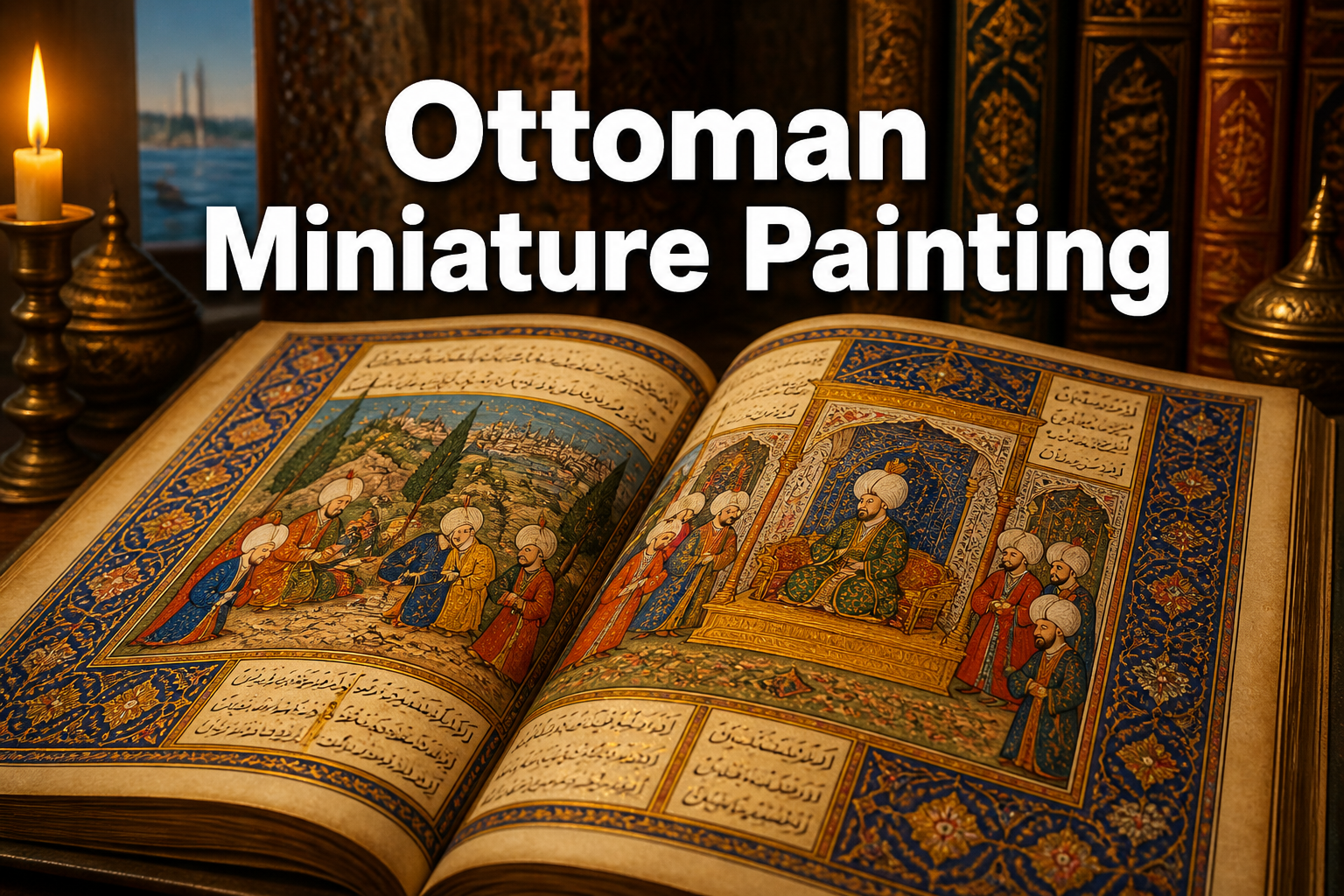
Ottoman miniature painting offers a captivating glimpse into centuries of Turkish history through intricate, jewel-toned scenes. Last updated: May 3, 2026
Quick Answer: Ottoman miniature painting is a centuries-old Islamic book art that flourished in Istanbul’s royal workshops from the 15th to 18th centuries, reaching its peak under Sultan Suleiman the Magnificent in the 1500s. These small, jewel-toned paintings documented empire — battles, festivals, court life — and blended Persian, Byzantine, and Timurid influences into a style entirely their own. Today, the best place to see them is Topkapı Palace Museum in Istanbul.
Key Takeaways 🎨
- Ottoman miniature painting emerged as a defined art form in the 15th century under Sultan Mehmed II (the Conqueror) [1]
- The art form’s golden age was the 16th century reign of Suleiman the Magnificent, when royal workshops called nakkashanes produced masterworks [1]
- The word “miniature” comes from minimum (red lead pigment) — not from the small size of the paintings [5]
- Ottoman miniatures are called taswir or nakish in Ottoman Turkish [5]
- These paintings served as visual historical records — essentially the empire’s official illustrated journalism [2]
- The style deliberately avoided shadows and used flat perspective, unlike Western Renaissance painting of the same era [3]
- Topkapı Palace Museum in Istanbul holds the most important collection in the world [2]
- The art was produced for over 300 years and was revived in Turkey in 1936 when a dedicated division opened at Istanbul’s Academy of Fine Arts [3]
- Key artists include Nakkas Osman and the remarkable Matrakçı Nasuh, who also happened to be a mathematician and champion wrestler (yes, really) [1]
What Exactly Is Ottoman Miniature Painting?
Ottoman miniature painting is a form of illustrated manuscript art produced in the Ottoman Empire, primarily between the 15th and 18th centuries. These works combined Persian miniature traditions with Byzantine and Mongol influences to create a distinctive visual language that documented imperial history with vivid, jewel-toned precision. [3]
Unlike Western painting of the same era, Ottoman miniatures used flat perspective with no cast shadows, bold outlines, and an almost encyclopedic attention to detail in costume, architecture, and ceremony. They weren’t hung on walls — they lived inside books, meant to be held in the hands of sultans and scholars.
Here’s what makes them genuinely fascinating: they weren’t purely decorative. Every painting was a record. A fortress conquered, a festival celebrated, a circumcision feast thrown for a prince — all of it documented in pigment and gold leaf, with the kind of specificity that makes historians giddy. [2]
“Ottoman miniatures were essentially the empire’s illustrated journalism — precise, purposeful, and breathtakingly beautiful.”
The paintings were called taswir (meaning depiction or image) or nakish in Ottoman Turkish. And here’s a fun fact to drop at your next dinner party: the word “miniature” has nothing to do with size. It comes from minimum, the Latin name for red lead pigment used extensively in early manuscript art. [5]
The Full History of Ottoman Miniature Painting: From Seljuk Roots to Imperial Masterworks
Ottoman miniature painting didn’t appear from nowhere — it grew from a rich tradition stretching back to the 12th-century Seljuk Turks, who established painting schools in Baghdad covering regions from Turkestan and Iran to Mesopotamia and Anatolia. [1]
The Seljuk Foundation (12th–14th centuries)
The Seljuks were serious art patrons. (If you want to explore their broader legacy in Turkey, check out this guide to Turkey’s historical sites from the Seljuq Dynasty.) Their manuscript traditions laid the groundwork for what would become a distinctly Ottoman art form — but the real transformation came with conquest.
The Mehmed II Era: Where It All Begins (15th century)
The Ottoman miniature as a defined art form emerged in the 15th century under Sultan Mehmed II — Mehmed the Conqueror, the man who took Constantinople in 1453 and immediately started redecorating. [1] (For the full story on the Ottoman sultans, our history buff’s guide to the Ottoman caliphs is absolutely worth bookmarking.)
Mehmed did something bold: he invited Italian artists, including the Venetian painter Gentile Bellini, to his court. The result was a fascinating cultural collision — Italian portraiture techniques meeting Persian compositional traditions and Timurid decorative sensibilities. This cross-pollination gave early Ottoman miniature painting its uniquely hybrid character. [1]
Ottoman Miniature Painting’s Golden Age: Suleiman the Magnificent (16th century)
This is where things get spectacular. The 16th century reign of Suleiman the Magnificent is widely considered the golden age of Ottoman miniature painting. [1] Royal workshops called nakkashanes operated inside the Topkapı Palace complex, employing teams of specialized artists — some for outlines, some for color, some for gold work — working together like a highly skilled creative studio. [6]
Two names stand out from this era:
- Nakkas Osman — the leading court painter whose style defined the classic Ottoman miniature aesthetic
- Matrakçı Nasuh — a genuine polymath who was simultaneously a mathematician, historian, and champion wrestler, and who produced extraordinary topographical paintings of cities across the empire [1]
The Most Productive Era: Selim II and Murad III (1566–1595)
The second half of the 16th century under Sultans Selim II (1566–74) and Murad III (1574–95) produced the most characteristic and prolific examples of Ottoman miniature art as historical painting. [2] This is the period that scholars point to when defining the “classic” Ottoman style.
Decline and Revival
By the 18th century, Western artistic influences had begun to dilute the tradition, and the art form entered a long decline. The early 20th century brought a genuine crisis. But — plot twist — the Turkish Republic stepped in. In 1936, a division called Turkish Decorative Arts was established in the Academy of Fine Arts in Istanbul, formally including miniature painting alongside other Ottoman book arts and beginning its modern revival. [3]
What Did Ottoman Miniatures Actually Depict?
Ottoman miniatures were overwhelmingly documentary in purpose. Nearly all of them depicted important historical events — and the list is wonderfully specific: [2]
| Subject Category | Examples |
|---|---|
| Military victories | Siege of Rhodes, Battle of Mohács |
| Fortress conquests | Detailed topographical views of captured cities |
| State ceremonies | Enthronement of sultans, diplomatic receptions |
| Festivals | The famous 52-day circumcision feast of 1582 |
| Formal processions | Janissary parades, guild marches |
| Court life | Hunting scenes, banquets, audiences |
The Surname-i Hümayun (Book of Festivals) — commissioned by Murad III to document the 1582 circumcision celebrations — is one of the most famous examples. It contains hundreds of miniatures showing guild processions through the Hippodrome over 52 consecutive nights. It’s basically a 16th-century documentary film, except painted. [4]
What Ottoman miniatures almost never depicted: religious scenes of prophets or divine figures (in keeping with Islamic artistic traditions), and — notably — individual psychological portraits in the Western sense. The focus was always on event and ceremony, not inner life. [3]
The Artistic Style: What Makes an Ottoman Miniature Look the Way It Does?
Ottoman miniature painting has a visual signature that’s immediately recognizable once you know what to look for. Understanding it makes viewing the real thing infinitely more rewarding.
Key stylistic features:
- No cast shadows — figures and objects exist in a kind of eternal, shadowless present
- Flat perspective — scenes are depicted from a slightly elevated viewpoint, with near and far objects stacked vertically rather than receding into the distance
- Vivid, unmixed pigments — lapis lazuli blue, malachite green, saffron yellow, and vermillion red appear in their full intensity
- Gold leaf details — used for sky, architectural elements, and decorative borders
- Fine outlines — every figure and object is precisely delineated
- Costume accuracy — court dress, military uniforms, and ethnic clothing are rendered with almost obsessive detail
This style deliberately combined Persian miniature art with Byzantine and Mongol influences while maintaining Islamic art’s traditional preference for abstract formal expression over illusionistic realism. [3] The result is paintings that feel simultaneously ancient and strikingly modern — almost like a sophisticated graphic novel aesthetic, centuries before the form existed.
The pigments themselves were extraordinary. Artists ground minerals by hand — lapis lazuli from Afghanistan, malachite from copper mines, saffron from spice markets. (Speaking of spice markets, if you’re planning a trip to Istanbul, our foodie’s guide to the spice bazaars of Turkey is essential reading.) These mineral pigments have kept their color for 500 years. That’s not a small achievement.
Where to See Ottoman Miniature Painting in Turkey
The best places to see authentic Ottoman miniatures are concentrated in Istanbul, with a few surprises elsewhere. Here’s the definitive list for 2026:
🏛️ Topkapı Palace Museum, Istanbul — The Essential Stop
This is the single most important collection of Ottoman miniatures in the world. [2] The palace’s Treasury and manuscript galleries hold thousands of illuminated manuscripts and individual miniature paintings produced in the very nakkashane workshops that once operated on these grounds. Fair warning: you could spend an entire day here and still feel like you’ve only scratched the surface.
- Location: Sultanahmet, Istanbul (walking distance from Hagia Sophia)
- What to look for: The Surname-i Hümayun, portraits of sultans, battle scene manuscripts
- Pro move: Visit on a weekday morning before tour groups arrive. The 9:00am opening slot is genuinely magical.
🏛️ Istanbul Museum of Turkish and Islamic Arts
Seriously underrated compared to Topkapı, this museum on the Hippodrome holds significant manuscript collections and often stages dedicated miniature painting exhibitions. The building itself — a former palace of Ibrahim Pasha — is worth the visit alone.
🏛️ Sakıp Sabancı Museum, Istanbul
Located in a stunning Bosphorus-side mansion in Emirgan, the Sabancı Museum holds an exceptional collection of Ottoman calligraphy and illuminated manuscripts. If you’re already interested in the broader world of Ottoman book arts, pair this with a visit to our guide on the art of Turkish calligraphy — the two art forms were deeply intertwined.
🏛️ Istanbul University Library
One of Turkey’s great hidden repositories. The library holds rare Ottoman manuscripts not always accessible to casual visitors, but scholars and serious enthusiasts can arrange access. Bookmark this for future research trips.
🏛️ Beyond Istanbul: Ankara’s Ethnography Museum
The Museum of Ethnography in Ankara holds Ottoman-era artifacts including manuscript collections. It’s worth a stop if you’re spending time in the capital.
Outside Turkey: The Chester Beatty Library in Dublin holds one of the finest collections of Ottoman manuscripts outside of Istanbul — genuinely world-class and often less crowded than Topkapı. [2]
How Has Ottoman Miniature Painting Influenced Turkish Art Today?
Ottoman miniature painting didn’t end with the empire — it evolved. After the 1936 revival at Istanbul’s Academy of Fine Arts, the tradition was reframed as a living decorative art rather than a historical relic. [3]
Today, you’ll find its influence in several places:
- Contemporary Turkish artists who incorporate miniature techniques and aesthetic conventions into modern work — sometimes in dialogue with digital media (see how digital art is evolving in Turkey)
- Craft workshops in Istanbul’s Grand Bazaar and Arasta Bazaar where artists still produce miniatures using traditional pigments and techniques
- Museum education programs at Topkapı and other institutions teaching the nakkashane methods to new generations
- Academic study at Istanbul’s Mimar Sinan Fine Arts University, where miniature painting remains a formal discipline
The broader Ottoman artistic legacy — including miniature painting — is one of the most significant ways the Ottoman Empire continues to influence modern Turkey.
Can You Take a Miniature Painting Workshop in Turkey?
Yes — and it’s one of the most memorable things you can do in Istanbul. Here’s how to find a good one:
What to look for in a workshop:
- Instruction in traditional pigment preparation (not just acrylic paint on paper)
- Use of genuine materials: natural pigments, bone folders, proper brushes
- A teacher with formal training in the Ottoman tradition
- Small group sizes (6 or fewer is ideal)
- Located in or near the historic peninsula for authenticity
Where to look:
- The Arasta Bazaar near the Blue Mosque has several reputable art workshops
- Istanbul Handicrafts Center (Çamlık Korusu area) offers structured courses
- Some hotels in Sultanahmet can arrange private sessions with master artists
Fair warning: One-hour tourist workshops will give you a souvenir experience. If you want to genuinely understand the technique, look for half-day or multi-day courses. Future you will thank us.
FAQ: Ottoman Miniature Painting
Q: Why don’t Ottoman miniatures show shadows? Ottoman miniature painting followed Islamic artistic conventions that favored abstract formal expression over illusionistic realism. The flat, shadowless style was a deliberate aesthetic choice, not a technical limitation. [3]
Q: Are Ottoman miniatures religious art? Mostly no. Unlike Persian miniatures, which often depicted religious narratives, Ottoman miniatures were primarily historical and documentary — recording court events, military campaigns, and state ceremonies. [2]
Q: How small are Ottoman miniatures actually? They vary considerably. Some fit on a single manuscript page (roughly A4 size), while double-page compositions can span 30–40cm wide. The name “miniature” refers to pigment, not dimensions. [5]
Q: Who made Ottoman miniatures — individual artists or teams? Teams. The nakkashane workshops operated like studios, with specialized artists handling different tasks: one for outlines, another for color, another for gold work. Individual attribution is rare. [6]
Q: Can you buy authentic Ottoman miniatures in Turkey? Genuine antique Ottoman miniatures are museum pieces and cannot be legally exported without permits. What you’ll find in markets are modern reproductions — which can still be beautiful and skillfully made, just not originals.
Q: What’s the difference between Ottoman and Persian miniatures? Persian miniatures tend to feature more romantic and literary themes (poetry, mythology, love stories). Ottoman miniatures are predominantly historical and documentary. Both share the flat perspective and jewel-tone palette, but the subject matter and purpose differ significantly. [3]
Q: Is miniature painting still practiced in Turkey today? Yes. After its formal revival in 1936, miniature painting has continued as both an academic discipline and a craft tradition. Contemporary Turkish artists work in the medium, and workshops are available throughout Istanbul. [3]
Q: What materials did Ottoman miniaturists use? Natural mineral pigments (lapis lazuli, malachite, cinnabar), gold leaf, fine brushes made from squirrel or cat hair, and paper or vellum. The pigments were bound with egg white or gum arabic. [1]
Conclusion: Your Ottoman Miniature Game Plan
Ottoman miniature painting is one of those art forms that rewards attention. The more you know going in, the more you’ll see — and once you’ve spotted the flat perspective, the shadowless figures, and the obsessive costume detail, you can’t unsee them. Consider this your sign to add Topkapı Palace’s manuscript galleries to the top of your Istanbul itinerary.
Your actionable next steps:
- Book Topkapı Palace tickets in advance — the manuscript galleries have timed entry and sell out, especially in summer
- Visit the Istanbul Museum of Turkish and Islamic Arts on the same day (it’s a 5-minute walk from Topkapı)
- Look up miniature painting workshops in the Sultanahmet area before you arrive — the good ones fill quickly
- Read up on the Ottoman sultans before your visit so the historical context clicks (our Ottoman caliphs guide is a great primer)
- Pair your art visit with a broader Turkish art exploration — Turkey’s contribution to the art world puts miniature painting in its full cultural context
The nakkashane artists who worked inside Topkapı’s walls were recording an empire in color, one brushstroke at a time. Walking through those same galleries, holding those images in your gaze — that’s not just tourism. That’s a genuine conversation across five centuries.
Prepare to be obsessed. 🎨
References
[1] Turkish Miniature Paintings | History Of Turkey – https://www.astaguru.com/blogs/turkish-miniature-paintings-%7C-history-of-turkey-676
[2] History Of Ottoman Turkish Miniature Paintings – https://www.lesartsturcs.com/history-of-ottoman-turkish-minature-paintings/
[3] Ottoman Miniature – https://en.wikipedia.org/wiki/Ottoman_miniature
[4] Reading An Empire In Color: How Ottoman Miniatures Recorded History – https://www.turkiyetoday.com/culture/reading-an-empire-in-color-how-ottoman-miniatures-recorded-history-3212428
[5] TRT World – Ottoman Miniature Art – https://www.trtworld.com/article/12787058
[6] From The Painting Treasury Of The Palace: Miniatures In Ottoman Art – https://istanbultarihi.ist/637-from-the-painting-treasury-of-the-palace-miniatures-in-ottoman-art
* { box-sizing: border-box; margin: 0; padding: 0; }
<code>body {
font-family: Georgia, 'Times New Roman', serif;
background: #fdf6ec;
color: #2c1a0e;
padding: 20px;
}
.cg-element-container {
max-width: 720px;
margin: 0 auto;
background: #fff9f0;
border: 2px solid #c9a96e;
border-radius: 12px;
overflow: hidden;
box-shadow: 0 4px 20px rgba(100, 60, 10, 0.12);
}
.cg-element-header {
background: linear-gradient(135deg, #3b1f0a 0%, #7a3e10 100%);
color: #f5e6c8;
padding: 24px 28px 20px;
text-align: center;
}
.cg-element-header h2 {
font-size: 1.35rem;
letter-spacing: 0.03em;
margin-bottom: 6px;
font-weight: bold;
}
.cg-element-header p {
font-size: 0.88rem;
opacity: 0.85;
font-style: italic;
}
.cg-element-tabs {
display: flex;
border-bottom: 2px solid #c9a96e;
background: #f5e6c8;
}
.cg-element-tab {
flex: 1;
padding: 12px 8px;
text-align: center;
cursor: pointer;
font-size: 0.82rem;
font-weight: bold;
color: #7a3e10;
border: none;
background: transparent;
transition: background 0.2s, color 0.2s;
border-bottom: 3px solid transparent;
font-family: Georgia, serif;
}
.cg-element-tab:hover {
background: #eddfc0;
}
.cg-element-tab.cg-active {
background: #fff9f0;
color: #3b1f0a;
border-bottom: 3px solid #c9a96e;
}
.cg-element-panel {
display: none;
padding: 24px 28px;
}
.cg-element-panel.cg-visible {
display: block;
}
/* Timeline styles */
.cg-timeline {
position: relative;
padding-left: 24px;
}
.cg-timeline::before {
content: '';
position: absolute;
left: 8px;
top: 0;
bottom: 0;
width: 2px;
background: #c9a96e;
}
.cg-timeline-item {
position: relative;
margin-bottom: 22px;
cursor: pointer;
}
.cg-timeline-item::before {
content: '';
position: absolute;
left: -20px;
top: 6px;
width: 12px;
height: 12px;
border-radius: 50%;
background: #c9a96e;
border: 2px solid #7a3e10;
transition: background 0.2s;
}
.cg-timeline-item:hover::before,
.cg-timeline-item.cg-open::before {
background: #7a3e10;
}
.cg-timeline-era {
font-size: 0.78rem;
font-weight: bold;
color: #c9a96e;
text-transform: uppercase;
letter-spacing: 0.08em;
margin-bottom: 2px;
}
.cg-timeline-title {
font-size: 1rem;
font-weight: bold;
color: #3b1f0a;
margin-bottom: 4px;
}
.cg-timeline-detail {
display: none;
font-size: 0.86rem;
color: #5a3a1a;
line-height: 1.6;
background: #f5e6c8;
border-left: 3px solid #c9a96e;
padding: 10px 14px;
border-radius: 0 6px 6px 0;
margin-top: 8px;
}
.cg-timeline-item.cg-open .cg-timeline-detail {
display: block;
}
/* Museum finder styles */
.cg-museum-filter {
display: flex;
gap: 8px;
flex-wrap: wrap;
margin-bottom: 18px;
}
.cg-filter-btn {
padding: 7px 14px;
border: 2px solid #c9a96e;
background: transparent;
color: #7a3e10;
border-radius: 20px;
cursor: pointer;
font-size: 0.82rem;
font-family: Georgia, serif;
transition: all 0.2s;
font-weight: bold;
}
.cg-filter-btn:hover,
.cg-filter-btn.cg-selected {
background: #7a3e10;
color: #f5e6c8;
border-color: #7a3e10;
}
.cg-museum-grid {
display: grid;
gap: 14px;
}
.cg-museum-card {
background: #fff;
border: 1px solid #e0c898;
border-radius: 8px;
padding: 16px;
transition: box-shadow 0.2s;
}
.cg-museum-card:hover {
box-shadow: 0 3px 12px rgba(100, 60, 10, 0.14);
}
.cg-museum-card[data-hidden="true"] {
display: none;
}
.cg-museum-name {
font-size: 0.98rem;
font-weight: bold;
color: #3b1f0a;
margin-bottom: 4px;
}
.cg-museum-meta {
display: flex;
gap: 10px;
flex-wrap: wrap;
margin-bottom: 8px;
}
.cg-museum-tag {
font-size: 0.74rem;
padding: 2px 9px;
border-radius: 10px;
font-weight: bold;
letter-spacing: 0.04em;
}
.cg-tag-essential { background: #fde8c8; color: #7a3e10; }
.cg-tag-hidden { background: #e8f5e9; color: #2e7d32; }
.cg-tag-international { background: #e3f2fd; color: #1565c0; }
.cg-tag-istanbul { background: #fce4ec; color: #880e4f; }
.cg-tag-ankara { background: #f3e5f5; color: #6a1b9a; }
.cg-museum-desc {
font-size: 0.84rem;
color: #5a3a1a;
line-height: 1.55;
}
.cg-museum-tip {
margin-top: 8px;
font-size: 0.8rem;
color: #7a3e10;
font-style: italic;
}
.cg-museum-tip::before {
content: '💡 ';
}
/* Style quiz */
.cg-quiz-question {
font-size: 1rem;
font-weight: bold;
color: #3b1f0a;
margin-bottom: 14px;
line-height: 1.5;
}
.cg-quiz-options {
display: grid;
gap: 10px;
}
.cg-quiz-option {
padding: 12px 16px;
border: 2px solid #c9a96e;
border-radius: 8px;
cursor: pointer;
font-size: 0.88rem;
color: #3b1f0a;
background: #fff;
text-align: left;
font-family: Georgia, serif;
transition: all 0.2s;
line-height: 1.45;
}
.cg-quiz-option:hover {
background: #f5e6c8;
border-color: #7a3e10;
}
.cg-quiz-option.cg-correct {
background: #e8f5e9;
border-color: #2e7d32;
color: #1b5e20;
}
.cg-quiz-option.cg-wrong {
background: #ffebee;
border-color: #c62828;
color: #b71c1c;
}
.cg-quiz-feedback {
display: none;
margin-top: 14px;
padding: 14px;
border-radius: 8px;
font-size: 0.88rem;
line-height: 1.55;
}
.cg-quiz-feedback.cg-show { display: block; }
.cg-quiz-feedback.cg-correct-fb { background: #e8f5e9; color: #1b5e20; border: 1px solid #a5d6a7; }
.cg-quiz-feedback.cg-wrong-fb { background: #ffebee; color: #b71c1c; border: 1px solid #ef9a9a; }
.cg-quiz-nav {
display: flex;
justify-content: space-between;
align-items: center;
margin-top: 18px;
}
.cg-quiz-btn {
padding: 9px 20px;
background: #7a3e10;
color: #f5e6c8;
border: none;
border-radius: 6px;
cursor: pointer;
font-size: 0.86rem;
font-family: Georgia, serif;
font-weight: bold;
transition: background 0.2s;
}
.cg-quiz-btn:hover { background: #3b1f0a; }
.cg-quiz-btn:disabled { background: #ccc; cursor: not-allowed; }
.cg-quiz-progress {
font-size: 0.8rem;
color: #7a3e10;
font-style: italic;
}
.cg-quiz-score {
text-align: center;
padding: 20px;
}
.cg-quiz-score h3 {
font-size: 1.3rem;
color: #3b1f0a;
margin-bottom: 10px;
}
.cg-quiz-score p {
font-size: 0.9rem;
color: #5a3a1a;
line-height: 1.6;
margin-bottom: 12px;
}
.cg-score-badge {
display: inline-block;
font-size: 2.5rem;
font-weight: bold;
color: #7a3e10;
margin: 10px 0;
}
.cg-restart-btn {
padding: 10px 22px;
background: #c9a96e;
color: #3b1f0a;
border: none;
border-radius: 6px;
cursor: pointer;
font-size: 0.88rem;
font-family: Georgia, serif;
font-weight: bold;
margin-top: 10px;
}
.cg-restart-btn:hover { background: #b8944a; }
@media (max-width: 480px) {
.cg-element-header h2 { font-size: 1.1rem; }
.cg-element-panel { padding: 18px 16px; }
.cg-element-tab { font-size: 0.74rem; padding: 10px 4px; }
}
</code>
🎨 Ottoman Miniature Painting Explorer
Interactive timeline, museum finder & knowledge quiz
TIMELINE PANEL
Click any era to expand details.
<code> <div class="cg-timeline-item" onclick="cg_toggleTimeline(this)">
<div class="cg-timeline-era">12th–14th Century</div>
<div class="cg-timeline-title">Seljuk Foundations</div>
<div class="cg-timeline-detail">The Seljuk Turks established painting schools in Baghdad, covering Turkestan, Iran, Mesopotamia, and Anatolia. These workshops laid the artistic groundwork — compositional conventions, pigment traditions, and manuscript formats — that Ottoman artists would later inherit and transform.</div>
</div>
<div class="cg-timeline-item" onclick="cg_toggleTimeline(this)">
<div class="cg-timeline-era">15th Century</div>
<div class="cg-timeline-title">Mehmed II & The Birth of Ottoman Miniature</div>
<div class="cg-timeline-detail">Sultan Mehmed II (the Conqueror) defined Ottoman miniature as a distinct art form after taking Constantinople in 1453. He invited Italian artists including Gentile Bellini to his court, creating a unique fusion of Italian portraiture, Persian composition, and Timurid decorative tradition. The earliest Ottoman miniatures appeared approximately 150 years after the empire's founding.</div>
</div>
<div class="cg-timeline-item" onclick="cg_toggleTimeline(this)">
<div class="cg-timeline-era">16th Century</div>
<div class="cg-timeline-title">Golden Age: Suleiman the Magnificent</div>
<div class="cg-timeline-detail">The peak of Ottoman miniature painting. Royal workshops called nakkashanes operated inside Topkapı Palace, employing specialized teams. Key artists: Nakkas Osman (defining the classic style) and Matrakçı Nasuh (mathematician, historian, wrestler, and brilliant topographical painter). Thousands of miniatures documented battles, festivals, and court life.</div>
</div>
<div class="cg-timeline-item" onclick="cg_toggleTimeline(this)">
<div class="cg-timeline-era">1566–1595</div>
<div class="cg-timeline-title">Most Productive Era: Selim II & Murad III</div>
<div class="cg-timeline-detail">Scholars consider the reigns of Selim II (1566–74) and Murad III (1574–95) the most characteristic and prolific period of Ottoman miniature as historical painting. The Surname-i Hümayun — a 52-day circumcision feast documented in hundreds of miniatures — was commissioned by Murad III in 1582. It remains one of the greatest examples of the form.</div>
</div>
<div class="cg-timeline-item" onclick="cg_toggleTimeline(this)">
<div class="cg-timeline-era">17th–18th Century</div>
<div class="cg-timeline-title">Decline & Western Influence</div>
<div class="cg-timeline-detail">Western artistic conventions — perspective, shading, portraiture — began infiltrating Ottoman court art. The distinctive flat style gradually gave way to hybrid forms. Production slowed and the nakkashane tradition weakened as European tastes became fashionable among Ottoman elites.</div>
</div>
<div class="cg-timeline-item" onclick="cg_toggleTimeline(this)">
<div class="cg-timeline-era">1936 – Present</div>
<div class="cg-timeline-title">Republican Revival & Modern Practice</div>
<div class="cg-timeline-detail">In 1936, the Turkish Republic established a Turkish Decorative Arts division at Istanbul's Academy of Fine Arts, formally reviving miniature painting as a living discipline. Today it's taught at Mimar Sinan Fine Arts University, practiced in Istanbul workshops, and explored by contemporary Turkish artists — sometimes in dialogue with digital media.</div>
</div>
</div>
</code>MUSEUMS PANEL
<code><div class="cg-museum-grid">
<div class="cg-museum-card" data-category="istanbul essential">
<div class="cg-museum-name">Topkapı Palace Museum</div>
<div class="cg-museum-meta">
<span class="cg-museum-tag cg-tag-essential">Essential</span>
<span class="cg-museum-tag cg-tag-istanbul">Istanbul</span>
</div>
<div class="cg-museum-desc">The world's most important collection of Ottoman miniatures. Treasury and manuscript galleries hold thousands of illuminated manuscripts produced in the palace's own nakkashane workshops. Look for the Surname-i Hümayun and sultan portrait series.</div>
<div class="cg-museum-tip">Book timed entry tickets online in advance — manuscript galleries sell out, especially May–September.</div>
</div>
<div class="cg-museum-card" data-category="istanbul hidden">
<div class="cg-museum-name">Istanbul Museum of Turkish & Islamic Arts</div>
<div class="cg-museum-meta">
<span class="cg-museum-tag cg-tag-hidden">Hidden Gem</span>
<span class="cg-museum-tag cg-tag-istanbul">Istanbul</span>
</div>
<div class="cg-museum-desc">Seriously underrated. Located in Ibrahim Pasha's former palace on the Hippodrome, this museum holds significant manuscript collections and stages dedicated miniature exhibitions. The building itself is a highlight.</div>
<div class="cg-museum-tip">Combine with Topkapı on the same day — it's a 5-minute walk away.</div>
</div>
<div class="cg-museum-card" data-category="istanbul">
<div class="cg-museum-name">Sakıp Sabancı Museum</div>
<div class="cg-museum-meta">
<span class="cg-museum-tag cg-tag-istanbul">Istanbul</span>
</div>
<div class="cg-museum-desc">A Bosphorus-side mansion in Emirgan housing exceptional Ottoman calligraphy and illuminated manuscript collections. The setting alone — overlooking the Bosphorus — makes this worth the trip to Emirgan.</div>
<div class="cg-museum-tip">Take the ferry from Eminönü to Emirgan for a scenic approach. The 10:30am sailing is particularly lovely.</div>
</div>
<div class="cg-museum-card" data-category="istanbul hidden">
<div class="cg-museum-name">Istanbul University Library</div>
<div class="cg-museum-meta">
<span class="cg-museum-tag cg-tag-hidden">Hidden Gem</span>
<span class="cg-museum-tag cg-tag-istanbul">Istanbul</span>
</div>
<div class="cg-museum-desc">Holds rare Ottoman manuscripts not always accessible to casual visitors. Scholars and serious enthusiasts can arrange access. One of Turkey's great under-visited repositories of manuscript art.</div>
<div class="cg-museum-tip">Contact the library in advance to arrange a research visit — walk-ins are rarely admitted to manuscript collections.</div>
</div>
<div class="cg-museum-card" data-category="ankara">
<div class="cg-museum-name">Museum of Ethnography, Ankara</div>
<div class="cg-museum-meta">
<span class="cg-museum-tag cg-tag-ankara">Ankara</span>
</div>
<div class="cg-museum-desc">Holds Ottoman-era artifacts including manuscript collections. Worth a visit if spending time in the capital, particularly alongside Ankara's other major museums.</div>
<div class="cg-museum-tip">Pair with the Museum of Anatolian Civilizations next door for a full day of Turkish cultural history.</div>
</div>
<div class="cg-museum-card" data-category="international">
<div class="cg-museum-name">Chester Beatty Library, Dublin</div>
<div class="cg-museum-meta">
<span class="cg-museum-tag cg-tag-international">International</span>
</div>
<div class="cg-museum-desc">One of the finest collections of Ottoman manuscripts outside Istanbul — genuinely world-class. Often less crowded than Topkapı, with superb conservation and display standards. A must for serious enthusiasts visiting Ireland.</div>
<div class="cg-museum-tip">Entry is free. The Islamic Arts galleries on the upper floors are where Ottoman miniatures are displayed.</div>
</div>
</div>
</code>QUIZ PANEL
// Tab switching function cg_showPanel(id, btn) { document.querySelectorAll('.cg-element-panel').forEach(p => p.classList.remove('cg-visible')); document.querySelectorAll('.cg-element-tab').forEach(t => t.classList.remove('cg-active')); document.getElementById('cg-panel-' + id).classList.add('cg-visible'); btn.classList.add('cg-active'); if (id === 'quiz' && !cg_quizStarted) { cg_initQuiz(); cg_quizStarted = true; } } // Timeline toggle function cg_toggleTimeline(el) { const isOpen = el.classList.contains('cg-open'); document.querySelectorAll('.cg-timeline-item').forEach(i => i.classList.remove('cg-open')); if (!isOpen) el.classList.add('cg-open'); } // Museum filter function cg_filterMuseums(category, btn) { document.querySelectorAll('.cg-filter-btn').forEach(b => b.classList.remove('cg-selected')); btn.classList.add('cg-selected'); document.querySelectorAll('.cg-museum-card').forEach(card => { if (category === 'all') { card.setAttribute('data-hidden', 'false'); card.style.display = ''; } else { const cats = card.getAttribute('data-category') || ''; if (cats.includes(category)) { card.setAttribute('data-hidden', 'false'); card.style.display = ''; } else { card.setAttribute('data-hidden', 'true'); card.style.display = 'none'; } } }); } // Quiz var cg_quizStarted = false; var cg_currentQ = 0; var cg_score = 0; var cg_answered = false; var cg_questions = [ { q: "What does the word 'miniature' actually refer to in Ottoman miniature painting?", options: ["The small size of the paintings", "A red lead pigment called minimum", "The number of figures depicted", "A Persian word for manuscript"], correct: 1, feedback: "Correct! 'Miniature' comes from minimum — the Latin name for red lead pigment used in early manuscript art. Nothing to do with size!", wrongFeedback: "Not quite. 'Miniature' comes from minimum, the Latin name for red lead pigment. The size of the paintings varies considerably." }, { q: "Which Ottoman sultan is credited with establishing the Ottoman miniature as a defined art form?", options: ["Suleiman the Magnificent", "Selim II", "Mehmed II (the Conqueror)", "Murad III"], correct: 2, feedback: "Exactly right! Mehmed II invited Western artists like Gentile Bellini to his court after 1453, blending Italian, Persian, and Timurid styles.", wrongFeedback: "The correct answer is Mehmed II (the Conqueror). He invited Italian artists including Gentile Bellini to Istanbul, creating the hybrid style that defined early Ottoman miniature." }, { q: "What were the royal Ottoman miniature workshops called?", options: ["Medrese", "Nakkashane", "Tekke", "Darüşşifa"], correct: 1, feedback: "Spot on! Nakkashanes were the royal workshops inside Topkapı Palace where specialized teams of artists worked together on manuscripts.", wrongFeedback: "The correct answer is nakkashane. These were the royal workshops inside Topkapı Palace where specialized artists collaborated on imperial manuscripts." }, { q: "Which distinctive visual feature sets Ottoman miniatures apart from Western painting of the same era?", options: ["Extremely small figures", "No cast shadows and flat perspective", "Use of oil paint on canvas", "Portraits showing psychological depth"], correct: 1, feedback: "Correct! Ottoman miniatures deliberately used flat perspective with no cast shadows — a conscious artistic choice reflecting Islamic aesthetic traditions, not a technical limitation.", wrongFeedback: "The answer is no cast shadows and flat perspective. This was a deliberate stylistic choice reflecting Islamic artistic conventions, not a technical limitation." }, { q: "What is the Ottoman Turkish term for miniature painting?", options: ["Ebru", "Taswir or nakish", "Hattat", "Çini"], correct: 1, feedback: "Well done! Taswir (meaning depiction or image) and nakish are the Ottoman Turkish terms for miniature painting.", wrongFeedback: "The correct terms are taswir or nakish in Ottoman Turkish. Ebru is marbling, hattat refers to calligraphers, and çini is tilework." }, { q: "In which year was a formal division for miniature painting established at Istanbul's Academy of Fine Arts?", options: ["1923", "1936", "1950", "1908"], correct: 1, feedback: "Correct! In 1936, the Turkish Republic established the Turkish Decorative Arts division at the Academy of Fine Arts, formally reviving miniature painting as a living discipline.", wrongFeedback: "The answer is 1936. The Turkish Republic established the Turkish Decorative Arts division at Istanbul's Academy of Fine Arts that year, beginning the modern revival." } ]; function cg_initQuiz() { cg_currentQ = 0; cg_score = 0; cg_answered = false; cg_renderQuestion(); } function cg_renderQuestion() { var container = document.getElementById('cg-quiz-container'); if (cg_currentQ >= cg_questions.length) { cg_showScore(container); return; } var q = cg_questions[cg_currentQ]; var optionsHTML = q.options.map(function(opt, i) { return '
'; }).join(''); container.innerHTML = '
Q' + (cg_currentQ + 1) + ' of ' + cg_questions.length + ': ' + q.q + '
' + '
' + optionsHTML + '
' + '
' + '
' + '
Score: ‘ + cg_score + ‘/’ + cg_questions.length + ‘' + '
' + '
'; } function cg_selectAnswer(btn, index) { if (cg_answered) return; cg_answered = true; var q = cg_questions[cg_currentQ]; var options = document.querySelectorAll('.cg-quiz-option'); var feedback = document.getElementById('cg-feedback'); options.forEach(function(opt) { opt.style.pointerEvents = 'none'; }); if (index === q.correct) { btn.classList.add('cg-correct'); feedback.textContent = '✅ ' + q.feedback; feedback.className = 'cg-quiz-feedback cg-show cg-correct-fb'; cg_score++; } else { btn.classList.add('cg-wrong'); options[q.correct].classList.add('cg-correct'); feedback.textContent = '❌ ' + q.wrongFeedback; feedback.className = 'cg-quiz-feedback cg-show cg-wrong-fb'; } document.getElementById('cg-next-btn').disabled = false; } function cg_nextQuestion() { cg_currentQ++; cg_answered = false; cg_renderQuestion(); } function cg_showScore(container) { var pct = Math.round((cg_score / cg_questions.length) * 100); var msg = pct === 100 ? "Perfect score! You're basically a nakkashane master. 🎨" : pct >= 67 ? "Solid knowledge! You'd hold your own in Topkapı's manuscript galleries." : "Good start! A visit to Topkapı Palace will fill in the gaps beautifully."; container.innerHTML = '
' + '
Quiz Complete!
' + '
' + cg_score + '/' + cg_questions.length + '
' + '
‘ + msg + ‘
' + '
(‘ + pct + ‘% correct)
' + '
' + '
'; }
Tags: Ottoman miniature painting, Turkish art history, Topkapi Palace museum, nakkashane workshops, Islamic manuscript art, Ottoman Empire culture, Istanbul museums, Suleiman the Magnificent art, Turkish cultural heritage, miniature painting Turkey, Ottoman book arts, Istanbul travel guide

