
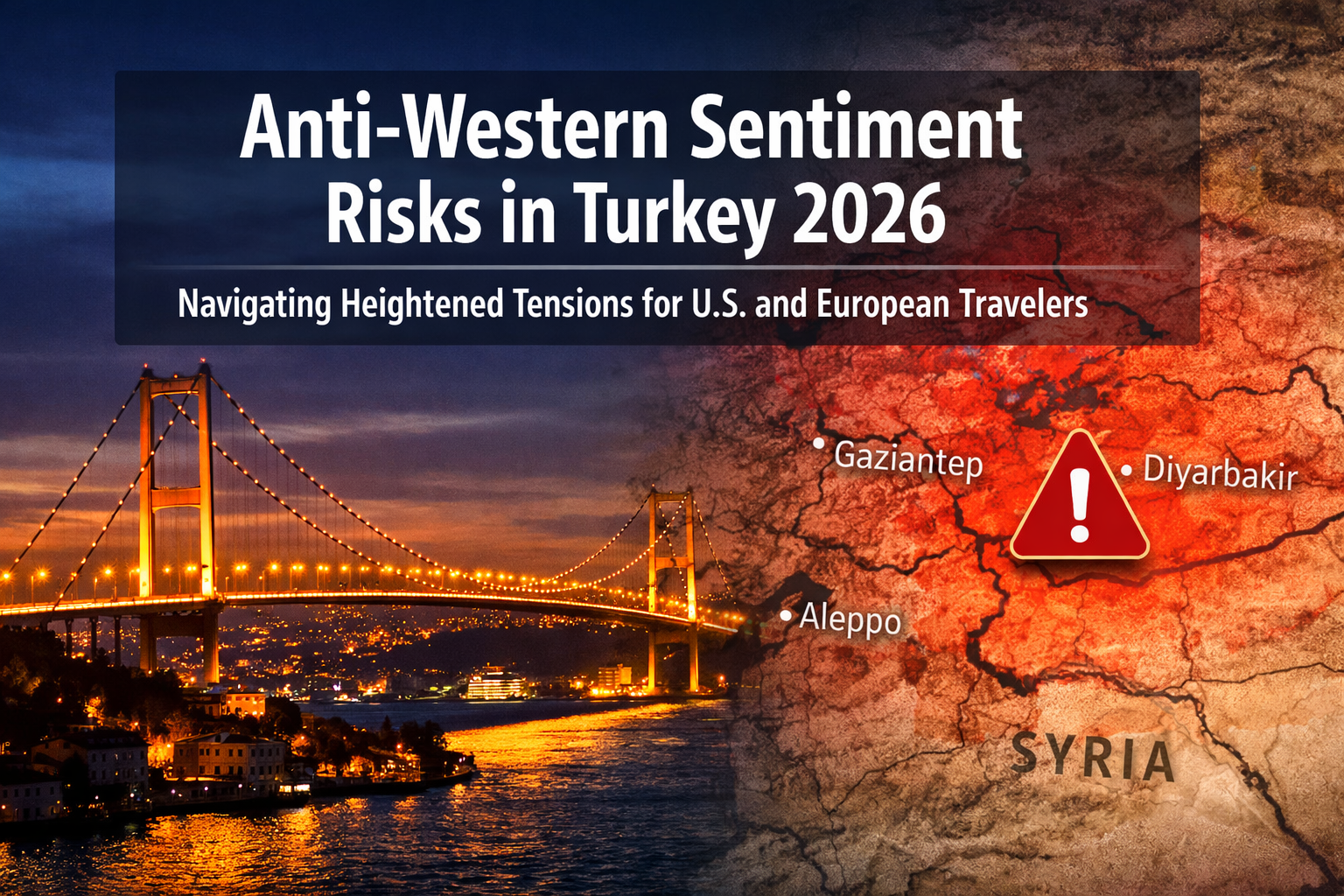

Only 18% of Turkish citizens view the United States favorably in 2026—a number that might make an American traveler’s stomach drop faster than the elevator at Istanbul’s Galata Tower [7]. But here’s the plot twist: that same survey found 56% of Turks want to join the European Union, and roughly 4,000 foreign tourists are strolling through Istanbul on any given day without incident. The reality of anti-Western sentiment risks in Turkey 2026: navigating heightened tensions for U.S. and European travelers is far more nuanced than a single statistic—or a single headline—can capture.
The truth? Turkey in 2026 is a country of contradictions. Regional conflict has pushed the U.S. State Department to issue stark warnings for southeastern provinces, Iranian ballistic missiles have entered Turkish airspace, and domestic protests periodically ripple through major cities [1]. Yet the çay is still flowing in Cappadocia’s cave hotels, the Aegean coast is still ridiculously good, and Turkish hospitality is no joke—even when geopolitics get complicated. This guide breaks down exactly where the risks are, where they aren’t, and how to travel smartly through it all.
Key Takeaways
- 🗺️ The danger is geographically concentrated. Twenty-two southeastern provinces carry a Level 4 “Do Not Travel” warning; major tourist destinations like Istanbul, Cappadocia, Antalya, and the Aegean coast remain at Level 2 [1][9].
- 🇺🇸 Anti-American sentiment is stronger than general anti-Western feeling. Only 18% of Turks view the U.S. favorably, but 46% view the EU positively [7].
- ✈️ No targeted attacks on Western tourists have occurred in 2026 so far. Protests exist but have remained largely peaceful and are not directed at visitors.
- 🛡️ Low-profile travel strategies work. Simple behavioral adjustments dramatically reduce any interpersonal friction.
- 📋 Both the U.S. and UK governments agree: the rest of Turkey outside the southeast remains open and operational for tourism.

Understanding the 2026 Threat Landscape: What’s Actually Happening
The State Department Advisory, Decoded
On April 28, 2026, the U.S. State Department updated Turkey’s Travel Advisory to Level 2: “Exercise Increased Caution,” citing terrorism, armed conflict, and arbitrary detentions [1]. Fair warning—the advisory language sounds alarming. But here’s what nobody tells you: that Level 2 rating applies to the entire country, including places like France, Germany, and the UK. It’s the geopolitical equivalent of “look both ways before crossing the street.”
The real red flags are concentrated in specific zones:
| Advisory Level | Where It Applies | What It Means |
|---|---|---|
| Level 2 – Exercise Caution | Most of Turkey (Istanbul, Antalya, Cappadocia, Izmir, Aegean/Mediterranean coasts) | Standard precautions; tourism operating normally |
| Level 3 – Reconsider Travel | Southeastern provinces (general) | Elevated risk; avoid unless essential |
| Level 4 – Do Not Travel | Within 10 km of Syrian & Iraqi borders (22 provinces) | Active conflict zone; NATO intercepting missiles [1] |
The critical context: since hostilities between the United States, Israel, and Iran on February 28, 2026, NATO air defenses have intercepted multiple Iranian ballistic missiles entering or headed toward Turkish airspace [1]. That’s serious—but it’s happening in the southeast, not in the streets of Sultanahmet.
The UK’s Foreign, Commonwealth & Development Office mirrors this assessment, advising against all travel only within 10 km of the Syrian border while keeping the rest of Turkey open.
The Roots of Anti-Western Sentiment
Here’s where things get interesting (and where a little cultural context becomes a total game-changer). Anti-Western sentiment in Turkey isn’t monolithic. A Brookings Institution analysis describes U.S.–Turkish relations as a “low-key estrangement,” noting that President Erdoğan has repeatedly leveraged anti-American rhetoric to consolidate domestic support [5]. This is political theater that shapes public attitudes—but it doesn’t automatically translate into hostility toward the American tourist asking for directions to the Grand Bazaar.
Pew Research data reveals the nuance beautifully: while only 18% of Turks view the U.S. favorably, 42% view NATO positively and 46% feel warmly toward the EU [7]. Turkish frustration is largely aimed at U.S. foreign policy—particularly regarding Israel and regional conflicts—not at individual Westerners. The distinction matters enormously for travelers.
“Turkish respondents perceive high risks in great-power conflicts involving the U.S., China, Russia, and the EU, reflecting anxiety about entanglement in broader confrontations rather than purely ideological hostility.” — Friedrich Ebert Stiftung, Security Radar 2025
Story time: seasoned travelers in Turkey consistently report that even during periods of heightened political tension, personal interactions remain warm. A shopkeeper in Izmir might passionately criticize American foreign policy over tea—and then insist on giving you a discount because you’re a guest in their country. That’s Turkey in a nutshell.
Safe Zones and Smart Strategies: Anti-Western Sentiment Risks in Turkey 2026 for U.S. and European Travelers

Where to Go (and Where to Absolutely Skip)
The secret sauce of safe Turkey travel in 2026 is geography. The vast majority of what travelers come to Turkey for—the history, the food, the coastline, the hot air balloons—sits firmly in the Level 2 zone. Here’s the breakdown:
✅ Green Light Destinations (Level 2 – Normal Tourism Operations)
- Istanbul – Still magnificent, still bustling, still serving the best Turkish coffee with centuries of cultural significance behind every cup. Protests occur but are localized and don’t target tourists [4].
- Cappadocia – Those fairy chimneys aren’t going anywhere. Balloon flights, cave hotels, and underground cities are operating normally.
- Antalya & the Turquoise Coast – Beach season is in full swing. Luxury resorts are welcoming guests as usual.
- Izmir & the Aegean Coast – Seriously underrated even in calm years, and a surprise gem for travelers wanting fewer crowds.
- Pamukkale, Ephesus, Bodrum – All operating without disruption.
🔴 No-Go Zones (Level 4)
- Anything within 10 km of the Syrian or Iraqi border
- The 22 southeastern provinces under the strictest advisory [1]
- Adana (where the U.S. has ordered non-emergency staff to depart) [1]
Low-Profile Travel in Turkey 2026: Your Practical Playbook
Pro move: the goal isn’t to hide who you are—it’s to be a respectful, culturally aware guest. Here are strategies that experienced Turkey travelers swear by:
🎒 What to Wear & Carry
- Skip clothing with prominent American flags, military branding, or political slogans
- When visiting religious sites, follow proper etiquette—this earns enormous respect
- Carry a photocopy of your passport rather than the original (reduces risk if detained)
🗣️ Communication Tips
- Learn a few Turkish phrases—merhaba (hello), teşekkür ederim (thank you), çok güzel (very beautiful). Prepare to be obsessed with how much doors this opens
- Avoid initiating political conversations, especially about U.S.-Israel relations or Kurdish issues
- If politics comes up (and it might—Turks love a good debate), listen more than you speak. A simple “I understand your perspective” goes a long way
📱 Digital Safety
- Register with the U.S. State Department’s STEP program (Smart Traveler Enrollment Program) or your country’s equivalent
- Download offline maps—useful if protests disrupt mobile networks
- Keep embassy contact numbers saved: U.S. Embassy Istanbul (+90 212 335 9000)
🚶 On-the-Ground Awareness
- Avoid large demonstrations—even peaceful ones can shift quickly. The June 2026 Istanbul protests disrupted metro stations and streets [4]
- Stay clear of government buildings during politically sensitive periods
- Bookmark this tip: hotel concierges are your best real-time intelligence source. They know which neighborhoods to avoid on any given day
Navigating Protests and Demonstrations
The 2025–2026 Turkish protests have been a feature of the political landscape, linked to domestic politics and regional issues [4]. Here’s what travelers need to know:
- Protests have remained largely peaceful and are not targeting tourists
- They can cause transport disruptions (metro closures, street blockages)
- Industry sources report only a 5–10% slowdown in Istanbul tourism demand—not a collapse
- About 4,000 foreign tourists remain in Istanbul at any given time without mass cancellations
The honest-with-humor take? Protests in Istanbul are about as likely to affect your Hagia Sophia visit as a subway delay in New York is to ruin your Broadway show. Annoying? Possibly. Dangerous? Almost certainly not—if you keep your distance.
Practical Preparation: Anti-Western Sentiment Risks in Turkey 2026 and How Travelers Can Stay Safe

Before You Go: The Pre-Trip Checklist
Consider this your sign to get organized before wheels-up:
- 📋 Check visa requirements – Turkey’s visa-free travel policies have expanded, but verify your nationality’s status
- 🏥 Know the healthcare system – Navigating Turkish healthcare as a traveler is essential reading, especially given that arbitrary detentions (however rare) could complicate insurance claims [1]
- 💰 Get travel insurance that explicitly covers civil unrest and political evacuation
- 🗓️ Monitor advisories weekly – Situations evolve; the April 2026 advisory replaced a March version [1][6]
- 📞 Share your itinerary with someone at home, including hotel addresses and flight numbers
Understanding Arbitrary Detention Risks
Here’s a topic that deserves straight talk. The State Department advisory specifically mentions arbitrary detentions as a risk in Turkey [1]. Freedom House continues to classify Turkey as “Not Free,” citing politicized courts and broad anti-terror laws. What does this mean practically?
- Dual nationals (especially Turkish-American or Turkish-European citizens) face higher risk
- Social media posts critical of the Turkish government—even old ones—have led to detentions
- Journalists, academics, and activists face elevated scrutiny
- For the average tourist visiting Turkey’s bazaars and beaches, the risk is minimal but not zero
Steal this tip: Before traveling, review your social media accounts for any posts that could be interpreted as critical of Turkey’s government or supportive of organizations Turkey considers terrorist groups. Future you will thank us.
The Bigger Picture: Turkey Still Wants Your Visit
Here’s the magic that often gets lost in advisory language: Turkey’s tourism industry is a $50+ billion economic engine, and the country is actively courting Western visitors. The disconnect between political rhetoric and economic reality creates a protective buffer for travelers. Hotel staff, tour operators, restaurant owners, and taxi drivers have a vested interest in making sure visitors feel welcome—and they deliver on that promise daily.
Turkey’s historical rivalries and friendships with Western nations are complex, stretching back centuries. The current tensions are real but exist alongside genuine warmth toward individual visitors. Understanding the role of family in Turkish society helps explain why: hospitality isn’t just a nicety in Turkey—it’s a deeply held cultural value that transcends politics.
Conclusion
Anti-Western sentiment risks in Turkey 2026 are real—but they’re also specific, geographically concentrated, and manageable with preparation. The southeastern border region is genuinely dangerous, and no sunset photo is worth ignoring a Level 4 advisory. But Istanbul’s spice markets, Cappadocia’s dawn balloon flights, the Aegean’s turquoise coves, and Antalya’s ancient ruins? They’re open, they’re operating, and they’re absolutely worth it.
Your actionable next steps:
- Check the latest advisories from both the U.S. State Department [1] and your country’s foreign office before booking
- Build your itinerary around Level 2 zones—which conveniently include every major tourist destination
- Register with STEP (or equivalent) and download offline maps
- Pack cultural awareness alongside your sunscreen—learn basic Turkish phrases, respect local customs, and leave the political debate T-shirts at home
- Travel with confidence, not complacency—stay informed, stay flexible, and trust that Turkish hospitality will meet you more than halfway
Turkey in 2026 isn’t a country to fear. It’s a country to approach with open eyes, a prepared mind, and—chef’s kiss—an empty stomach ready for the best meal of your life. 🇹🇷
References
[1] Travel Advisory Turkiye April 2026 – https://tr.usembassy.gov/travel-advisory-turkiye-april-2026/ [4] 2025–2026 Turkish Protests – https://en.wikipedia.org/wiki/2025%E2%80%932026_Turkish_protests [5] Sustainable Estrangement Embracing The New Normal In Us Turkish Relations – https://www.brookings.edu/articles/sustainable-estrangement-embracing-the-new-normal-in-us-turkish-relations/ [6] Us Warns Travelers To Exercise Increased Caution While Visiting This Popular Country – https://www.nj.com/news/2026/03/us-warns-travelers-to-exercise-increased-caution-while-visiting-this-popular-country.html [7] How People In Turkey View International Affairs – https://www.pewresearch.org/global/2024/10/16/how-people-in-turkey-view-international-affairs/ [9] Turkey Travel Advisory Update 11928333 – https://www.travelandleisure.com/turkey-travel-advisory-update-11928333
Related Turkey safety guides: For a broader, less headline-driven view of regional risk, see our Turkey safety guide for 2026, best time to visit Turkey guide, and 7-day Turkey itinerary.