

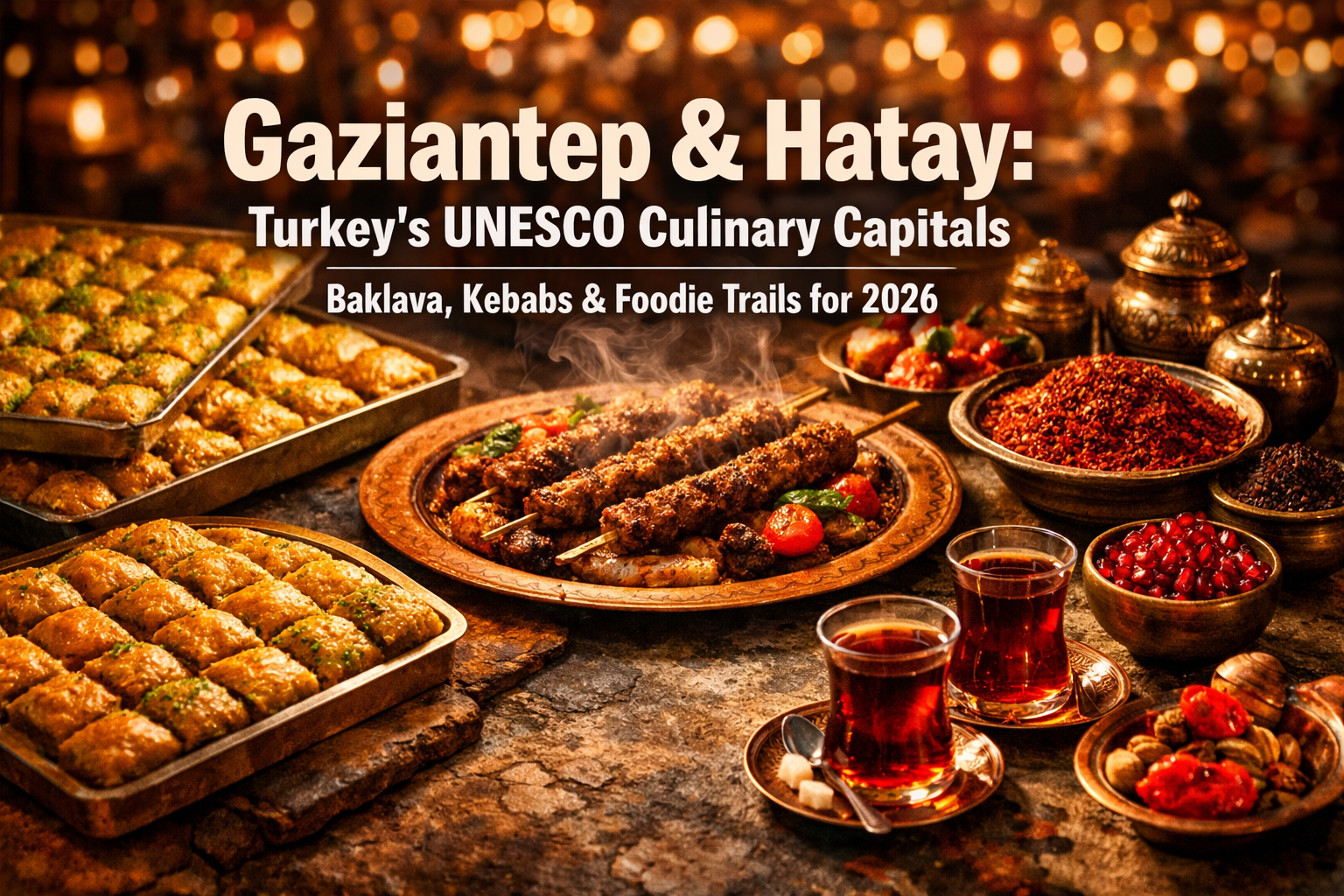

Gaziantep baklava has earned its place among the world’s most celebrated pastries, drawing food lovers to Turkey’s southern culinary heartland. Close your eyes for a second. Imagine the sound of a copper tray sliding across a marble counter, the scent of roasted pistachios so intense it practically grabs you by the collar, and a vendor pressing a warm, syrup-drenched triangle of baklava into your hand before you've even asked for it. That's Gaziantep on a Tuesday morning. Now shift the scene: a charcoal grill hisses in a stone-walled restaurant, lamb fat drips onto glowing embers, and someone places a bowl of brick-red muhammara beside you that's so ridiculously good, you briefly consider canceling the rest of your itinerary and just… staying.
Welcome to southeastern Turkey, where Gaziantep and Hatay: Turkey's UNESCO Culinary Capitals – Baklava, Kebabs, and Foodie Trails for 2026 aren't just a marketing tagline—they're a way of life. These two cities earned their UNESCO Creative Cities of Gastronomy status (Gaziantep in 2015, Hatay in 2017), and in 2026, they're doubling down with new digital tools, expanded certification programs, and food festivals that make even Lyon look over its shoulder. For food lovers who want to skip the crowded coastal resorts and dive fork-first into something authentic? Consider this your sign.
Key Takeaways 📋
- Gaziantep boasts over 30 types of baklava and launched a new "Baklava Trail" app in January 2026, mapping 50+ workshops for visitors.
- Hatay expanded its kebab certification program in February 2026, standardizing 12 traditional kebab varieties—a total game-changer for culinary authenticity.
- Hatay welcomed 1.2 million food tourists in 2025, an 18% jump, with average per-person spending of $150 on food experiences alone.
- Both cities offer UNESCO-backed foodie trails that rival Italy's most famous food routes, at a fraction of the price.
- 2026 food festivals and cultural events make this the perfect year to visit, especially for travelers seeking substance over selfie spots.
Why Gaziantep and Hatay Are Turkey's UNESCO Culinary Capitals in 2026

Here's what nobody tells you about Turkey's food scene: the real magic doesn't happen in Istanbul's trendy restaurants or Antalya's all-inclusive buffets. It happens 1,200 kilometers to the southeast, where the Silk Road once funneled spices, techniques, and flavors from Aleppo, Persia, and Mesopotamia into kitchens that haven't changed their recipes in centuries. The historical trade routes through Turkey shaped these cuisines in ways that are still visible—and tasteable—today.
The UNESCO Factor: More Than a Badge
When UNESCO designated Gaziantep as a Creative City of Gastronomy in 2015, it wasn't handing out participation trophies. The city had to demonstrate a thriving food culture, local ingredients of distinction, traditional food markets, and culinary education programs. Hatay followed in 2017, bringing its own extraordinary blend of Arab, Turkish, and Mediterranean influences to the table.
Plot twist: this recognition has had measurable economic impact. According to TÜRSAB (Turkey's Travel Agencies Association), Hatay's UNESCO status drives 20% more visitors than comparable food cities like San Sebastián in Spain. Gaziantep produced 200 tons of baklava in 2025 alone—up 12% from the year before—and leads with over 1,200 certified food varieties compared to Hatay's 800.
🗣️ "Gaziantep's baklava diversity—over 30 types—positions it as Turkey's top culinary exporter. We're predicting 15% growth in 2026."
— Dr. Elif Bilici, Gastronomy Expert (February 2026)
Some critics argue that UNESCO status inflates prices without improving quality. Fair point—Gaziantep baklava runs $5–8 per kilogram, about 22% above the national average. But research from Turkey's Food Institute suggests the global recognition justifies an 18% premium compared to non-UNESCO cities. And honestly? After tasting a 40-layer pistachio baklava made by a fourth-generation usta (master baker), the price debate evaporates faster than phyllo dough in a hot oven.
What's New for 2026
Turkey's Culture Ministry kicked off the year by spotlighting 2026 food festivals across both cities. Here's a quick look at what's fresh:
| Development | Date | Details |
|---|---|---|
| Culture Ministry festival promotion | January 10, 2026 | Highlighted upcoming food festivals across Gaziantep and Hatay |
| Baklava Trail App launch | January 25, 2026 | Digital map of 50+ workshops; aims to boost winter tourism |
| Hatay Kebab Certification expansion | February 5, 2026 | 12 traditional varieties standardized for domestic and export markets |
The Baklava Trail app, in particular, is a pro move for travelers. It maps workshops, provides historical context, and even lets you book hands-on sessions. If you're the type who enjoys cooking classes in Turkey, this is going to be your new favorite tool.
Gaziantep's Baklava Mastery: A Deep Dive Into Turkey's Sweetest Obsession

Let's get nerdy for a moment—in the most delicious way possible.
The Anatomy of Gaziantep Baklava
Gaziantep baklava isn't just "baklava." Saying that is like calling a Stradivarius "a violin." The city's version is defined by a few non-negotiable elements:
- Antep fıstığı (Antep pistachios): Grown in the surrounding countryside, these pistachios are smaller, more intensely green, and more flavorful than any you've had before. They're the secret sauce—literally.
- Paper-thin phyllo: A master baker (baklava ustası) rolls dough so thin you can read a newspaper through it. We're talking 40+ layers in a single tray.
- Şerbet (syrup): Not honey (that's a common misconception). Gaziantep baklava uses a sugar-and-water syrup infused with a squeeze of lemon, poured hot over cool pastry—or cool over hot pastry, depending on the workshop's tradition.
30+ Varieties: Yes, Really
Here's where it gets wild. Most people think of baklava as one thing. In Gaziantep, there are over 30 documented varieties, including:
- Fıstıklı baklava – The classic pistachio version (the one that made the city famous)
- Şöbiyet – Cream-filled, slightly puffier, absolutely worth a detour
- Bülbül yuvası – "Nightingale's nest," a rolled version that's as pretty as it sounds
- Havuç dilimi – "Carrot slice," cut into elongated triangles
- Kuru baklava – A drier version with less syrup, perfect for gifting (and sneaking into your suitcase)
- Sütlü Nuriye – A lighter, milk-soaked cousin that's seriously underrated
Steal this tip: When visiting a baklava workshop, ask for a tadım (tasting). Most places will let you sample 3–4 varieties before buying. The third café on the left side of Gaziantep's Bakırcılar Çarşısı (Coppersmith's Bazaar)? That one makes the difference. Trust us on this.
The Baklava Trail App: Your 2026 Digital Guide
Launched on January 25, 2026, the Baklava Trail app is Gaziantep's answer to post-earthquake recovery tourism efforts. It maps over 50 workshops, bakeries, and pistachio farms across the city, complete with:
- 📍 GPS-guided walking routes
- 🎥 Video profiles of master bakers
- 📅 Workshop booking integration
- 🌍 Multilingual support (Turkish, English, Arabic, German)
The app is part of a broader push to attract winter visitors—because here's the magic: Gaziantep in January and February is quieter, cooler, and the baklava is arguably better (lower humidity means crispier layers). Future you will thank us for that nugget.
Beyond Baklava: Gaziantep's Broader Food Scene
Don't let the baklava fame fool you—Gaziantep's savory game is equally staggering. The city claims over 500 distinct dishes in its culinary repertoire. Some highlights:
- Beyran çorbası – A fiery lamb-and-garlic soup eaten for breakfast (yes, breakfast). It's Turkey's answer to a hangover cure, and it works.
- Lahmacun – Thin, crispy flatbread topped with spiced minced meat. Gaziantep's version is thinner and more intensely seasoned than anywhere else.
- Yuvalama – Tiny meatballs in a chickpea-and-yogurt broth. Comfort food elevated to art.
- Ali Nazik kebab – Smoky eggplant purée topped with sautéed lamb. Chef's kiss. 🤌
If you're exploring Turkey's broader food landscape, the culinary journey through Turkey's Aegean Region offers a fascinating contrast—olive oil and seafood versus Gaziantep's butter-and-pistachio intensity.
Hatay's Kebab Kingdom and the Muhammara-Hummus Scene

Now let's head south to Hatay (ancient Antioch), where the food gets bolder, the spices get louder, and the cultural influences multiply like mezes on a dinner table.
The Kebab Certification Program: 12 Varieties, One Standard
In February 2026, Hatay announced an expanded kebab certification program that standardizes 12 traditional kebab varieties. This came after EU food safety discussions and is designed to protect authenticity both domestically and for export. Here are some of the certified stars:
| Kebab Variety | Key Characteristics | Spice Level 🌶️ |
|---|---|---|
| Kağıt kebabı | Lamb wrapped in parchment, slow-cooked | Mild |
| Oruk | Bulgur-coated meat balls, deep-fried | Medium |
| Tepsi kebabı | Tray-baked lamb with vegetables | Medium |
| Kâğıtta tavuk | Chicken in paper, herb-infused | Mild |
| Süzme köfte | Hand-pressed meatballs in tomato sauce | Medium-Hot |
| Alinazik | Smoky eggplant base with grilled meat | Medium |
Fair warning: Hatay's flavor profile is noticeably bolder than what you'll find in western Turkey. The Arab and Levantine influences bring cumin, Aleppo pepper (pul biber), and sumac into heavy rotation. If you prefer milder flavors, Konya's etliekmek might be more your speed—surveys suggest about 25% of Turkish food tourists lean that direction. But if you want flavor that tells a 2,000-year story? Hatay is where you need to be.
Muhammara and Hummus: Hatay's Unsung Heroes
Here's the thing about Hatay that even seasoned Turkey travelers miss: the meze culture here is on another level entirely. While Istanbul restaurants serve decent hummus, Hatay's version—made with local tahini, a generous pour of olive oil, and a whisper of cumin—is a completely different experience.
And then there's muhammara. This walnut-and-red-pepper dip, tangy with pomegranate molasses, is Hatay's gift to the culinary world. You'll find it at virtually every table, scooped up with fresh flatbread that's still warm from the tandır (clay oven).
Prepare to be obsessed with these meze staples:
- 🫒 Hummus – Creamier and more tahini-forward than Lebanese versions
- 🌶️ Muhammara – Smoky, sweet, tangy, nutty—all at once
- 🥒 Zahter salatası – Wild thyme salad with olive oil and lemon
- 🧀 Süzme yoğurt – Strained yogurt with herbs, drizzled with local olive oil
- 🍋 Biberli ekmek – Pepper-studded bread that's ridiculously good on its own
For travelers interested in distinguishing authentic Turkish cuisine from imitations, Hatay is essentially a masterclass. The flavors here can't be faked.
Künefe: Hatay's Dessert Crown Jewel
If Gaziantep owns baklava, Hatay owns künefe—a warm, cheese-filled pastry made with shredded kadayıf dough, soaked in syrup, and topped with crushed pistachios. At $4–6 per serving, it's one of the best dessert deals in the Mediterranean world. The cheese (Hatay peyniri) stretches in that impossibly satisfying way, and the contrast between the crispy exterior and molten interior is… well, it's a total game-changer.
Bookmark this: The best künefe in Hatay is served at small, family-run shops in the Uzun Çarşı (Long Bazaar) district. Look for places where locals are lining up. Turkish hospitality is no joke—you'll likely be offered tea while you wait.
Foodie Trails for 2026: Planning Your Culinary Adventure
Ready to turn all this food knowledge into an actual trip? Here's the practical stuff, wrapped in just enough enthusiasm to keep things fun.
The Gaziantep-Hatay Food Trail: A Suggested 5-Day Itinerary
Day 1–2: Gaziantep
- Morning: Beyran soup breakfast at the Bakırcılar Çarşısı area
- Mid-morning: Baklava Trail app walking tour (3–4 workshops)
- Lunch: Lahmacun and Ali Nazik at a local ocakbaşı (grill restaurant)
- Afternoon: Zeugma Mosaic Museum (because even food lovers need a culture break—and these mosaics are a surprise gem among Turkey's archaeological discoveries)
- Evening: Full Gaziantep meze dinner with yuvalama
Day 3: Transit Day (Gaziantep → Hatay)
- The drive takes about 3–4 hours. Stop in İslahiye for roadside tantuni (spiced beef wraps). Alternatively, check transport options for rural Turkey to plan your route.
Day 4–5: Hatay
- Morning: Explore Antakya's Uzun Çarşı for spices, soaps, and street food
- Late morning: Muhammara and hummus tasting at a traditional lokanta
- Lunch: Certified kebab experience (try at least 3 varieties)
- Afternoon: Visit the Hatay Archaeology Museum and St. Pierre Church
- Evening: Künefe crawl through the old city (yes, that's a thing, and it's absolutely worth it)
Budget Breakdown (February 2026 Prices)
| Item | Gaziantep | Hatay |
|---|---|---|
| Baklava (per kg) | $5–8 | $6–9 |
| Kebab meal | $8–15 | $7–12 |
| Künefe (per serving) | $4–5 | $4–6 |
| Full meze dinner | $15–25 | $12–20 |
| Cooking workshop | $30–50 | $25–40 |
| Daily food budget (comfortable) | $40–60 | $35–50 |
Compared to Lyon, France—often cited as Europe's food capital—where average food tourist spending hits $220 per person, Hatay's $150 average is a steal. You get UNESCO-level cuisine at emerging-destination prices.
Festivals and Events to Watch in 2026
Turkey's Culture Ministry has been actively promoting food festivals throughout 2026. While specific dates shift, here's what to plan around:
- Gaziantep International Gastronomy Festival (typically September/October)
- Hatay Gastronomy Days (usually late spring)
- Pistachio Harvest Festival in Gaziantep's surrounding villages (August–September)
- Ramadan food events in both cities—experiencing Ramadan customs and festivities in Turkey adds an entirely different dimension to the culinary journey
Practical Tips for the Food Trail
- Learn a few phrases. "Çok güzel" (very beautiful/delicious) and "Elinize sağlık" (health to your hands—a compliment to the cook) will earn you extra portions and enormous smiles. For more on navigating communication, check out tips on dealing with language barriers in Turkey.
- Go early. The best baklava workshops start production at dawn. Watching the process at 7 AM, when the dough is being rolled and the ovens are firing up, is an experience no afternoon visit can match.
- Pace yourself. This is not a sprint. Hatay alone has enough meze varieties to fill a week. Build in walking time between meals—your stomach (and your Instagram feed) will thank you.
- Respect the craft. These aren't tourist attractions performing for cameras. Many workshops have been family-run for generations. Ask before photographing, and always buy something if you've taken someone's time.
The Adana Question: Friendly Rivalry
No article about southeastern Turkish kebabs would be complete without mentioning Adana, which hosts its own annual Adana Kebap Festival (running since 2018) and claims higher spice authenticity. Here's the honest take: Adana's kebab is a magnificent thing—longer, spicier, and served with a swagger that matches its reputation. Gaziantep's kebabs tend to run about 10% pricier but carry the UNESCO backing. Hatay's are more diverse in variety.
The real pro move? Visit all three. They're within a few hours of each other, and the regional differences are a masterclass in how geography, culture, and climate shape flavor. Think of it as Turkey's answer to the barbecue trail through the American South—except with more history and better bread.
Conclusion: Your 2026 Culinary Adventure Starts Here
Gaziantep and Hatay: Turkey's UNESCO Culinary Capitals – Baklava, Kebabs, and Foodie Trails for 2026 represent something rare in the travel world: destinations where the food isn't just a highlight of the trip—it is the trip. From Gaziantep's 40-layer pistachio baklava to Hatay's certified kebab varieties and its soul-warming muhammara, these cities deliver flavors that no Michelin-starred restaurant in a capital city can replicate. Because the recipes were perfected here, in these kitchens, over centuries.
Here are your next steps:
- Download the Baklava Trail app (launched January 2026) and start mapping your Gaziantep workshop visits.
- Book a cooking class in either city—hands-on learning is the fastest way to understand these cuisines.
- Plan around festivals—check Turkey's Culture Ministry announcements for 2026 dates.
- Budget smart—at $35–60 per day for food, this is one of the most affordable UNESCO culinary destinations on the planet.
- Read up on Turkish dining etiquette so you can fully immerse yourself in the experience.
The baklava is waiting. The kebabs are sizzling. And somewhere in Hatay's old bazaar, a vendor is about to hand you a piece of künefe that will rearrange your entire understanding of dessert.
Go. Eat. Come back changed. 🇹🇷✨
Frequently Asked Questions
How many types of Gaziantep baklava are there, and what makes each one different?
Gaziantep boasts over 30 varieties of baklava, each with distinct flavor profiles, nut selections, and syrup preparations. The differences range from the type of pistachio used to the thickness of the phyllo layers and the intensity of the honey or sugar syrup. The new Baklava Trail app launched in January 2026 maps 50+ workshops where you can see these variations firsthand and taste your way through the city’s baklava heritage.
Is there a digital guide to help me find the best Gaziantep baklava workshops?
Yes! Gaziantep launched the Baklava Trail app in January 2026, which maps 50+ baklava workshops across the city and guides you through the region’s sweetest obsession. The app includes details on each workshop’s specialties, opening hours, and artisan stories, making it easy to plan your baklava-focused itinerary without any guesswork.
How much should I budget for food experiences in Hatay and Gaziantep?
According to 2025 data, visitors to Hatay spent an average of $150 per person on food experiences alone, giving you a solid benchmark for budgeting. Both cities offer UNESCO-backed foodie trails at a fraction of the cost of Italy’s famous food routes, so you can enjoy world-class culinary experiences without breaking the bank. The article includes a detailed budget breakdown for February 2026 prices to help you plan accordingly.
What major food events and festivals should I plan my 2026 visit around?
2026 is the perfect year to visit because both Gaziantep and Hatay are hosting expanded food festivals and cultural events backed by their UNESCO status. The article details specific festivals and events to watch throughout 2026, making this an ideal time to experience these culinary capitals at their most vibrant. These events offer deeper cultural immersion beyond typical tourist experiences.