

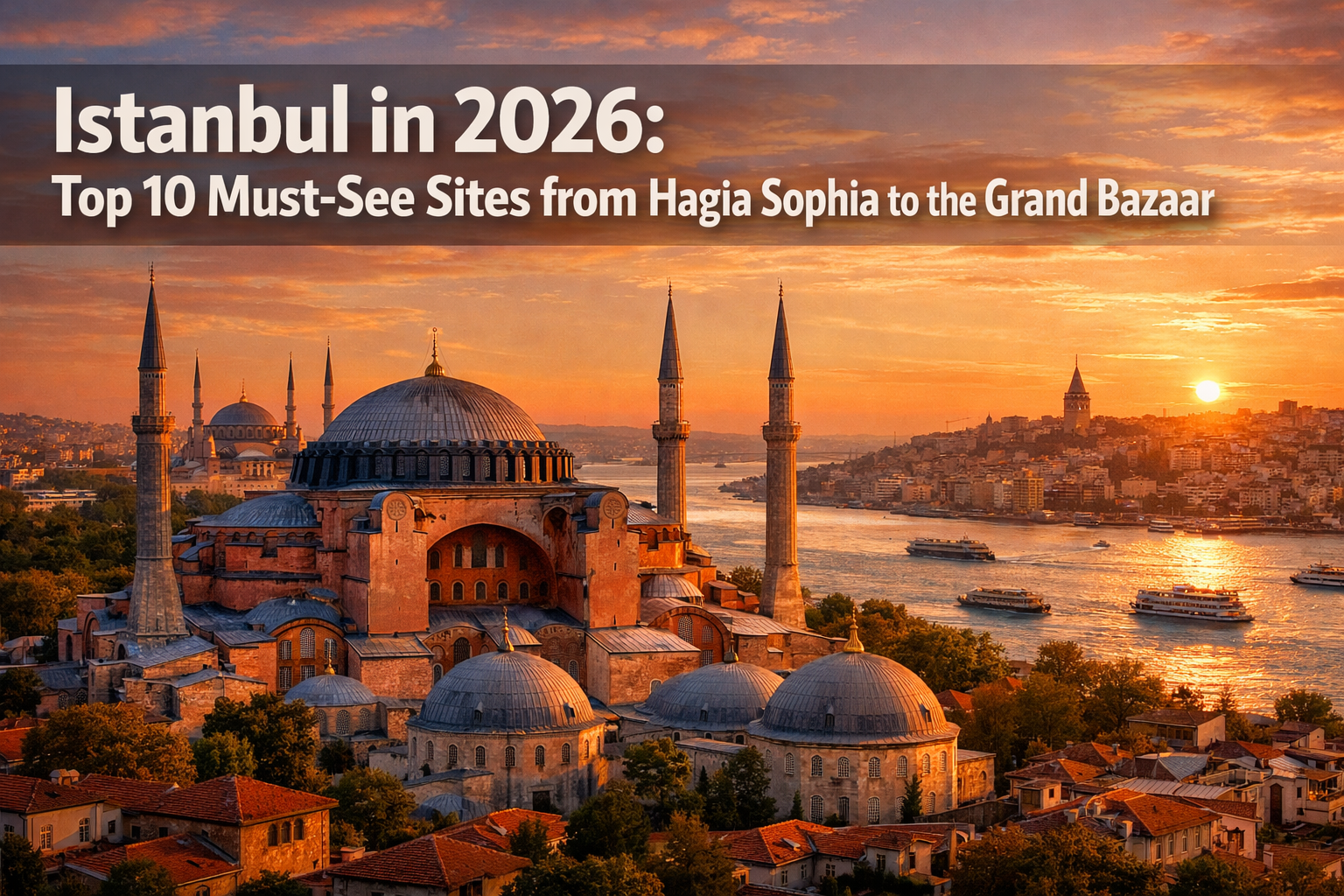

Quick Answer: Istanbul’s top 10 must-see sites in 2026 include Hagia Sophia, the Grand Bazaar, Topkapi Palace, the Basilica Cistern, the Blue Mosque, Galata Tower, a Bosphorus cruise, Istanbul Modern, Dolmabahce Palace, and the Spice Bazaar. Most major attractions now stay open until 22:00, which gives visitors real flexibility to avoid midday crowds. Spring (April to May) and fall (September to October) are the best times to visit for comfortable weather and manageable tourism levels.
Key Takeaways
- Hagia Sophia is free to enter and open daily from 9:00 to 22:00 (last entry 21:00). Non-Muslims are welcome outside of prayer times.
- The Grand Bazaar covers 61 streets and more than 4,000 shops. Plan at least 2 to 3 hours, go early, and expect to haggle.
- Most major Istanbul attractions, including Topkapi Palace, Basilica Cistern, and Galata Tower, now open on January 1st, expanding year-round access.
- Istanbul is generally safe for tourists in 2026, though standard urban precautions apply, especially in crowded bazaars.
- A minimum of 4 days is recommended to cover the top sites without rushing. Five to six days allows for day trips and deeper neighborhood exploration.
- The Blue Mosque and Hagia Sophia are both in Sultanahmet and look similar from outside, but serve completely different historical and architectural purposes.
- The T1 tram line connects most major sites in the historic peninsula. Ferries are the best way to cross to the Asian side.
- Istanbul was named Europe’s most desirable destination heading into 2026, which means crowds are real. Timing your visits matters.
- Hidden gems worth adding to any itinerary include the Chora Church (Kariye Mosque), Balat neighborhood, and the Pierre Loti Hill viewpoint.
- Checking a solid Turkey itinerary before you arrive saves significant time and reduces decision fatigue on the ground.
What Is Hagia Sophia and Why Is It Important?
Hagia Sophia is a 6th-century architectural landmark in Istanbul’s Sultanahmet district that has functioned as a Byzantine cathedral, an Ottoman mosque, a secular museum, and an active mosque again since 2020. It ranks as Istanbul’s single most visited attraction, and for good reason: nowhere else on earth can you stand beneath a dome completed in 537 AD and look up at both Christian mosaics and Islamic calligraphy sharing the same walls.
The building was commissioned by Byzantine Emperor Justinian I and completed in just five years, a construction feat that still impresses engineers today. Its central dome spans roughly 31 meters in diameter and sits 55 meters above the floor, creating the illusion that it floats. When the Ottomans converted it to a mosque in 1453, they added four minarets and covered many of the Christian mosaics with plaster, which actually helped preserve them. Today, those mosaics depicting Jesus, Mary, and Byzantine emperors have been partially restored and are visible again alongside massive Arabic calligraphy medallions.
Why it matters beyond the architecture:
- It represents one of the longest continuously used religious buildings in history, spanning nearly 1,500 years.
- The building directly influenced the design of Ottoman mosques across Istanbul and the wider empire.
- Its conversion back to a mosque in 2020 sparked international debate about cultural heritage, making it a living symbol of ongoing historical tensions.
- According to Tripadvisor’s 2026 Istanbul rankings, it consistently holds the top spot among the city’s historical landmarks.
How Much Does It Cost to Visit Hagia Sophia?
Hagia Sophia is free to enter. There is no admission fee for any visitor, regardless of nationality or religion. The only cost is your time and, if you’re visiting during summer, your patience with the queues.
Hours in 2026 are 9:00 to 22:00 daily, with last entry at 21:00. The extended evening hours are relatively new and genuinely useful for avoiding the worst of the daytime crowds. Visiting between 4:00 PM and 6:00 PM on a weekday currently offers the best balance of natural light and manageable visitor numbers.
Practical entry details:
- No ticket needed. Walk in through the main entrance on Sultanahmet Square.
- Modest dress is required. Women need a headscarf; everyone must cover shoulders and knees. Free cover-ups are available at the entrance if needed.
- Shoes must be removed before entering the prayer hall.
- Photography is permitted in most areas, but be respectful during prayer times.
- Prayer times occur five times daily and last roughly 30 to 45 minutes. During these windows, the interior is closed to non-worshippers.
Can You Visit Hagia Sophia If You’re Not Muslim?
Yes, Hagia Sophia welcomes visitors of all faiths and backgrounds. It functions as an active mosque but has maintained open access for tourists since its reconversion in 2020. The key requirement is respecting the dress code and avoiding the interior during the five daily prayer times.
The prayer schedule shifts daily based on sunrise and sunset, so check the current times before you visit. Most travel apps and the official Turkish Diyanet website list accurate prayer times for Istanbul. If you arrive and prayers are underway, the wait is typically under 45 minutes, and the area around Sultanahmet Square has plenty of spots to sit and watch the neighborhood while you wait.
What’s the Difference Between Hagia Sophia and the Blue Mosque?
Hagia Sophia and the Blue Mosque are two distinct buildings located about 400 meters apart in Sultanahmet. They are often confused by first-time visitors because both feature large domes and minarets, and both are visible from the same park.
Here’s how they differ:
| Feature | Hagia Sophia | Blue Mosque (Sultanahmet Camii) |
|---|---|---|
| Built | 537 AD (Byzantine) | 1616 AD (Ottoman) |
| Original purpose | Christian cathedral | Mosque |
| Minarets | 4 | 6 (unusual, most have 4) |
| Interior highlight | Byzantine mosaics + Islamic calligraphy | 20,000+ blue Iznik ceramic tiles |
| Admission | Free | Free |
| Current use | Active mosque | Active mosque |
| Capacity | Approx. 10,000 | Approx. 10,000 |
The Blue Mosque gets its nickname from the handmade Iznik tiles that cover the interior walls in shades of blue and turquoise. It also has 200 stained glass windows that create a dramatically different atmosphere from Hagia Sophia’s more austere grandeur. Both are worth visiting, and since they’re a short walk apart, most visitors do both in the same morning or afternoon.
Common mistake: Tourists sometimes skip the Blue Mosque assuming it’s redundant after Hagia Sophia. The interiors feel completely different. Hagia Sophia is overwhelming in scale; the Blue Mosque feels more cohesive and ornate. Visit both.
Best Time to Visit Istanbul in 2026
The best times to visit Istanbul in 2026 are April to May and September to October. These shoulder seasons offer mild temperatures (roughly 15 to 22 degrees Celsius), fewer crowds than peak summer, and lower hotel prices.
Summer (June to August) is the busiest period. Temperatures regularly exceed 30 degrees Celsius, queues at major sites stretch significantly longer, and accommodation costs peak. If summer is your only option, arrive at attractions right at opening time and plan indoor or water-based activities for midday.
Winter (November to March) is genuinely underrated. Visitor numbers drop sharply, prices fall, and the city takes on a quieter, more local character. The main trade-off is cooler, sometimes rainy weather. But if you’re primarily interested in museums, bazaars, and food, winter works well. Istanbul’s Tulip Festival in April is also worth timing a trip around, with millions of tulips blooming across the city’s parks.
By time of day:
- Early morning (9:00 to 11:00): Best for Hagia Sophia, Topkapi Palace, and the Basilica Cistern before tour groups arrive.
- Late afternoon (16:00 to 18:00): Good for Galata Tower views and the Grand Bazaar’s final shopping hours.
- Evening (19:00 to 22:00): Extended hours at Hagia Sophia and the Basilica Cistern mean genuinely uncrowded visits with atmospheric lighting.
Are There Crowds at Istanbul Attractions in 2026?
Yes, crowds are a real factor at Istanbul’s top sites in 2026. The city attracted record tourism numbers heading into this year, and popular sites like Hagia Sophia, Topkapi Palace, and the Grand Bazaar can feel genuinely overwhelming during peak hours in summer.
That said, the situation is manageable with basic planning. According to GetYourGuide’s 2026 Istanbul activity data, guided early-morning tours sell out weeks in advance during July and August, which gives you a sense of demand levels. The extended evening hours at several major sites have meaningfully distributed visitor flow throughout the day.
Practical crowd-avoidance strategies:
- Book timed-entry tickets for Topkapi Palace and the Basilica Cistern in advance. Walk-up queues during summer can exceed 90 minutes.
- Visit the Grand Bazaar on a Tuesday or Wednesday morning. Weekends and Mondays are noticeably busier.
- The Blue Mosque is free and has no ticketing system, so crowds are unpredictable. Aim for weekday mornings or after 18:00.
- Hagia Sophia’s 22:00 closing time is underused by tourists. An 8:00 PM visit in summer is genuinely quiet compared to midday.
Grand Bazaar Istanbul: What to Expect and How Long to Spend
The Grand Bazaar (Kapali Carsi) is one of the world’s oldest and largest covered markets, with 61 covered streets, more than 4,000 shops, and a history stretching back to 1461. Expect a sensory overload of carpets, ceramics, jewelry, leather goods, spices, and textiles packed into a maze of vaulted corridors.
Plan to spend at least 2 to 3 hours. Serious shoppers or anyone who enjoys getting genuinely lost in a market could easily spend half a day. The bazaar is open Monday to Saturday, 8:30 to 19:00, and closed Sundays and religious holidays.