


Last updated: May 1, 2026
Quick Answer
Eastern Turkey is the country’s least-visited yet most rewarding region for travelers seeking ancient ruins, dramatic landscapes, and authentic cultural encounters without crowds. Van, Kars, and the ghost city of Ani form the core triangle of any eastern itinerary, and 2026 is an excellent year to visit thanks to improved domestic flight connections and new boutique accommodations. Budget roughly 7-10 days, expect to spend 40-60% less than western Turkey, and prepare for hospitality so intense you might gain five kilos.
Key Takeaways
- Best time to visit: June through September for warmth and accessibility; January-February for dramatic snow landscapes in Kars (but some roads close)
- Getting there: Direct flights from Istanbul to Van (2 hours) and Kars (2.5 hours) via Turkish Airlines and AnadoluJet run daily in 2026
- Budget: Expect $30-60/day including accommodation, meals, and local transport
- Ani ruins are a UNESCO World Heritage Site and require a full half-day minimum
- Lake Van is the largest lake in Turkey (3,755 km²) and one of the world’s few alkaline lakes
- Safety: The region is stable for tourism in 2026; standard travel precautions apply (check our safety guide for adventure travel for specifics)
- Language: English is rare outside hotels; learn 20 Turkish phrases and you’ll be treated like family
- Turkish hospitality is no joke — you will be invited to tea, dinner, and possibly someone’s wedding
Why Should Eastern Turkey Be on Your 2026 Travel List?
Here’s what nobody tells you about eastern Turkey: it’s where the country keeps its best secrets, almost deliberately. While millions flock to Cappadocia and the Aegean coast, the east sits there with its 5,000-year-old ruins, its volcanic lakes, its snow-dusted steppe, and maybe twelve other tourists on any given Tuesday.
This is Turkey without the Instagram filter. The breakfast spreads are bigger (we didn’t think that was possible either), the landscapes are wilder, and the sense of discovery is real. You won’t find a Starbucks. You will find a 72-year-old man who insists on driving you to a medieval church because “it’s only 40 minutes away” and then refuses payment because you’re a guest in his country.
The cultural differences between eastern and western Turkey are significant — the east is more conservative, more Kurdish, more mountainous, and more generous with its time. Consider this your sign to go before everyone else figures it out.
What Are the Must-See Destinations in Van?
Van is your gateway to eastern Turkey’s most dramatic natural scenery and some seriously underrated historical sites. The city sits at 1,727 meters elevation on the eastern shore of Lake Van, and it delivers on every front: nature, history, food, and that particular brand of Kurdish warmth that makes you feel like a long-lost cousin.
Top experiences in Van:
-
Akdamar Island (Akdamar Adası): A 10th-century Armenian church sits on this island like something from a fairy tale. The 20-minute ferry ride costs about 100 TL round trip. The carved biblical reliefs on the exterior walls are ridiculously good — Jonah and the whale, David and Goliath, all rendered in stone a thousand years ago. Pro move: take the first ferry at 9:00 AM before tour groups arrive.
-
Van Castle (Van Kalesi): Urartian fortress dating to 800 BCE, perched above the city. The cuneiform inscriptions are still legible. Free entry, sunrise visits are absolutely worth it.
-
Van Breakfast (Van Kahvaltısı): This deserves its own section, honestly. Van breakfast is legendary across Turkey — we’re talking 20+ dishes including otlu peynir (herbed cheese), murtuğa (egg dish with butter and flour), and kaymak with honey. Budget 2 hours. Steal this tip: Sütçü Fevzi or Kahvaltıcılar Çarşısı (Breakfast Street) are local favorites.
-
Nemrut Crater Lake: Not to be confused with Mount Nemrut in Adıyaman. This volcanic crater holds both a hot and cold lake. The drive up takes 45 minutes from Tatvan, and the view from the rim is chef’s kiss.
Common mistake: Booking only one night in Van. You need minimum two full days — one for the lake and islands, one for the castle, museum, and breakfast culture.
What Makes Kars and Ani Worth the Journey?
Kars is where Russia, the Caucasus, and Anatolia collide in the most fascinating way. The city’s grid-pattern streets and Baltic-style architecture come from its time as a Russian imperial outpost (1878-1918), giving it a vibe unlike anywhere else in Turkey. And Ani — 45 km east of Kars — is the real showstopper.
Kars City Highlights:
- Kars Castle: Imposing 12th-century fortress with panoramic views. The climb takes 15 minutes and rewards you with a full-city panorama.
- Kars Museum: Small but excellent collection of Urartian, Seljuk, and Ottoman artifacts.
- Russian-era architecture: Walk along Faikbey Caddesi and Atatürk Caddesi for the best-preserved examples. These buildings are tucked away from main tourist circuits.
- Kars gravyer cheese and honey: The local cheese rivals Swiss Gruyère (seriously). Find it at the morning market.
For more on the Seljuk heritage you’ll encounter throughout this region, our guide to Turkey’s Seljuq Dynasty sites covers the architectural context beautifully.
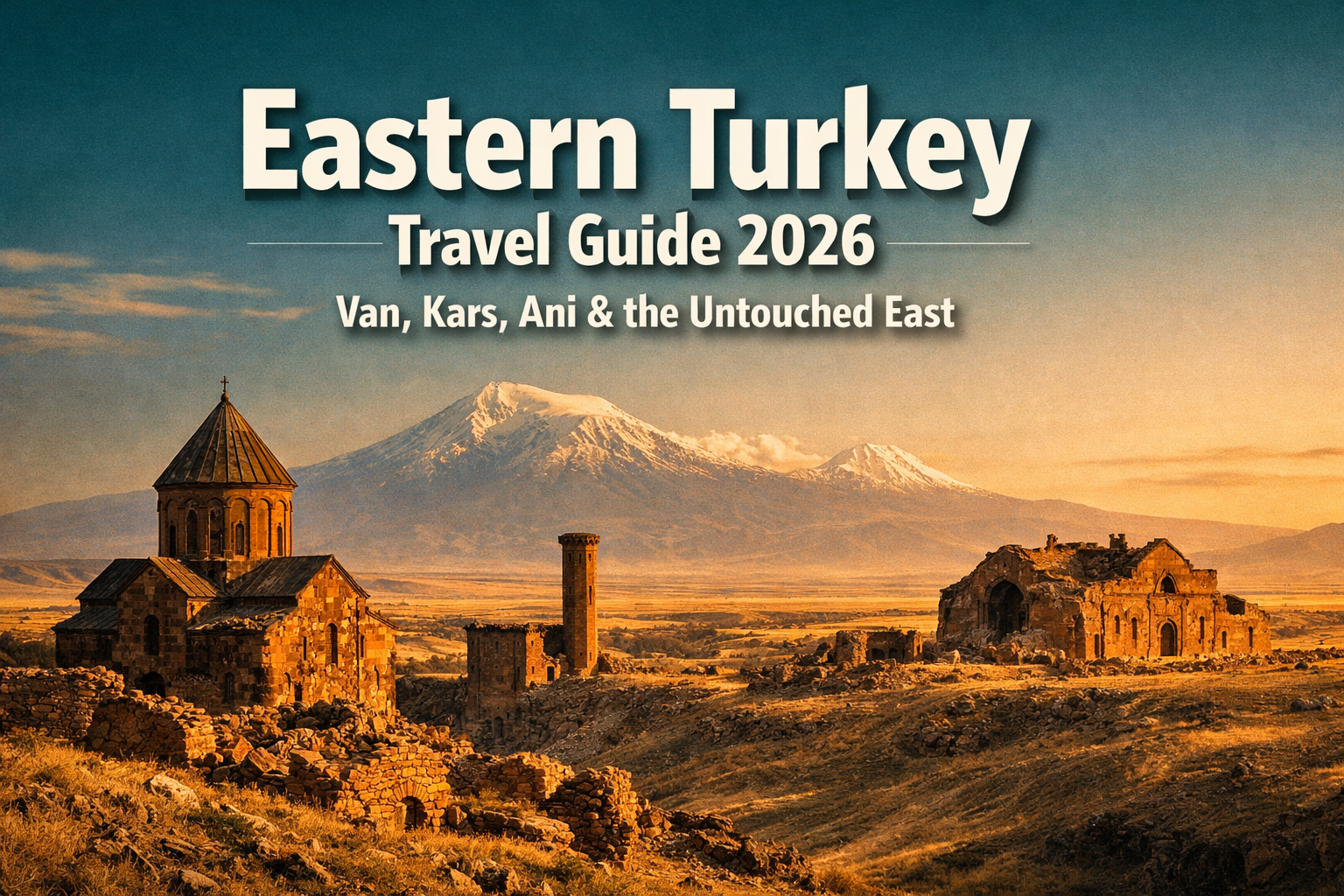
Ani: The Ghost City on the Armenian Border
Here’s the magic of Ani: it was once a city of 100,000 people — a Silk Road metropolis rivaling Constantinople — and now it’s empty. Just you, the wind, and dozens of medieval churches, mosques, and fortifications spread across a grassy plateau above the Akhurian River gorge, with Armenia visible on the other side.
What to see at Ani:
| Site | Period | Why It Matters |
|---|---|---|
| Cathedral of Ani | 989-1001 CE | Masterpiece of Armenian architecture; influenced Gothic design |
| Church of the Redeemer | 1035 CE | Half-collapsed, dramatically photogenic |
| Menüçehr Mosque | 11th century | Possibly the first Seljuk mosque in Anatolia |
| Church of St. Gregory (Tigran Honents) | 1215 CE | Stunning frescoes still visible inside |
| City Walls | 5th-11th century | Double fortification stretching 1.5 km |
Practical info: Entry is 220 TL (as of early 2026). The site has no shade, no café, and no mercy in summer heat — bring water, sunscreen, and a hat. Allow 3-4 hours minimum. Minibuses run from Kars, or hire a taxi for approximately 400-500 TL round trip with waiting time.
Ani earned UNESCO World Heritage status in 2016, and it’s one of Turkey’s most important archaeological discoveries that still feels genuinely undiscovered by mass tourism.
How Do You Get Around Eastern Turkey in 2026?
Getting around requires more planning than western Turkey, but it’s completely doable — even for solo travelers. Here’s the breakdown:
Flights: Turkish Airlines and AnadoluJet connect Istanbul to Van (daily, ~2 hours) and Kars (daily, ~2.5 hours). Book 2-3 weeks ahead for fares around 800-1,500 TL one way.
Buses: Metro Turizm and other companies run comfortable overnight buses from Ankara to Van (14 hours) and Kars (12 hours). Not glamorous, but cheap and reliable.
Local transport: Dolmuş (shared minibuses) connect towns. For flexibility, rent a car in Van or Kars — roads are well-maintained on main routes. Fair warning: distances are vast. Van to Kars is 330 km (about 4.5 hours driving).
Pro move: Fly into Van, spend 3 days, then take the scenic drive north through Doğubayazıt (hello, Mount Ararat views and İshak Paşa Palace) before reaching Kars. This route is a total game-changer for your itinerary.
For guidance on choosing between organized tours and going solo in this region, check our breakdown on guided tours vs. independent travel.
What Should You Know About Safety and Practical Matters?
Eastern Turkey is safe for tourists in 2026. The region has been stable and welcoming to visitors for years. Standard precautions apply: register with your embassy, keep copies of documents, and check current advisories before travel.
Practical tips:
- Cash is king: ATMs exist in cities but are scarce in villages. Carry Turkish lira.
- Accommodation: Boutique hotels in Van and Kars range from 800-2,500 TL/night. Budget pensions start around 400 TL.
- Internet: 4G coverage is solid in cities, patchy in rural areas. Our internet access guide has workaround tips.
- Dress code: More conservative than western Turkey, especially in smaller towns. Cover shoulders and knees when visiting mosques or rural communities.
- Best season: June-September for reliable weather. Kars gets brutally cold in winter (down to -30°C), but the winter sports scene at Sarıkamış has phenomenal powder snow if you’re into that.
What Else Is Worth Exploring in the Untouched East?
Beyond the Van-Kars-Ani triangle, eastern Turkey hides a constellation of surprise gems:
- Doğubayazıt & İshak Paşa Palace: An 18th-century Ottoman palace perched on a cliff with Ararat looming behind. Prepare to be obsessed.
- Muradiye Waterfalls: 20 km from Van, these falls are stunning in spring when snowmelt powers them.
- Hasankeyf (Batman Province): Ancient cave city, partially submerged by the Ilısu Dam — visit what remains while you can.
- Mount Ararat: Turkey’s highest peak (5,137 m). Climbing requires a permit and guide; the season runs July-September.
- Çavuştepe: Urartian fortress south of Van with remarkably intact temple foundations.
For those who love quiet, authentic villages, our guide to rural Turkey’s quaintest villages includes several eastern gems.
Conclusion
Eastern Turkey in 2026 offers what most of the world’s famous destinations have lost: authenticity, solitude, and the thrill of genuine discovery. Van gives you natural drama and culinary glory. Kars delivers architectural intrigue and Caucasian charm. Ani provides one of the most haunting historical experiences in all of Turkey — maybe all of Europe.
Your action plan:
- Book flights to Van or Kars 3-4 weeks ahead for best prices
- Plan 7-10 days to do the region justice
- Learn basic Turkish greetings (future you will thank us)
- Pack layers — temperatures swing dramatically between day and night
- Bring an open schedule, because spontaneous invitations will reshape your days
This isn’t the Turkey of package tours and all-inclusive resorts. It’s better. It’s the Turkey that Turks themselves road-trip to when they want to feel something. Bookmark this, and go.
FAQ
Is eastern Turkey safe for solo travelers in 2026?
Yes. Cities like Van and Kars are safe and welcoming. Exercise normal precautions, avoid border zones without local guidance, and inform someone of your itinerary.
How many days do I need for Van, Kars, and Ani?
Minimum 5 days (2 in Van, 2 in Kars/Ani, 1 transit). Ideal is 7-10 days to include Doğubayazıt and side trips without rushing.
Do I need to speak Turkish?
It helps enormously. English speakers are rare outside hotel reception desks. A translation app and 20 memorized phrases will transform your experience.
Can I visit Ani independently or do I need a guide?
You can visit independently — it’s an open archaeological site with information panels. A guide (bookable in Kars for about 500-800 TL) adds historical context that’s absolutely worth it.
What’s the best food to try in eastern Turkey?
Van breakfast (kahvaltı), Kars gravyer cheese, kuymak (melted cheese dish), tandır kebab, and local honey. The east is seriously underrated for food.
Is there alcohol available in eastern Turkey?
In cities, yes — hotels and some restaurants serve alcohol. In smaller towns, availability is limited. This is a more conservative region than western Turkey.
Can I cross into Armenia from Ani?
No. The Turkey-Armenia land border remains closed. Ani sits directly on the border, but crossing is not possible.
What currency should I bring?
Turkish lira. Euros and dollars can be exchanged in Van and Kars but aren’t accepted by most businesses. Credit cards work in hotels and larger restaurants only.
References
- UNESCO World Heritage Centre. “Archaeological Site of Ani.” Inscribed 2016. https://whc.unesco.org/en/list/1518
- Turkish Ministry of Culture and Tourism. “Van and Kars Visitor Information.” 2024. https://www.ktb.gov.tr
- Lonely Planet. “Eastern Turkey Travel Guide.” Updated 2024. https://www.lonelyplanet.com/turkey/eastern-turkey
Tags: Eastern Turkey travel, Van Turkey, Kars Turkey, Ani ruins, Turkey travel guide 2026, Lake Van, Turkish food, off the beaten path Turkey, UNESCO Turkey, Mount Ararat, Kurdish culture, solo travel Turkey