

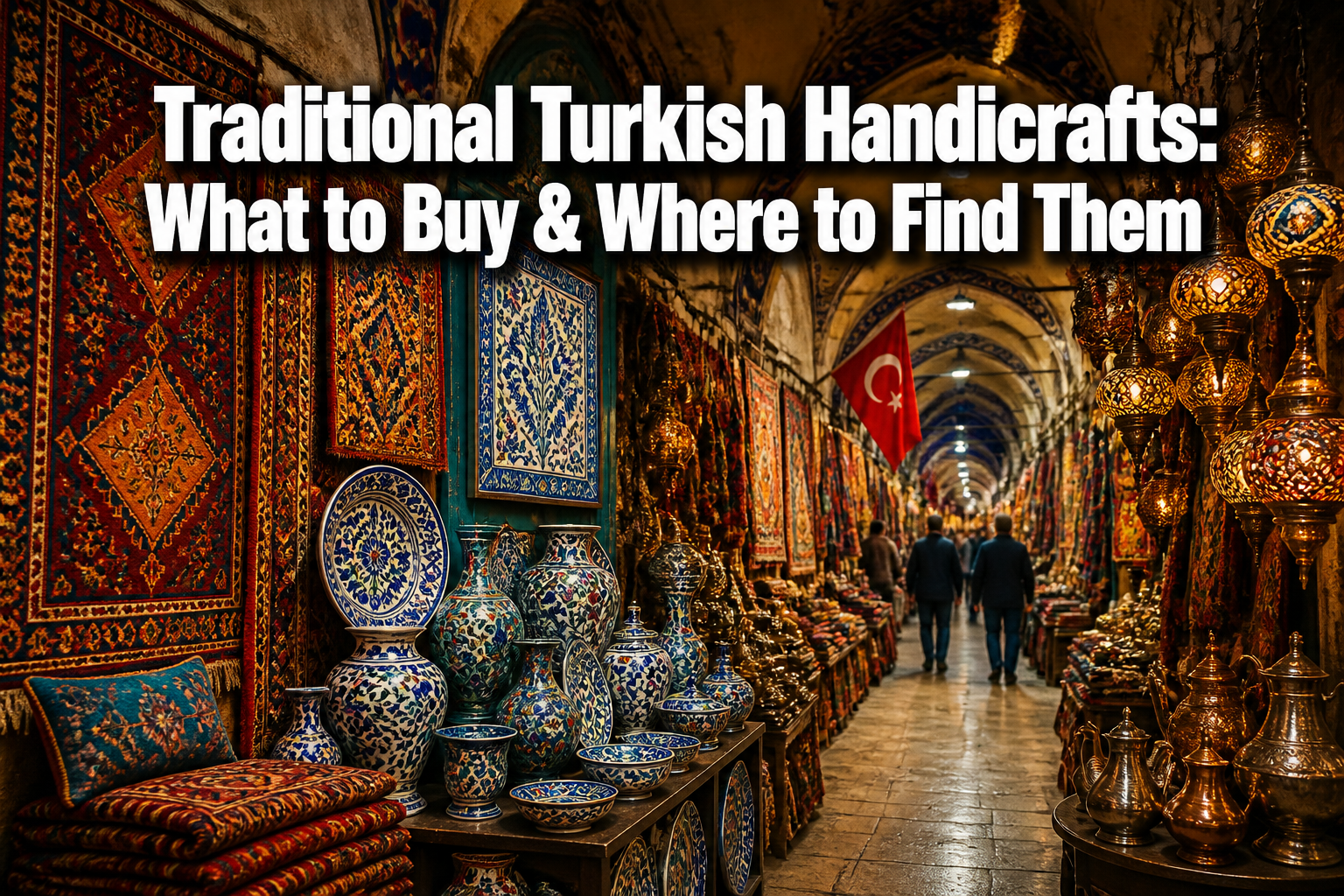

From ornate carpets to hand-painted ceramics, Turkey offers travelers an extraordinary variety of traditional handicrafts worth discovering. Last updated: May 3, 2026
Quick Answer: Turkey is home to some of the world’s oldest and most diverse craft traditions, from hand-knotted carpets that date back roughly 9,000 years to 800-year-old paper marbling. The best places to buy authentic Turkish handicrafts are the Grand Bazaar in Istanbul, regional artisan markets, and government-certified craft shops. Knowing what to look for — and where to look — saves you money and helps you bring home something genuinely special.
Key Takeaways: Essential Turkey Craft Guide
- 🎨 Turkish carpet weaving traces back to the ancient settlement of Çatalhöyük, making it one of the oldest craft traditions on Earth [2]
- 🏺 Iznik ceramics and tiles date to the 15th century Ottoman Empire and remain among the most sought-after souvenirs [7]
- 🔨 Copper craftsmanship in Turkey spans over 10,000 years, originating in Central Asia and brought to Anatolia by the Seljuk Turks [4]
- 📜 Ebru (Turkish paper marbling) is an 800-year-old art form — every piece is genuinely one-of-a-kind [3]
- 🛍️ The Grand Bazaar in Istanbul, regional bazaars, and UNESCO-listed craft centers are your best bets for authentic pieces
- 💡 Look for government certification or artisan guild marks to avoid mass-produced imitations
- 🪵 Kündekâri woodcarving, where pieces interlock without glue or nails, is a rare and valuable find [2]
- 🧵 Turkish embroidery peaked in the 16th century; bead embroidery from Adana and İçel is especially prized [4]
- 💰 Prices vary widely — a small ceramic piece starts around $10–$30, while quality hand-knotted carpets can run into the thousands
- 🗺️ Different cities specialize in different crafts: Iznik for tiles, Bursa for woodcarving, Gaziantep for copper and metalwork

What Makes Traditional Turkish Handicrafts Worth Buying?
Turkish handicrafts aren’t just pretty souvenirs — they’re living records of civilizations that shaped the ancient world. Each craft carries a specific regional identity, technique, and history that mass-produced goods simply can’t replicate.
Here’s why they stand out:
- Age and continuity: Carpet weaving at Çatalhöyük dates back approximately 9,000 years, and many techniques remain largely unchanged [2]
- Genuine uniqueness: An ebru (marbled paper) piece, for example, can never be exactly duplicated because the pigments move differently every single time [3]
- Cultural depth: The Kündekâri woodcarving technique — where small wooden pieces fit together like a puzzle with no glue or nails — is found on mosque doors and Ottoman pulpits across Turkey [2]
- Investment potential: Authentic hand-knotted carpets and antique Iznik ceramics tend to hold or increase in value over time
“Every piece of Turkish craft tells you something about the region, the era, and the hands that made it. You’re not just buying an object — you’re buying a story.”
Common mistake: Buying from the first stall you see in a tourist area without comparing. The same ceramic bowl can cost three times more near the Blue Mosque than in a neighborhood market two streets away.
A Guide to Traditional Turkish Handicrafts: What to Buy & Where to Find Them
Here’s a breakdown of the main craft categories, what makes each one special, and where to find the best examples.
🏺 Ceramics and Iznik Tiles
Iznik ceramics date to the 15th century and were a prized industry during the Ottoman Empire — the recipes and techniques were closely guarded secrets [7]. The Blue Mosque in Istanbul alone features over 20,000 Iznik tiles, most in the signature deep cobalt blue and white floral style [2].
What to buy:
- Decorative plates and bowls with hand-painted floral or geometric patterns
- Tile sets for home décor
- Iznik-style vases and cups
Where to find them:
- Iznik (the original source city, near Bursa)
- Ceramic shops in Sultanahmet, Istanbul
- The Grand Bazaar, Istanbul
Choose Iznik if: you want a piece with historical provenance. Modern Kütahya ceramics are also high quality and more affordable.
🪄 Ebru (Turkish Paper Marbling)
Ebru is an 800-year-old practice where artists brush natural pigments onto oily water and transfer the floating design to paper, creating patterns that can never be exactly repeated [3]. It’s one of the most accessible crafts for travelers because workshops in Istanbul let you try it yourself.
What to buy: Framed ebru prints, marbled bookmarks, notebooks with marbled covers
Where to find it: Ebru workshops and studios in the Beyoğlu and Fatih districts of Istanbul [3]
Edge case: If a shop sells “ebru prints” that look perfectly identical, they’re likely machine-printed reproductions. Authentic ebru always has slight variations.
🪵 Woodcarving (Kündekâri)
The Kündekâri technique involves fitting small geometric wood pieces together without nails or adhesive — a method seen on historic mosque doors and ceilings across Anatolia [2]. Bursa and Konya are the main centers for skilled woodcarvers today.
What to buy: Decorative boxes, mirror frames, small furniture pieces, ornamental panels
Where to find it:
- Artisan workshops in Bursa and Konya
- The Museum of Turkish and Islamic Art in Istanbul (for historic reference) [4]
🔨 Copper and Metalwork
Copper craftsmanship in Turkey spans over 10,000 years [4]. Today, you’ll find hand-hammered trays, coffee sets, lanterns, and decorative plates. Gaziantep, Bursa, and Zonguldak are known for their metalwork traditions.
What to buy: Copper coffee pots (cezve), trays, lanterns, decorative plates
Price range (estimate): Small copper items start around $15–$40; large decorative pieces can reach $200+
🧵 Textiles: Carpets, Kilims, and Embroidery
This is the big one. Turkish carpet weaving goes back roughly 9,000 years to Çatalhöyük, and hand-knotted carpets remain among the most treasured Turkish exports [2]. Kilims (flat-woven rugs) are a more affordable alternative with bold geometric patterns.
Turkish embroidery peaked in the 16th century, with bead embroidery from Adana and İçel being especially distinctive [4].
| Type | Technique | Price Range (estimate) | Best Region |
|---|---|---|---|
| Hand-knotted carpet | Wool or silk, knotted | $300–$5,000+ | Cappadocia, Hereke |
| Kilim | Flat-woven, geometric | $80–$800 | Eastern Anatolia |
| Silk carpet | Silk threads, fine knot | $1,000–$10,000+ | Hereke |
| Embroidered textile | Hand-stitched | $20–$200 | Adana, İçel |
Buying tip: Ask for the knot count per square inch — higher knot density generally means higher quality and value.
🪆 Quilts (Yorgancılık) and Other Textiles
Traditional Turkish quilt-making is more time-intensive than most people realize. Simple designs take about 1.5 days to complete, while complex patterns can take anywhere from one week to a full month [4]. That time investment is reflected in the price — and the quality.
Where to find them: Local bazaars in central Anatolia, artisan cooperatives
Where to Shop for Traditional Turkish Handicrafts: What to Buy & Where to Find Them
Finding authentic pieces requires knowing which venues to prioritize. Here’s a practical breakdown.

Istanbul: The Grand Bazaar and Beyond
The Grand Bazaar (Kapalıçarşı) is the obvious starting point — it’s one of the world’s oldest covered markets with over 4,000 shops. But it’s also heavily tourist-facing, so prices are higher and quality varies.
Better options within Istanbul:
- Arasta Bazaar (near the Blue Mosque): smaller, less crowded, more curated
- Egyptian Spice Bazaar (Mısır Çarşısı): good for textiles and small crafts
- Neighborhood shops in Beyoğlu and Karaköy: often run by younger artisans with contemporary takes on traditional crafts
- Ebru workshops in Fatih and Beyoğlu: buy directly from the artist [3]
Regional Cities for Specific Crafts
| City | Best Craft to Buy |
|---|---|
| Iznik | Ceramic tiles and pottery |
| Bursa | Woodcarving, silk textiles |
| Konya | Woodcarving, kilims |
| Gaziantep | Copper, metalwork |
| Cappadocia | Hand-knotted carpets |
| Adana | Bead embroidery |
| Zonguldak / Ordu | Decorated walking sticks [5] |
Museums Worth Visiting (for Context and Inspiration)
- Museum of Turkish and Islamic Art, Istanbul: displays fine woodwork from the 8th to 19th centuries [4]
- Military Museum, Harbiye, Istanbul: features embroidered objects from Seljuk and Ottoman soldiers [4]
Visiting these before you shop gives you a strong reference point for quality and authenticity.
How to Spot Authentic Pieces vs. Mass-Produced Imitations
This is where most first-time buyers go wrong. Here’s a quick checklist:
Signs of authentic craftsmanship:
- ✅ Slight irregularities in pattern (handmade means imperfect)
- ✅ Natural dyes (colors are slightly uneven, not perfectly uniform)
- ✅ Weight and texture consistent with the material (real copper feels heavy; real silk has a specific sheen)
- ✅ Artisan can explain the technique or origin
- ✅ Government certification or artisan guild mark
Red flags:
- ❌ Perfectly identical “handmade” pieces stacked in rows
- ❌ Very low prices on items that should take days to make
- ❌ Seller can’t tell you where the piece was made
- ❌ “Made in China” labels on the back of ceramics
FAQ: Traditional Turkish Handicrafts
Q: What’s the single best souvenir to buy in Turkey? A hand-painted Iznik ceramic plate or a small kilim rug offers the best combination of portability, authenticity, and lasting value. Both travel well and represent genuine Turkish craft traditions.
Q: Are carpets at the Grand Bazaar authentic? Some are, many aren’t. Ask specifically whether the carpet is hand-knotted or machine-made, request a burn test for wool vs. synthetic fibers, and compare prices across multiple stalls before committing.
Q: How much should I budget for a quality Turkish carpet? A genuine hand-knotted wool carpet in a small size (roughly 3×5 feet) typically starts around $300–$500. Silk carpets from Hereke start much higher. Machine-made rugs cost far less but aren’t considered traditional handicrafts.
Q: Can I take Turkish handicrafts through customs? Most items are fine. Antiques (items over 100 years old) require an export permit from Turkish authorities. Always ask the seller for documentation if a piece is described as antique.
Q: Where can I learn to make Turkish crafts as a traveler? Istanbul has several ebru (paper marbling) workshops that offer hands-on sessions, often for around $30–$60 per person [3]. Some carpet cooperatives in Cappadocia also offer short weaving demonstrations.
Q: Is it okay to bargain in Turkish markets? Yes, especially in bazaars and smaller shops. Fixed-price shops (often marked as such) are the exception. A reasonable opening offer is typically 30–40% below the asking price, then negotiate from there.
Q: What’s the difference between a kilim and a carpet? A kilim is flat-woven with no pile — it’s thinner, lighter, and generally less expensive than a hand-knotted carpet. Both are traditional Turkish textiles, but they use different techniques and have different visual styles.
Q: Are there government-certified shops for authentic handicrafts? Yes. Turkey’s Ministry of Culture and Tourism certifies some artisan shops and cooperatives. Look for official certification marks, or buy from cooperatives affiliated with regional craft guilds [1].
Q: What cities outside Istanbul are best for handicraft shopping? Iznik for ceramics, Bursa for silk and woodcarving, Cappadocia for carpets, and Gaziantep for copper and metalwork are all excellent regional destinations [4] [5].
Q: Is ebru paper marbling considered a UNESCO heritage craft? Yes. Ebru was inscribed on UNESCO’s Representative List of Intangible Cultural Heritage of Humanity in 2014, recognizing its cultural significance and the importance of preserving the tradition.
Conclusion: Your Actionable Next Steps
Traditional Turkish handicrafts are genuinely worth the effort to find and buy well. The key is doing a little homework before you shop.
Here’s what to do:
- Decide on your budget before you arrive — it shapes which craft categories are realistic for you
- Visit at least one museum (the Museum of Turkish and Islamic Art is a great start) to calibrate your eye for quality
- Go regional if you can — buying a ceramic in Iznik or a carpet in Cappadocia gives you a better story and often a better price than buying in Istanbul’s tourist zones
- Ask questions — any legitimate artisan will be happy to explain their technique and materials
- Don’t rush — the best finds come from wandering neighborhood markets and smaller workshops, not the first stall at the Grand Bazaar entrance
Turkey’s craft traditions have survived for thousands of years because they’re genuinely extraordinary. With a bit of patience and the right knowledge, you’ll bring home something that lasts just as long.
References
[1] Yazdir – https://www.ktb.gov.tr/yazdir?E5FA2E4BEC4BAC7B0474EDFC4F26A35E [2] Turkish Handicrafts – https://iyc.com/blog/turkish-handicrafts/ [3] Handicrafts – https://sponsorcontent.cnn.com/edition/2022/tga-turkiye-tourism/handicrafts/ [4] Traditional Turkish Handicrafts And Their History – https://goturkiye.com/blog/traditional-turkish-handicrafts-and-their-history [5] Traditional Turkish Handicrafts And Their History – https://tastepeler.goturkiye.com/traditional-turkish-handicrafts-and-their-history [7] Turkish Craft Making And Design A Legacy Of Artisans In Modern Day Turkey – https://kikibazaar.com/blogs/travel/turkish-craft-making-and-design-a-legacy-of-artisans-in-modern-day-turkey
Tags: traditional Turkish handicrafts, Turkish ceramics, Iznik tiles, Turkish carpets, kilim rugs, ebru paper marbling, Grand Bazaar Istanbul, Turkish souvenirs, copper crafts Turkey, Turkish embroidery, artisan crafts Turkey, Turkish culture
Related Turkey culture and planning guides: To build a culture-led route around crafts and local traditions, compare our 7-day Turkey itinerary, 10-day Turkey itinerary, must-do Turkey experiences, and best time to visit Turkey guide.