


Turkey’s ghost towns and abandoned ruins offer haunting glimpses into civilizations that once thrived across this ancient land. Last updated: May 3, 2026
Quick Answer: Turkey has some of the most compelling abandoned places on earth, ranging from ancient ghost towns with thousands of years of history to a half-built $200 million luxury resort that went bust in 2018. Whether you’re into dark tourism, history, or just want a photo spot unlike anything else, these 10 sites deliver. Most are accessible by car or public transport, and entry is free or very cheap.
Key Takeaways: Ghost Towns Worth Exploring
- Turkey holds dozens of ghost towns and ruins, but 10 stand out for accessibility, history, and visual impact.
- Kayaköy (near Fethiye) is one of the most visited abandoned villages in the world, with around 600 empty stone homes [2].
- Burj Al Babas is a surreal modern ghost town: 732 château-style villas left half-built after a 2018 bankruptcy [1].
- Ani is a UNESCO-listed medieval ghost city on the Armenian border, often called one of Turkey’s most underrated sites [3].
- Most sites are open year-round; spring (April–May) and autumn (September–October) offer the best weather for exploring.
- Wear sturdy shoes. Many sites have uneven ground, no guardrails, and zero safety infrastructure.
- Photography is generally allowed, but always check local rules, especially at UNESCO sites.
- Budget roughly 0–150 TRY per site for entry fees (many are free or very low cost as of 2026).
Why Turkey Is a Gold Mine for Abandoned Place Hunters
Turkey sits at the crossroads of dozens of civilizations, and that history shows up in layers of ruins, ghost towns, and forgotten settlements. Few countries can match the sheer variety on offer here.
The country has been home to Greeks, Romans, Byzantines, Ottomans, and more, and each left something behind when they moved on, were displaced, or simply ran out of money. Atlas Obscura officially catalogues at least three major Turkish ghost towns: Burj Al Babas, Ani, and Kayaköy [3]. But the real number of interesting abandoned places is much higher.
Who these sites are for:
- History buffs and archaeology fans
- Urban explorers and dark tourists
- Photographers looking for dramatic, crowd-free backdrops
- Travelers who want something beyond the standard Istanbul-Cappadocia circuit
Who should skip them: Anyone expecting polished tourist infrastructure. These are raw, often unguarded sites. Facilities are minimal.
Abandoned Places in Turkey: 10 Ghost Towns & Ruins Worth Visiting
Here’s the full list, with enough detail to help you decide which ones fit your itinerary.
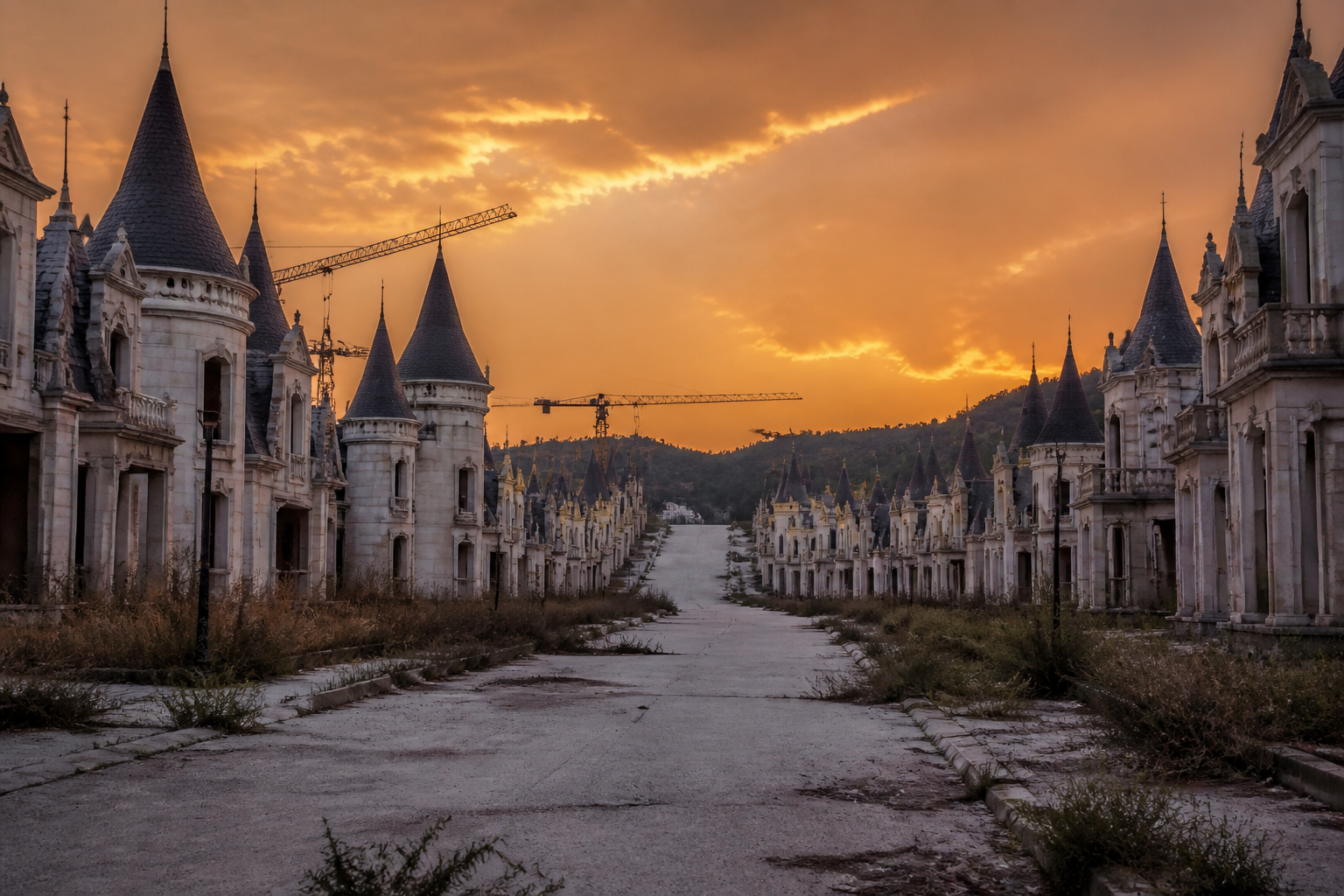
1. Burj Al Babas (Mudurnu, Bolu Province)
The short version: A $200 million development of 732 French château-style villas, started in 2014, abandoned by 2018, and now one of the strangest sights in Turkey [1].
The project targeted wealthy Arab buyers who were drawn to the area’s thermal hot springs and nature scenery. Environmental complaints surfaced in 2014, worker strikes followed in 2015, and then Turkey’s 2018 economic crisis hit hard. Currency devaluation combined with falling oil prices pushed the developer into bankruptcy, and construction stopped overnight [1].
What you get today: row after row of identical mini-castles with turrets, empty windows, and weeds pushing through unfinished concrete. It looks like a fairy-tale village that nobody ever moved into.
Practical info:
- Location: Near Mudurnu, about 3 hours from Istanbul
- Entry: No official fee, but access rules can change — check locally before visiting
- Best for: Photographers, urban explorers
2. Kayaköy (Fethiye, Muğla Province)
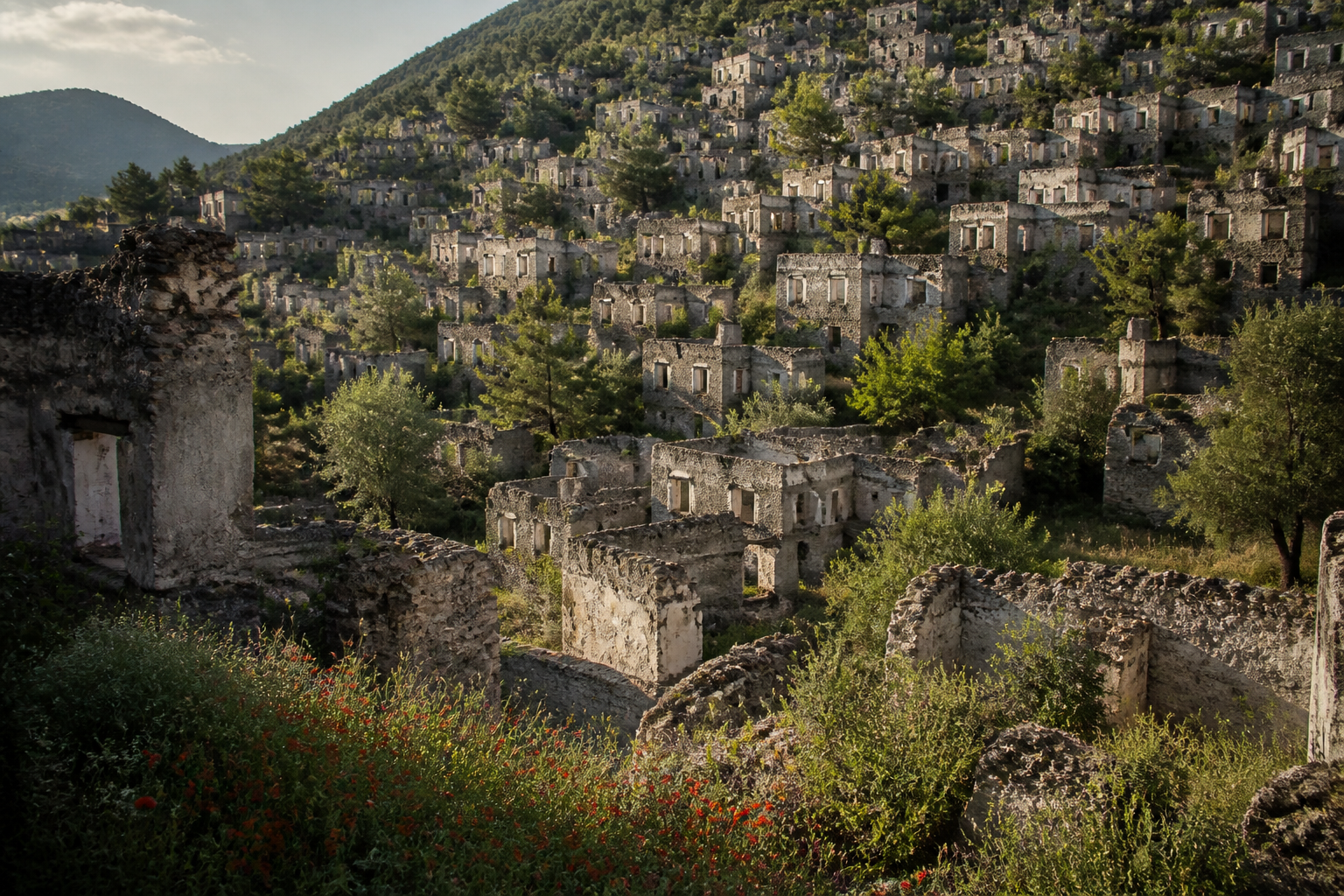
The short version: A Greek village of roughly 600 homes, completely emptied in the 1920s after the Turkish War of Independence, and left largely untouched since [2].
Kayaköy’s population was relocated to Greece as part of the population exchange that followed the war. The stone houses, churches, and cobblestone streets were simply left behind. Today it’s an open-air museum and one of the most emotionally affecting abandoned places in Turkey [2].
Why it stands out: Unlike most ruins, Kayaköy is recent enough that the buildings are still recognizable as homes. You can walk through doorways, see where fireplaces once stood, and get a real sense of the lives interrupted here.
- Location: 8 km from Fethiye, easy to reach by dolmuş (shared minibus)
- Entry fee: Small fee applies (open-air museum status)
- Best time to visit: Early morning before tour groups arrive
3. Ani (Kars Province)
The short version: A UNESCO World Heritage Site and medieval ghost city that was once the capital of the Armenian Bagratid kingdom, home to over 100,000 people at its peak.
Ani sits right on the Turkish-Armenian border, which adds an extra layer of atmosphere. The site includes a cathedral, mosques, palaces, and city walls, all in various states of ruin. It’s genuinely massive and takes at least half a day to explore properly [3].
Common mistake: People underestimate the walking distances inside Ani. Bring water and comfortable shoes — it’s a large site with no shade.
4. Hasankeyf (Batman Province)
The short version: An ancient cave city with 12,000 years of continuous settlement history, partially flooded by the Ilısu Dam project. What remains above water is still worth visiting.
Hasankeyf is a complicated site. Many structures were relocated or submerged when the dam filled. But the remaining clifftop ruins, cave dwellings, and the old bridge pillars rising from the water create an unforgettable visual.
5. Ephesus (İzmir Province)
The short version: One of the best-preserved ancient cities in the world, Ephesus was a major Roman port city abandoned after its harbor silted up.
Yes, Ephesus is famous and gets crowds. But it earns its place on any list of abandoned places in Turkey. The Library of Celsus, the Great Theatre, and the marble-paved streets are extraordinary. Go early or late in the day to avoid the worst of the tour groups.
6. Hierapolis (Pamukkale, Denizli Province)
The short version: A Greco-Roman spa city built over natural hot springs, now a UNESCO site alongside the famous white travertine terraces of Pamukkale.
Hierapolis has a massive necropolis (one of the largest in Anatolia), a well-preserved theatre, and the ruins of temples and baths. The combination of ruins and natural landscape is hard to beat.
7. Perge (Antalya Province)
The short version: A large Hellenistic and Roman city near Antalya, less visited than Ephesus but equally impressive in scale.
Perge has colonnaded streets, a stadium, baths, and a well-preserved agora. It’s often overlooked because Antalya’s other attractions get more attention, which means you’ll often have it nearly to yourself.
8. Aizanoi (Kütahya Province)
The short version: A remarkably intact Roman temple dedicated to Zeus, plus a stadium, theatre, and bridge, all largely unrestored and uncrowded.
Aizanoi is one of Turkey’s best-kept secrets. The Temple of Zeus here is considered one of the best-preserved Roman temples in Anatolia. A UNESCO World Heritage nomination has been in progress, which may change visitor numbers in coming years.
9. Tlos (Muğla Province)
The short version: A Lycian rock-cut tomb city perched on a dramatic clifftop, with sweeping views over the Xanthos Valley.
Tlos is one of the oldest continuously inhabited cities in the world, with layers of Lycian, Greek, Roman, and Ottoman history stacked on top of each other. The acropolis views alone are worth the drive.
10. Assos (Çanakkale Province)
The short version: A clifftop ancient city with a Temple of Athena, where Aristotle once lived and taught, overlooking the Aegean Sea.
Assos is smaller than some sites on this list, but the combination of ancient ruins, a charming harbor village below, and stunning sea views makes it a perfect half-day stop.
Quick Comparison: Top Abandoned Places in Turkey at a Glance
| Site | Region | Era | Entry Fee | Crowds | Best For |
|---|---|---|---|---|---|
| Burj Al Babas | Bolu | Modern (2014–2018) | Free/unofficial | Low | Photography, urban exploration |
| Kayaköy | Muğla | 1920s | Low fee | Medium | History, emotional impact |
| Ani | Kars | Medieval | Moderate fee | Low | Architecture, history |
| Hasankeyf | Batman | Ancient/modern | Free | Low | Unique landscapes |
| Ephesus | İzmir | Roman | Higher fee | High | Scale, preservation |
| Hierapolis | Denizli | Greco-Roman | Moderate | Medium | Combined with Pamukkale |
| Perge | Antalya | Hellenistic/Roman | Moderate | Low-medium | Off-the-beaten-path |
| Aizanoi | Kütahya | Roman | Low | Very low | Hidden gem |
| Tlos | Muğla | Lycian/Roman | Low | Low | Views, rock tombs |
| Assos | Çanakkale | Ancient Greek | Low | Low-medium | Scenery, philosophy history |
How to Plan a Trip Around Abandoned Places in Turkey
Start with a realistic itinerary. Turkey is large. Trying to hit all 10 sites in one trip isn’t practical unless you have three weeks or more. Instead, group sites by region.
Regional clusters to consider:
- Aegean coast: Kayaköy, Ephesus, Hierapolis, Tlos, Assos
- Central/northwest: Burj Al Babas, Aizanoi
- South (Antalya area): Perge
- East: Ani, Hasankeyf (these two require a dedicated eastern Turkey trip)
Practical tips:
- Rent a car for flexibility. Public transport reaches the major sites but not all of them.
- Spring (April–May) and autumn (September–October) are the sweet spots for weather and smaller crowds.
- Download offline maps before visiting remote sites like Ani or Aizanoi. Signal can be unreliable.
- Carry cash. Many smaller sites don’t accept cards at entry points.
Choose eastern Turkey (Ani, Hasankeyf) if you want fewer tourists and a more raw, unpolished experience. Choose the Aegean coast sites if you want easier logistics and more infrastructure around you.
Common Mistakes to Avoid at Turkish Ghost Towns and Ruins
Skipping the eastern sites because they seem remote. Ani and Hasankeyf are genuinely harder to reach, but they’re also the most unique experiences on this list. Fly into Kars for Ani and Van or Diyarbakır for Hasankeyf.
Visiting Ephesus at midday in summer. The site has almost no shade, and summer temperatures in the İzmir region regularly hit 38–40°C. Go at 8 a.m. when it opens or late afternoon.
Assuming all sites are free. Most of Turkey’s major ruins charge entry. Fees are generally low by international standards, but budget for them.
Ignoring local guidance at Burj Al Babas. The site has no official management, and access rules can shift. Check recent traveler reports before making the drive.
FAQ: Abandoned Places in Turkey
Is it legal to visit Burj Al Babas? As of 2026, visitors do explore the site, but it has no official tourist status. There are no fences or guards in most areas, but access is technically on private or disputed land. Visit at your own discretion and check recent reports before going.
Is Kayaköy safe to walk around? Yes, Kayaköy is an officially recognized open-air museum with marked paths. The ruins are stable enough to walk through, though some areas have uneven ground. Wear closed-toe shoes.
How long does it take to see Ani? Budget at least 3–4 hours for Ani. The site is large, and rushing through it means missing the detail in the architecture and the atmosphere of the place.
What’s the best abandoned place in Turkey for photographers? Burj Al Babas wins for surreal, modern imagery. Ani wins for dramatic medieval architecture. Kayaköy is best for emotional, human-scale photography.
Are there guided tours to these sites? Yes, guided tours run to Kayaköy, Ephesus, Hierapolis, and Perge from nearby cities. Ani and Burj Al Babas are less commonly covered by standard tours but some specialist operators do run trips.
Can I visit Hasankeyf after the dam flooding? Yes. Parts of Hasankeyf were relocated to a new area nearby, and the original clifftop ruins are still accessible. The flooded lower town creates an unusual visual of ruins emerging from the reservoir.
Is Ephesus worth it despite the crowds? Yes. The scale and preservation of Ephesus justify the visit even with crowds. Go early and you’ll have the main street largely to yourself for the first hour.
What should I pack for visiting Turkish ruins? Sturdy walking shoes, sunscreen, a hat, water, and cash for entry fees. A portable charger is useful for remote sites where you’ll be using maps heavily.
Conclusion: Where to Start
If you’re new to exploring abandoned places in Turkey, start with Kayaköy. It’s accessible, emotionally powerful, and close to Fethiye, which has plenty of accommodation and onward travel options. From there, Ephesus and Hierapolis make a natural pairing on the Aegean coast.
If you’ve already done the western circuit, push east. Ani is genuinely one of the most underrated sites in the entire country, and combining it with Hasankeyf makes for a memorable eastern Turkey road trip.
For something completely unlike anything else, Burj Al Babas is a must-see. A half-built ghost town of 732 identical châteaux in the Turkish hills is the kind of place you’ll struggle to explain to people who haven’t seen it [1].
Your next steps:
- Pick a region based on your available time and base city.
- Check current entry fees and access conditions before you go (things change).
- Book accommodation in nearby towns, not at the sites themselves.
- Travel in spring or autumn for the best experience.
Turkey’s abandoned places aren’t just ruins. They’re physical records of everything that went wrong, or right, or simply got left behind. That’s what makes them worth visiting.
References
[1] Watch – https://www.youtube.com/watch?v=627HvFA6M5I [2] Attraction Review – Abandoned Village of Kayakoy – https://www.tripadvisor.com/Attraction_Review-g635670-d19653087-Reviews-Abandoned_Village_of_Kayakoy-Kayakoy_Fethiye_Mugla_Province_Turkish_Aegean_Coast.html [3] Ghost Towns in Turkey – https://www.atlasobscura.com/things-to-do/turkey/ghost-towns
Tags: abandoned places in Turkey, ghost towns Turkey, Kayaköy, Burj Al Babas, Ani ghost city, Turkish ruins, dark tourism Turkey, urban exploration Turkey, Ephesus, Hasankeyf, ancient ruins Turkey, travel Turkey
Related Turkey destination guides: If you are exploring unusual places, also see our 7-day Turkey itinerary, 10-day Turkey itinerary, must-do Turkey experiences, and Turkey safety guide.