

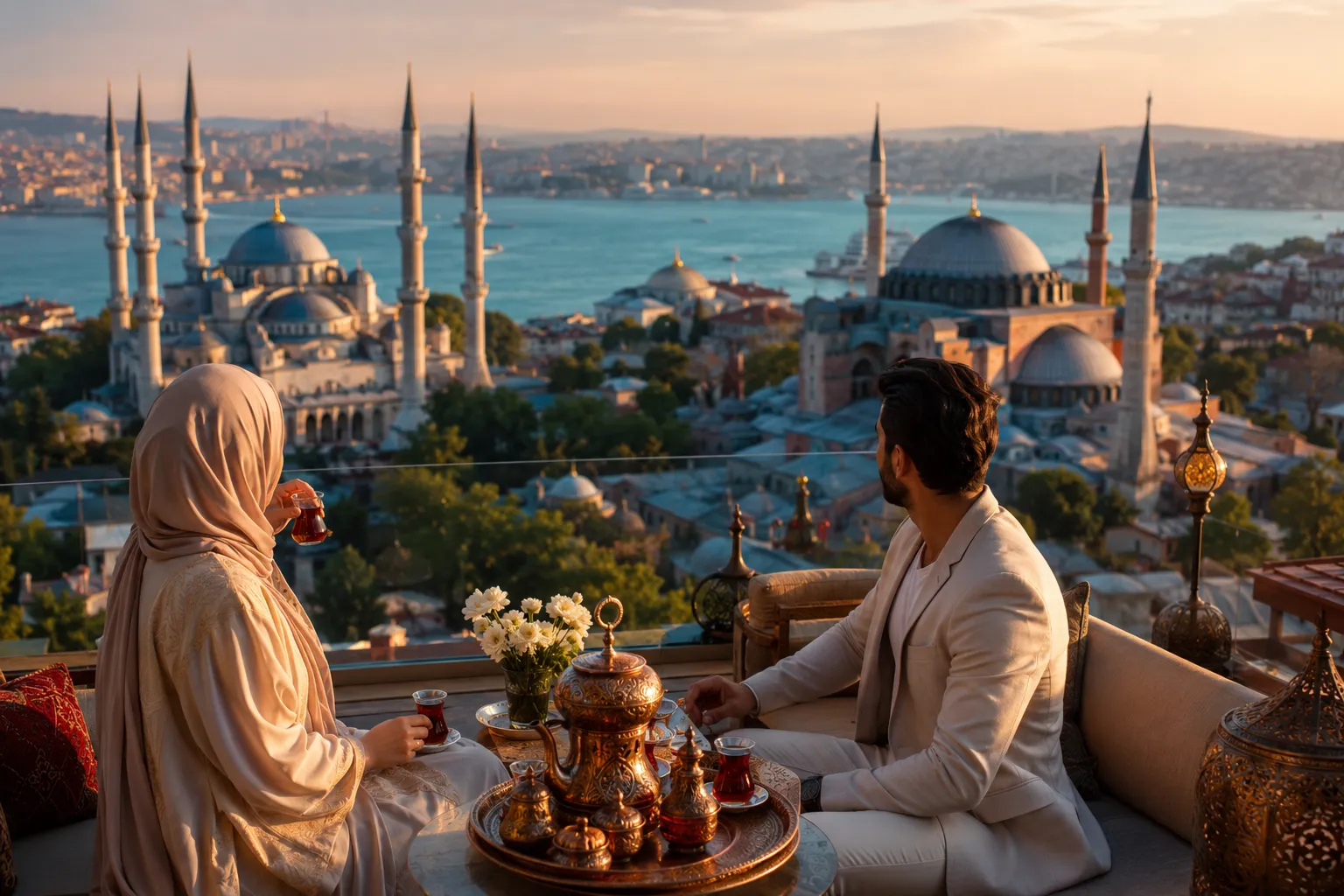

Tourism to Turkey surged dramatically in 2026 as Middle Eastern travelers, particularly from Saudi Arabia and Egypt, embraced new luxury experiences. Last updated: July 20, 2026
Quick Answer: Saudi Arabian visitors to Turkey surged 37.71% year-over-year in January 2026, while Egyptian arrivals jumped 22.35%, pushing the combined Middle Eastern visitor share to 10.66% of all foreign arrivals [1]. This growth is fueled by expanded direct flights, competitive luxury pricing, Turkey’s deeply rooted halal dining infrastructure, and a shared cultural affinity that makes the country feel less like a foreign destination and more like a second home. For Middle Eastern travelers planning a 2026 trip, Turkey offers a rare combination: world-class luxury resorts with Islamic amenities, prayer-friendly itineraries through historic cities, and a cuisine that’s already overwhelmingly halal by default.
Key Takeaways
- Saudi arrivals to Turkey grew 37.71% YoY in January 2026, making the Kingdom one of Turkey’s fastest-growing source markets [1]
- Egyptian arrivals rose 22.35% YoY in the same period, driven by stronger diplomatic and tourism ties [5]
- Middle Eastern visitors now represent 10.66% of Turkey’s total foreign arrivals [1]
- Q1 2026 tourism revenue reached approximately $9.9 billion despite regional disruptions from the Iran crisis [4]
- Halal itineraries aren’t a niche product in Turkey, the country’s Muslim-majority culture means prayer facilities and halal food are standard, not special requests
- Luxury resorts along the Turkish Riviera and in Cappadocia increasingly offer dedicated women-only pools, in-room prayer amenities, and Arabic-speaking concierge services
- Best travel windows for Saudi and Egyptian visitors are March, May (spring, often aligning with Ramadan/Eid) and September, November (mild weather, fewer crowds)
- Visa processes are straightforward: e-Visa for Saudi nationals, visa-on-arrival or e-Visa for Egyptians meeting specific criteria
- Istanbul, Antalya, Trabzon, and Bursa rank as the most popular Turkish cities among Middle Eastern tourists
Why Are Saudi and Egyptian Tourists Visiting Turkey More in 2026?
The short answer: a perfect storm of economics, diplomacy, and cultural magnetism. Saudi arrivals to Turkey spiked 37.71% in January 2026, and Egyptian arrivals climbed 22.35% over the same period the previous year [1]. But the numbers only tell part of the story.
Economic pull: The Turkish lira’s continued weakness against the Saudi riyal and Egyptian pound (for those earning in Gulf currencies) makes Turkey ridiculously good value for luxury experiences. A five-star resort stay that might cost $800/night in Dubai can run $250-400/night along Turkey’s Mediterranean coast [9].
Diplomatic warming: Egypt’s Tourism Minister highlighted strengthened Egyptian-Turkish tourism cooperation in early 2026, with new direct flight routes and joint promotional campaigns [5]. Saudi-Turkish relations have also stabilized significantly since 2023, removing a major psychological barrier to travel.
Cultural bridge: Here’s what nobody tells you, Turkey doesn’t feel “foreign” to most Middle Eastern travelers the way, say, Paris or London might. The call to prayer echoes through every city. Ottoman-era architecture carries familiar aesthetic DNA. And the food? It’s already halal. Turkish hospitality is no joke, and for Arab visitors, that warmth feels like an amplified version of home.
Flight connectivity: Direct flights from Riyadh, Jeddah, Cairo, and Alexandria to Istanbul, Antalya, and Trabzon have multiplied. Budget carriers and legacy airlines alike have added capacity, making weekend getaways genuinely feasible.
AKTOB (the Mediterranean Tourism Business Association) also noted that the alignment of Ramadan, Eid, and Nowruz holidays in early 2026 created a concentrated travel window that Turkey was well-positioned to capture [8].
What Is a Halal Itinerary and How Do I Book One in Turkey?
A halal itinerary is a travel plan designed around Muslim travelers’ needs: guaranteed halal dining, convenient prayer times and mosque access, alcohol-free accommodation options, and often gender-segregated wellness facilities. In Turkey, booking one is surprisingly easy because the baseline infrastructure already exists.
How Turkey differs from other destinations: In many European countries, a “halal tour” requires significant logistical workarounds. In Turkey, it’s more about curating the existing landscape. Most Turkish restaurants serve halal meat by default. Mosques are everywhere (Istanbul alone has over 3,000). The real value of a halal itinerary in Turkey is the curation, knowing which luxury hotels offer in-room Quran and prayer mats, which spas have dedicated women’s hours, and which historical sites carry Islamic significance.
Booking options include:
- Specialized halal tour operators like HalalBooking, Serendipity Tailormade, and Turkey-based agencies that design prayer-friendly routes
- Self-planned itineraries using apps like Muslim Pro (for prayer times) and HappyCow (filtered for halal options)
- Hotel concierge services at major chains that now offer “Muslim-friendly packages” including Suhoor/Iftar arrangements during Ramadan
For a deeper look at Turkey’s most spiritually significant stops, check out the top religious sites to visit in Turkey, from the Hagia Sophia to the tomb of Rumi in Konya.
Pro move: Book through agencies that are CrescentRating or Mastercard-Crescent Rating certified. These operators meet standardized criteria for halal travel services, so there’s no guesswork involved.

Best Luxury Hotels Driving Tourism to Turkey for Arab Travelers
Turkey’s luxury hotel scene has evolved specifically to court Middle Eastern guests, and the results are chef’s kiss. Here are the standout categories:
Istanbul:
- Çırağan Palace Kempinski, Ottoman-era palace on the Bosphorus with Arabic-speaking staff, halal fine dining, and a hammam that feels like stepping into a sultan’s private quarters
- Raffles Istanbul, Located in the Zorlu Center, offering halal room service, prayer amenities, and family suites designed for larger traveling parties
Antalya/Belek:
- The Land of Legends, A resort-theme park hybrid that’s become a magnet for Gulf families, with halal restaurants, private beach sections, and waterpark access
- Regnum Carya, Golf resort with women-only pool areas, full halal certification, and suites that accommodate extended family groups
Cappadocia:
- Museum Hotel, Cave suites with private pools and balloon-viewing terraces. While not exclusively halal, they accommodate all dietary requirements with advance notice. For the full Cappadocia cave hotel experience, see the ultimate Cappadocia cave hotel guide
For a broader luxury overview, the top 10 luxury resorts in Turkey covers properties across every region and budget tier.
Turkey Visa Requirements for Saudi Arabia and Egypt Citizens
Saudi citizens can obtain an e-Visa online before travel. The process takes roughly 24 hours for approval, costs approximately $50, and grants a 30-day stay for tourism purposes. Multiple-entry options are available.
Egyptian citizens face slightly more complex requirements. Those holding valid Schengen, US, UK, or Ireland visas can obtain a Turkish e-Visa online. Egyptians without these visas need to apply at a Turkish embassy or consulate in advance.
Key tips:
- Passports must be valid for at least 6 months beyond entry date
- Turkey’s visa-free travel boost has streamlined processes for many nationalities, though Middle Eastern travelers should still verify current requirements before booking
- Travel insurance isn’t mandatory but is strongly recommended (and some luxury tour packages include it)
- Processing times can extend during peak seasons, so apply at least 2-3 weeks before departure
Halal Restaurants and Food Options in Istanbul and Cappadocia
Here’s the magic: Turkey is a Muslim-majority country, so roughly 95% of restaurants serve halal meat without any special labeling. The exceptions are primarily some upscale Western-style restaurants and bars in tourist-heavy areas like Istanbul’s Beyoğlu district that may serve pork-based charcuterie or non-halal imported meats.
Istanbul essentials:
- Sultanahmet and Fatih districts, Almost universally halal. Street food vendors selling simit, döner, and lahmacun are safe bets
- Karaköy Lokantası, Elevated Turkish cuisine, fully halal, with a seafood focus that’s absolutely worth the wait
- Hafız Mustafa 1864, Historic dessert shop (the baklava alone is worth the flight) with multiple locations
For the full street food experience, the must-try street foods guide covers everything from balık ekmek to midye dolma.
Cappadocia essentials:
- Topdeck Cave Restaurant in Göreme, Traditional Anatolian cuisine in a cave setting, halal by default
- Dibek, Famous for its testi kebab (pottery kebab), which is cracked open at your table in a theatrical flourish
- Most hotel restaurants in Cappadocia serve halal Turkish breakfast spreads that’ll ruin you for all other breakfasts forever. Fair warning: Turkish breakfast is genuinely unique, and future you will thank us for the recommendation.
Common mistake: Assuming you need to seek out specifically “halal-certified” restaurants. In Turkey, the default IS halal. The real question is whether a specific venue serves alcohol (most do, but non-alcoholic options are always available) and whether you want to avoid establishments where alcohol is the primary focus.
How Much Does a Luxury Turkey Vacation Cost for Middle Eastern Visitors?
Turkey’s “affordable luxury” positioning is a total game-changer for Middle Eastern travelers accustomed to Gulf pricing [9]. Here’s a realistic budget breakdown for a 7-night luxury trip:
| Category | Budget Range (per person) | Notes |
|---|---|---|
| Flights (round-trip) | $300-700 | From Riyadh/Cairo to Istanbul; less during sales |
| 5-star hotel | $200-500/night | Higher in Istanbul, lower on Mediterranean coast |
| Halal fine dining | $30-80/meal | Significantly cheaper than equivalent Gulf restaurants |
| Private guided tours | $100-250/day | Including transport and entrance fees |
| Hammam experience | $50-150/session | Ranges from traditional to ultra-luxury |
| Shopping (Grand Bazaar) | $200-2,000+ | Depends entirely on self-control (good luck) |
| Hot air balloon (Cappadocia) | $150-300/person | Book at least 2 weeks ahead in peak season |
Total estimate for 7 nights: $3,000-7,000 per person for genuine luxury. That same experience in Dubai or the Maldives could easily run $8,000-15,000.
The Mediterranean tourism boom has made Turkey one of the best-value luxury destinations globally [9], and the lira’s exchange rate continues to favor visitors paying in riyals, dirhams, or dollars.

What’s the Difference Between Halal Tours and Regular Turkey Tours?
The honest answer? Less than you’d think. A halal tour in Turkey is essentially a regular tour with three specific additions:
- Accommodation guarantees, Hotels confirmed to offer alcohol-free minibar options, prayer mats, Qibla direction markers, and sometimes women-only facilities
- Dining curation, While most Turkish food is halal, these tours specifically avoid venues where alcohol is the centerpiece (no wine-tasting tours through Cappadocia vineyards, for example)
- Schedule flexibility, Itineraries built around prayer times, with mosque stops integrated naturally into sightseeing routes
What stays the same: The destinations, the quality of guides, the historical content, and the overall experience. A halal tour of Istanbul still visits the Hagia Sophia, Grand Bazaar, and Topkapı Palace, the top 10 must-see Istanbul sites remain identical.
Steal this tip: If you’re comfortable self-navigating, you can easily create your own halal-friendly itinerary without paying the premium for a specialized tour. Turkey’s infrastructure makes it straightforward. But if it’s your first visit and you want zero stress, a curated halal tour removes all guesswork. For help deciding, see the guided tours vs. independent travel comparison.
Best Time When Turkey Surged for Saudi Arabia and Egypt Visitors
March through May and September through November are the sweet spots. Here’s why:
- Spring (March, May): Temperatures are comfortable (15-25°C in most regions), tourist crowds haven’t peaked, and spring 2026 aligned beautifully with Ramadan and Eid al-Fitr, creating natural travel windows [8]
- Autumn (September, November): The summer heat subsides, Mediterranean waters are still warm enough for swimming, and hotel prices drop 20-40% from July/August peaks
- Summer (June, August): Hot (35°C+ in southern Turkey), crowded, and expensive, but ideal if beach time is the priority and you’re accustomed to Gulf heat
- Winter (December, February): Surprisingly appealing for Istanbul city breaks and Uludağ skiing, with the lowest prices of the year
Edge case for Saudi travelers: Many Saudi families travel during school holidays (June, July), which unfortunately coincides with peak season pricing. Booking 3-4 months ahead is essential for this window.
Turkey Luxury Resorts with Halal Dining and Islamic Amenities
Beyond individual hotels, Turkey has developed entire resort ecosystems designed for Muslim travelers. These properties go beyond token gestures:
- Women-only pools and beach sections, Not just a roped-off corner, but genuinely private, landscaped areas with full service
- On-site mosques or dedicated prayer rooms, With scheduled imam-led prayers during Ramadan
- Alcohol-free premises, Some resorts are entirely dry, which is a surprise gem for families who prefer this environment
- Arabic-speaking staff, Not just at reception, but across dining, spa, and activities teams
- Suhoor and Iftar services, During Ramadan, with special menus and pre-dawn wake-up calls
Standout properties in 2026:
- Adenya Hotel & Resort (Antalya), Fully halal-concept resort with no alcohol on premises
- Bera Alanya, Women-only beach, halal all-inclusive, and kids’ club
- Wome Deluxe (Antalya), Blends luxury with conservative-friendly facilities
Which Turkish Cities Are Most Popular with Middle Eastern Tourists?
Istanbul leads overwhelmingly, followed by Antalya, Trabzon, and Bursa. Each city serves a different travel mood:
- Istanbul, The cultural heavyweight. Shopping (the Grand Bazaar is basically a sport), historical sites, Bosphorus cruises, and a food scene that’s mapped beautifully from kebabs to baklava. Prepare to be obsessed.
- Antalya, Beach luxury and resort life. The Belek corridor is especially popular with Gulf families for its all-inclusive halal resorts
- Trabzon, The seriously underrated star. Black Sea greenery, cooler summer temperatures, and the Sumela Monastery tucked away in a cliff face. Hugely popular with Saudi and Gulf tourists who crave mountain scenery over beach
- Bursa, Ottoman history, the famous Iskender kebab (yes, the original), thermal spas, and Uludağ mountain. A 2-hour ferry-and-drive from Istanbul
Emerging destinations: Cappadocia is gaining fast among Middle Eastern honeymooners and Instagram-savvy travelers. Konya (home of Rumi) draws spiritually motivated visitors year-round.

Do I Need a Tour Guide for Halal Travel in Turkey?
No, but it depends on your comfort level and travel style. Turkey is highly navigable for independent Middle Eastern travelers because of the shared cultural and linguistic touchpoints (many Turks in tourism areas speak basic Arabic, and Ottoman Turkish shares significant Arabic vocabulary).
Choose a guide if:
- It’s your first time in Turkey and you want a curated, stress-free experience
- You’re traveling with elderly family members or large groups
- You want deep historical context at sites like Hagia Sophia or Ephesus
- You prefer someone else handling restaurant reservations and prayer-time logistics
Go independent if:
- You’ve traveled internationally before and enjoy spontaneity
- You speak some Turkish or are comfortable with translation apps
- You want to control your own schedule and budget
- You’re visiting primarily for shopping and beach relaxation
Common Mistakes Middle Eastern Travelers Make in Turkey
Consider this your sign to avoid these pitfalls:
- Overpacking Istanbul, underpacking everywhere else, Istanbul deserves 3-4 days, but Turkey’s real magic often lives in Cappadocia, the Aegean coast, and the Black Sea region
- Assuming all “Turkish” restaurants abroad represent actual Turkish food, The real thing is on another level entirely. That shawarma place at home? Not even close to an actual Adana kebab
- Not bargaining at the Grand Bazaar, Vendors expect negotiation. Starting at 50% of the asking price is standard practice, not rude
- Booking only beach resorts, Turkey’s interior (Cappadocia, Konya, Pamukkale) offers experiences you genuinely cannot find anywhere else on Earth
- Traveling without travel insurance, Regional disruptions in 2026, including the Iran crisis impact on flights, reminded everyone that plans can shift quickly [3]
- Ignoring shoulder seasons, July and August are brutally hot in southern Turkey. September offers the same beaches with 30% fewer people and lower prices
How Has Tourism from the Middle East to Turkey Changed Recently?
The trajectory has been dramatic. Turkey’s overall foreign arrivals dipped 3.58% YoY in May 2026, partly due to regional instability from the U.S.,Israel, Iran tensions [3]. But Middle Eastern source markets, particularly Saudi Arabia and Egypt, have bucked this trend with strong growth [1].
Key shifts in the 2024-2026 period:
- Gulf arrivals initially dropped due to geopolitical tensions, but Saudi and Egyptian markets proved more resilient than UAE or Iranian traffic [7]
- Q1 2026 saw approximately 6.84-7 million foreign visitors and nearly $9.9 billion in tourism revenue, showing the industry’s overall strength [4]
- Turkey’s positioning as “affordable luxury” has specifically attracted Middle Eastern travelers who previously defaulted to European destinations [9]
- The halal tourism segment has matured from a niche offering to a mainstream category, with major hotel chains and tour operators building dedicated products [8]
The WTTC and Oxford Economics have noted that Turkey’s exposure to Saudi and Egyptian markets provides a buffer against volatility in other Gulf states, making these two corridors strategically critical for Turkey’s tourism future [6].
Conclusion
The Middle East surge to Turkey in 2026 isn’t a blip, it’s a structural shift. With Saudi arrivals up 37.71% and Egyptian visitors growing 22.35%, Turkey has cemented itself as the go-to destination for Middle Eastern travelers seeking luxury, cultural familiarity, and halal-friendly infrastructure at prices that make Gulf alternatives look overpriced.
Your next steps:
- Check visa requirements for your nationality (e-Visa for most Saudi citizens, embassy application for many Egyptians)
- Book accommodation early if traveling during Eid, summer school holidays, or October’s pleasant shoulder season
- Build your itinerary around 2-3 cities maximum for a 7-day trip (Istanbul + Cappadocia or Istanbul + Antalya are the classic combos)
- Download Muslim Pro and Google Translate before departure, they’ll be your two most-used apps
- Budget generously for food, Turkish cuisine is so ridiculously good that you’ll want to eat your way through every city
Bookmark this, share it with your travel crew, and start planning. Turkey in 2026 isn’t just welcoming Middle Eastern visitors, it’s rolling out the red carpet, complete with prayer rugs and the best kebabs you’ve ever tasted.
FAQ
Is Turkey safe for Middle Eastern tourists in 2026? Yes. Turkey remains one of the safest destinations for Middle Eastern travelers, with strong tourism infrastructure and cultural familiarity. Regional tensions from the Iran crisis affected some flight routes temporarily but did not impact ground safety for tourists [3].
Can I find halal food easily in Turkey? Absolutely. Turkey is a Muslim-majority country, and the vast majority of restaurants serve halal meat by default. You don’t need to seek out specialty halal restaurants, the standard IS halal.
Do Turkish hotels provide prayer facilities? Most 4- and 5-star hotels catering to Middle Eastern guests provide Qibla direction indicators, prayer mats, and sometimes in-room Qurans. Many luxury resorts have dedicated prayer rooms or on-site mosques.
How long does the Turkey e-Visa take for Saudi citizens? Typically 24 hours or less. Apply online, pay approximately $50, and receive approval via email. Apply at least a week before travel to account for any delays.
Is Trabzon really popular with Arab tourists? Very much so. Trabzon and the broader Black Sea region attract hundreds of thousands of Arab visitors annually, drawn by green mountain landscapes, cooler summer temperatures, and a strong Arabic-speaking tourism infrastructure.
What’s the best city for a first-time Middle Eastern visitor to Turkey? Istanbul. It offers the most complete experience: historical sites, world-class shopping, halal dining everywhere, and excellent hotel infrastructure for Middle Eastern guests. Add Cappadocia for a 2-destination trip.
Are there women-only beaches in Turkey? Yes. Several resorts along the Antalya and Alanya coasts offer private women-only beach sections and pools. These are most common at halal-concept resorts but are increasingly available at mainstream luxury properties.
How much cheaper is Turkey compared to Dubai for a luxury holiday? Roughly 40-60% cheaper for comparable luxury experiences, depending on the season and specific properties. The favorable exchange rate for Gulf currencies amplifies this advantage.
Can I use Saudi riyals or Egyptian pounds in Turkey? Turkish lira is the official currency, but many tourist-area shops and hotels accept US dollars and euros. Exchange bureaus are widespread. Credit cards are accepted almost everywhere in cities and resorts.
What should I pack for a Turkey trip from the Middle East? Layers (even summer evenings can be cool in Cappadocia), comfortable walking shoes for cobblestone streets, modest clothing for mosque visits, and a universal power adapter (Turkey uses Type F plugs).
References
[1] tradingeconomics – https://tradingeconomics.com/turkey/tourist-arrivals/news/527340 [3] Turkey Joins Egypt Saudi Arabia UAE Qatar Bahrain And Others In Facing Tourism Revenue Decline Due To Iran’s Tensions – https://www.travelandtourworld.com/news/article/turkey-joins-egypt-saudi-arabia-uae-qatar-bahrain-and-others-in-facing-an-almost-twenty-percent-decline-in-tourist-arrivals-and-over-thirty-billion-dollar-loss-in-tourism-revenue-due-to-irans-t/ [4] Ahmed Wasey – Tourism Ministry Domestic Tourism Grows – https://www.linkedin.com/posts/ahmed-wasey-926b5322_tourism-ministry-domestic-tourism-grows-activity-7447934810284576768-iDCt [5] Tourism Minister Highlights Growth In Egyptian Turkish Ties – https://sis.gov.eg/en/media-center/news/tourism-minister-highlights-growth-in-egyptian-turkish-ties/ [6] Turkey Joins Middle East Countries Facing Tourism Decline and 2026 Approach – https://www.travelandtourworld.com/news/article/turkey-joins-saudi-arabia-uae-kuwait-oman-iran-and-other-countries-in-the-middle-east-in-facing-a-strong-decline-in-tourism-last-year-and-how-they-will-approach-2026-heres-what-you-need-to-kn/ [7] Turkey Wins Q1 Tourism Growth But Gulf Demand Leaves Big Gap – https://www.altexsoft.com/travel-industry-news/turkey-wins-q1-tourism-growth-but-gulf-demand-leaves-big-gap/ [8] Turkey Tourism Statistics 2026 – https://safaryarholidays.com/blog/turkey-tourism-statistics-2026 [9] Mediterranean Tourism Boom With Affordable Luxury Holidays – https://www.micetraveladvisor.com/news/article/turkey-greece-bulgaria-uk-albania-portugal-and-malta-drive-mediterranean-tourism-boom-with-fast-track-visas-and-affordable-luxury-holidays/