


Last updated: August 3, 2026
Quick Answer: Pamukkale’s white travertine terraces and the ancient city of Hierapolis sit about 20 km north of Denizli in southwestern Turkey. In 2026, a single €30 combined ticket covers the travertines, Hierapolis ruins, and the on-site museum, with summer hours running roughly 06:30-21:00 [6]. Swimming in the travertine terraces themselves is strictly prohibited, but you can wade barefoot through shallow pools on designated paths and swim in the separate Cleopatra’s Antique Pool for an additional ~€13 [1][4]. New accessibility upgrades make the site more navigable for visitors with mobility challenges than ever before.
Key Takeaways
- One ticket, three experiences: €30 gets you the travertines, Hierapolis archaeological site, and museum [6]
- No swimming in the terraces, only shallow wading on approved paths; Cleopatra’s Antique Pool is the designated swim spot [1][4]
- Barefoot only on the travertines, with tightened enforcement in 2026 [5]
- Best months: April, June and September, October for fewer crowds and comfortable temperatures
- Getting there: Denizli to Pamukkale takes about 25-30 minutes by dolmuş (minibus) from Denizli’s otogar
- Allow 4-6 hours to see the terraces, ruins, museum, and Cleopatra’s Pool without rushing
- Accessibility improvements in 2026 include widened pathways and better ramp access near key archaeological zones
- Stay in Pamukkale village for early-morning access, or base yourself in Denizli for more hotel variety
- Combine with Cappadocia via an overnight bus or a short domestic flight for an unforgettable multi-stop Turkey trip

What Is Pamukkale and Why Is It Famous?
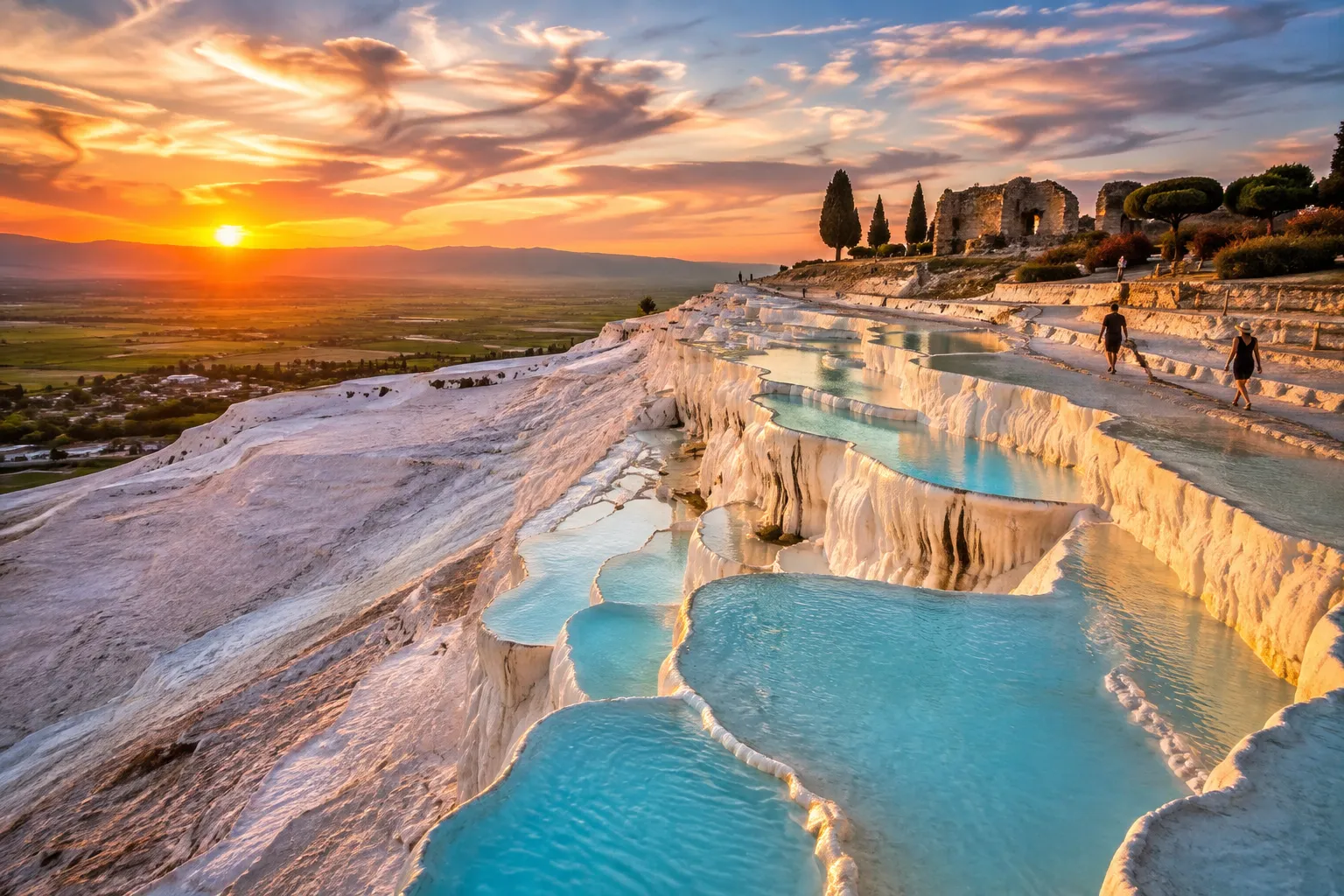
Pamukkale, Turkish for “Cotton Castle”, is a UNESCO World Heritage Site where calcium-rich thermal water has spent thousands of years building blindingly white travertine terraces down a 160-meter hillside. It looks like someone draped an entire cliff in meringue, and honestly, photos don’t do it justice.
The thermal springs emerge at roughly 36°C (97°F) and deposit calcium carbonate as they cool, creating those signature crescent-shaped pools. The site has drawn wellness seekers since at least the 2nd century BCE, when the Greco-Roman city of Hierapolis was built directly on top of the plateau to take advantage of the hot springs [1][3].
Here’s the magic: Pamukkale isn’t just a natural wonder. It’s a natural wonder with a 2,200-year-old city sitting on its head. That combination of geology and archaeology in one ticket is what makes it one of Turkey’s most visited destinations, and one of the most worthwhile entries on any list of ancient ruins worth visiting in Turkey.
Best Time to Visit Pamukkale in 2026
April through June and September through October offer the sweet spot of manageable crowds, comfortable walking temperatures (20-28°C), and the best light for photos. The travertines practically glow during golden hour in spring and autumn.
Summer (July, August): The terraces are open until 21:00, which is great, but midday temperatures can hit 38°C+ and the white calcium surface amplifies the heat like a reflector oven. If summer is your only option, arrive at opening (06:30) or come after 17:00 [6].
Winter (November, March): Shorter hours (08:00-18:00) and cooler weather, but far fewer visitors. The thermal water still flows warm, and there’s something almost surreal about wading through steaming pools on a crisp January morning.
Pro move: Visit on a weekday regardless of season. Weekend crowds, especially from domestic tourism, can triple the foot traffic on the terraces.
How Much Does It Cost to Visit Pamukkale and Hierapolis?
The combined entrance ticket costs €30 per person in 2026, covering the travertine terraces, Hierapolis ruins, and the Hierapolis Archaeological Museum [6][11].
| Item | Cost (2026) | Notes |
|---|---|---|
| Combined site ticket | €30 | Travertines + Hierapolis + Museum [6] |
| Cleopatra’s Antique Pool | ~€13 extra | Separate admission, summer hours 08:00-19:00 [4] |
| Dolmuş from Denizli | ~€1-2 | Each way, from Denizli otogar |
| Guided tour (optional) | €40-80 | Varies by operator and group size |
| Towel rental on-site | ~€2-3 | Available near Cleopatra’s Pool |
Fair warning: Prices are often listed in Turkish Lira (roughly 150-250 TRY for Cleopatra’s Pool), and exchange rates fluctuate. Carry some lira for small purchases, card acceptance at the village shops can be spotty [3][10].
Children under 8 typically enter free, and there are occasional discounts for students with valid international student IDs. Check the ticket booth for current promotions.
What Are the New Accessibility Upgrades at Pamukkale 2026?
Pamukkale has historically been challenging for visitors with mobility issues, uneven travertine surfaces, steep ancient paths, and limited infrastructure. In 2026, Turkish authorities have made notable improvements to change that.
Key upgrades include:
- Widened paved pathways connecting the south entrance to the Hierapolis plateau, allowing wheelchair and stroller access to the upper archaeological zone
- Improved ramp systems near the Roman theater and the museum entrance
- Better signage with multilingual accessibility information at both the north and south gates
- Shaded rest areas with benches along the main walking routes, a small but meaningful addition when the sun is relentless
What hasn’t changed: The travertine terraces themselves remain naturally uneven, and the barefoot-only rule applies to everyone. Wheelchair users can view the terraces from paved overlook points but cannot traverse the calcium formations directly. Cleopatra’s Antique Pool also has limited step-free access, though staff are generally helpful.
For travelers with mobility considerations, entering from the south gate (top of the hill) and working downhill is significantly easier than climbing up from the village-level north entrance.

Can You Swim in Pamukkale Thermal Pools?
No, you cannot swim in the travertine terraces. This is the single most common misconception, and 2026 rules are unusually clear about it [1][5]. You can wade barefoot through shallow pools on designated paths, the water is typically ankle- to calf-deep, but full immersion swimming in the terraces is strictly prohibited.
Here’s what nobody tells you: The calcium carbonate formations that make Pamukkale so stunning take decades to build up even a few centimeters. Sunscreen, body oils, and heavy foot traffic can discolor and erode them. The barefoot-only, no-swimming policy exists because the alternative is watching this place slowly dissolve [5].
Where you CAN swim: Cleopatra’s Antique Pool, located within the Hierapolis site, is a warm (36°C) thermal pool scattered with ancient marble column fragments. It costs ~€13 on top of your site ticket and is open 08:00-19:00 in summer [4]. The experience of floating among submerged Roman columns is absolutely worth it, consider this your sign to budget for it.
How Long Does It Take to Visit Pamukkale and Hierapolis?
Plan for 4-6 hours to see the main attractions without feeling rushed. Here’s a realistic breakdown:
- Travertine terraces: 1-1.5 hours for walking, wading, and photos
- Hierapolis ruins (theater, necropolis, main street): 1-2 hours
- Cleopatra’s Antique Pool: 1-1.5 hours (including changing time)
- Hierapolis Archaeological Museum: 30-45 minutes
If you’re a history enthusiast who wants to explore the massive Hierapolis necropolis (one of the largest ancient cemeteries in Anatolia), add another hour. The site is genuinely huge, Hierapolis covers roughly 1,000 meters of plateau.
Steal this tip: Start at the south (upper) entrance early morning, explore Hierapolis first while it’s cool, then descend through the terraces as the light improves for photography.
What’s the Difference Between Pamukkale and Hierapolis?
Pamukkale refers to the natural travertine terraces, the white calcium formations and thermal pools. Hierapolis is the ancient Greco-Roman city built on the plateau directly above the terraces. They’re physically connected and covered by one ticket, but they’re distinct experiences [2].
Think of it this way: Pamukkale is the geology, Hierapolis is the archaeology. One is nature showing off; the other is humanity showing off on top of nature.
Hierapolis highlights include:
- A remarkably well-preserved Roman theater seating 12,000
- The Plutonium, a cave once believed to be an entrance to the underworld (seriously)
- An enormous necropolis with over 1,200 tombs spanning multiple centuries
- The Hierapolis Archaeological Museum housed in restored Roman baths
- The Martyrium of St. Philip, an important early Christian pilgrimage site
For those interested in Turkey’s religious heritage, Hierapolis connects to a broader network of top religious sites across the country.
What Ancient Ruins Can You See at Hierapolis Beyond the Travertines?
Hierapolis isn’t just the travertine backdrop — the ruins on the plateau above the pools are worth building time into your visit. The Temple of Apollo, built over a natural cave once believed to be a gateway to the underworld (locally known as the Plutonium), was where ancient priests reportedly demonstrated the site’s toxic geothermal gases to visitors as a display of divine power. Nearby, the Frontinus Gate — a well-preserved Roman-era monumental entrance from the 1st century AD — marks the original approach into the ancient city and is one of the most intact structures on site.
Best Day Trip Route from Denizli to Pamukkale
The most efficient day trip from Denizli follows this route, and it works whether you’re on a dolmuş or driving yourself.
Recommended itinerary:
- 07:00, Depart Denizli otogar (bus station) via dolmuş to Pamukkale village (~25 min)
- 07:30, Enter through the village (north) gate, walk up through the travertines barefoot
- 09:00, Reach the plateau; explore Hierapolis ruins and the Roman theater
- 10:30, Visit the Hierapolis Archaeological Museum
- 11:30, Swim in Cleopatra’s Antique Pool (bring a swimsuit and small towel)
- 13:00, Lunch in Pamukkale village (the gözleme at family-run spots near the north gate is ridiculously good)
- 14:00, Return to Denizli by dolmuş, or continue exploring the village
Alternative for drivers: If you’re renting a car or coming from the coast, enter via the south gate (top entrance), which has a large parking area. This lets you start at Hierapolis and walk downhill through the terraces, easier on the legs.
For a broader Turkish road trip context, the Denizli region also sits along routes that connect to Turkey’s wine country, making a multi-day southwestern Turkey loop very doable.

How Do I Get from Denizli to Pamukkale?
Dolmuş (shared minibus) is the easiest and cheapest option. Minibuses depart from Denizli’s main otogar roughly every 15-20 minutes during peak season, cost about €1-2, and take 25-30 minutes [2][3].
Other options:
- Taxi: Around €15-20 one way; useful if you’re in a group or arriving late
- Rental car: Gives maximum flexibility, especially if combining with other Denizli-area stops; parking available at both the north and south gates
- Organized tours: Many operators run day trips from Denizli (and even from coastal cities like Antalya or Bodrum), typically including transport, guide, and lunch for €40-80
Getting to Denizli itself: Denizli Çardak Airport receives domestic flights from Istanbul (about 1 hour). Long-distance buses connect Denizli to Istanbul (10 hours), Antalya (3 hours), and İzmir (~4 hours). The Denizli train station also has connections to İzmir via the regional rail network.
What Should I Wear to Pamukkale Thermal Pools?
Shoes come off on the travertines, this is non-negotiable and enforced in 2026 [5]. Beyond that, dress for comfort and practicality.
Packing checklist:
- Swimsuit (worn under clothes) for Cleopatra’s Pool
- Quick-dry shorts or a skirt that you don’t mind getting wet at the hem
- Waterproof phone pouch, the terraces are slippery and phones have met watery ends here
- Sunscreen (apply before reaching the travertines, not on them, the runoff damages formations)
- Sunglasses and a hat, the white surface reflects intense light
- A plastic bag for carrying shoes while barefoot
- Small towel (or rent one near Cleopatra’s Pool for ~€2-3)
Common mistake: Wearing jeans or long pants that drag in the water. You’ll be wading through ankle-deep thermal pools, and wet denim is nobody’s friend. Lightweight, roll-up clothing is the pro move.
Is Pamukkale Good for People with Mobility Issues?
It’s significantly better in 2026 than in previous years, but it still has limitations. The new paved pathways and ramps make the Hierapolis plateau and museum accessible for wheelchair users and those with limited mobility. The south (upper) entrance is the best starting point because it avoids the steep uphill climb through the terraces.
What’s accessible:
- Paved paths from south gate to Hierapolis ruins, museum, and Cleopatra’s Pool area
- The Roman theater viewing area (though the theater seating itself involves steps)
- Shaded rest stops along main routes
What remains challenging:
- The travertine terraces themselves, uneven, wet calcium surfaces with no handrails
- Cleopatra’s Pool entry involves steps into the water
- The necropolis area has rough, unpaved terrain
For family-friendly travel planning in Turkey, Pamukkale works well for families with strollers if you stick to the upper plateau routes.
Is Pamukkale’s Ecosystem Under Pressure? 2025 Visitor Numbers and Conservation Status
Pamukkale drew roughly 2.3 million visitors in 2025, and that volume has kept conservation on the agenda for the site’s managers. The IUCN’s 2025 World Heritage Outlook assessment flagged ongoing concerns about water management and tourism pressure on the travertine formations, reinforcing why Turkey’s Ministry of Culture has continued tightening visitor rules and rolling out e-ticketing ahead of the 2026 season.
The white terraces themselves are a natural phenomenon roughly 400,000 years in the making: calcium-rich thermal water, heated to 36–38°C deep in the Denizli basin, rises to the surface and releases dissolved CO2 as it cools and flows downhill. That CO2 loss causes calcium carbonate to precipitate out of the water, building up the travertine terraces layer by layer — the same slow process still shaping the pools today.
Sources: IUCN World Heritage Outlook 2025 assessment (worldheritageoutlook.iucn.org); 2025 visitor statistics and 2026 e-ticketing update (Turkish Ministry of Culture channels).
What Are Common Mistakes Visitors Make at Pamukkale?
Bookmark this, future you will thank us.
- Arriving midday in summer. The white travertines become a solar reflector. Arrive early or late.
- Skipping Hierapolis entirely. Roughly 40% of visitors only see the terraces and miss one of Turkey’s most impressive ancient cities sitting right there [2].
- Forgetting sunscreen (or applying it on the terraces). Apply before you arrive. Sunscreen residue in the thermal water damages the calcium formations [5].
- Not bringing a swimsuit. Cleopatra’s Pool is the highlight for many visitors, and discovering you can’t swim because you didn’t pack a suit is genuinely heartbreaking.
- Wearing socks on the travertines. Some visitors try this as a shoe alternative. It’s slippery, not allowed, and you’ll get asked to remove them [5].
- Underestimating the site’s size. Hierapolis alone stretches over a kilometer. Wear comfortable shoes for the non-travertine portions.
- Not carrying water. Shade is limited on the terraces, and dehydration sneaks up fast.
Can You Visit Pamukkale and Cappadocia in One Trip?
Absolutely, and you should. These two destinations pair beautifully for a 5-7 day Turkey itinerary combining natural wonders, ancient history, and surreal landscapes.
How to connect them:
- Domestic flight: Denizli Çardak Airport to Kayseri or Nevşehir (Cappadocia’s airports), about 1.5 hours with a connection through Istanbul. Book early for fares around €40-80 one way.
- Overnight bus: Direct buses run Denizli to Göreme/Nevşehir (~10 hours). Budget option, and Turkish long-distance buses are surprisingly comfortable.
- Rental car: A scenic but long drive (~7-8 hours) through central Anatolia.
A solid combo itinerary: two days in the Pamukkale/Denizli area, travel day, then two to three days exploring Cappadocia’s fairy chimneys and underground cities. Add a hot air balloon flight in Cappadocia and you’ve got a trip that’ll make everyone back home deeply jealous.
Are There Hotels Near Pamukkale or Should I Stay in Denizli?
Stay in Pamukkale village if early-morning access matters to you. The village sits right at the north gate, and being able to walk onto the terraces at 06:30 before the tour buses arrive is a total game-changer for photos and peaceful wading.
Pamukkale village pros:
- Walking distance to the north entrance
- Small, family-run pensions with genuine Turkish hospitality (which is no joke)
- Several hotels have their own thermal pools
- Quieter, more atmospheric evenings
Denizli pros:
- More hotel variety across all budgets
- Better restaurant and shopping options
- Easier transport connections for onward travel
- More reliable Wi-Fi and amenities for digital nomads
The verdict: For one night, Pamukkale village. For a longer base exploring the wider Denizli region, the city itself. Many village pensions offer rooms for €30-60 per night, while Denizli has everything from budget chains to comfortable four-star hotels.
For more practical travel tips for navigating Turkey, including accommodation strategies, check out the full tips collection.
Conclusion
Pamukkale and Hierapolis deliver one of Turkey’s most extraordinary one-two punches: otherworldly natural beauty and genuinely significant ancient history, all reachable in under 30 minutes from Denizli. The 2026 season brings clearer visitor rules, improved accessibility, and the same jaw-dropping terraces that have drawn travelers for over two millennia.
Your action plan:
- Book your Denizli transport, flights from Istanbul are quick, buses from coastal cities are affordable
- Choose your base, Pamukkale village for early access, Denizli for variety
- Pack smart, swimsuit, sunscreen (applied beforehand), quick-dry clothes, waterproof phone pouch
- Budget €45-50 per person for site entry plus Cleopatra’s Pool
- Enter early, start high, south gate at opening, Hierapolis first, terraces as you descend
- Consider combining with Cappadocia for a 5-7 day trip that covers Turkey’s greatest hits
Prepare to be obsessed. The terraces really do look like they belong on another planet, and yet they’re right here, in southwestern Turkey, waiting for your bare feet.
FAQ
Is Pamukkale worth visiting in 2026? Yes. The site remains one of Turkey’s most visually stunning destinations, and 2026 accessibility upgrades and clearer conservation rules make the visitor experience better than in recent years [5][6].
Can I visit Pamukkale for free? No. A combined ticket costing €30 is required for entry to the travertines, Hierapolis, and the museum [6]. Cleopatra’s Pool costs an additional ~€13 [4].
Is the water at Pamukkale safe to touch? Yes. The thermal water is mineral-rich and safe for skin contact. You’ll be wading barefoot through it on the terraces. The water temperature hovers around 36°C (97°F) [3].
How slippery are the travertines? Moderately slippery, especially on wet calcium surfaces. Walk slowly and carefully, particularly on slopes. The surface feels smooth and slightly gritty underfoot.
Do I need a guide for Pamukkale? Not required, but a guide significantly enriches the Hierapolis portion. The ruins are extensive and the historical context, from Roman bath culture to early Christianity, is fascinating with expert narration [2].
Can I bring food and drinks onto the terraces? Food is generally discouraged on the travertine surfaces to prevent litter and contamination. Water bottles are fine and strongly recommended. Eat in the village or at the on-site café near Cleopatra’s Pool.
Is there Wi-Fi at Pamukkale? Limited. Some cafés near the entrances offer Wi-Fi, but don’t count on connectivity on the terraces or throughout Hierapolis. Download offline maps before arriving.
What time does Pamukkale close in summer 2026? Summer hours run approximately 06:30-21:00 for the main site, with last entry around 18:50. Cleopatra’s Pool closes at 19:00 [4][6].
Are drones allowed at Pamukkale? No. Drone flying is prohibited at the site without special authorization from Turkish authorities. This is enforced and violations can result in equipment confiscation.
Can I visit Pamukkale from Antalya as a day trip? Yes, but it’s a long day, roughly 3 hours each way by car or bus. Many tour operators run Antalya-to-Pamukkale day trips. An overnight stay in Pamukkale village or Denizli makes the experience much more relaxed.
References
[1] Pamukkale Travel Guide 2026 Unesco Cotton Castle Travertines – https://www.machupicchu.org/pamukkale-travel-guide-2026-unesco-cotton-castle-travertines.htm [2] Pamukkale Hierapolis Ultimate Guide 2026 – https://toursce.com/blog/pamukkale-hierapolis-ultimate-guide-2026/ [3] Pamukkale Hot Springs Guide – https://sahinogluturizm.com.tr/en/blog/travel-guide/pamukkale-hot-springs-guide [4] Cleopatra Antique Pools – https://www.allistanbultours.com/things-to-do/cleopatra-antique-pools/ [5] What Are Pamukkale Visiting Rules In 2026 Entry Guide – https://www.guidedistanbultours.com/en/blog/what-are-pamukkale-visiting-rules-in-2026-entry-guide [6] travelpamukkale – https://travelpamukkale.com/ [10] Pamukkale Travel Guide Cotton Castle Thermal Pools 2026 – https://antalyatransfer.taxi/en/blog/pamukkale-travel-guide-cotton-castle-thermal-pools-2026
Book Your Visit
Skip the entrance queue: browse Pamukkale day tours and combo tickets on GetYourGuide.