

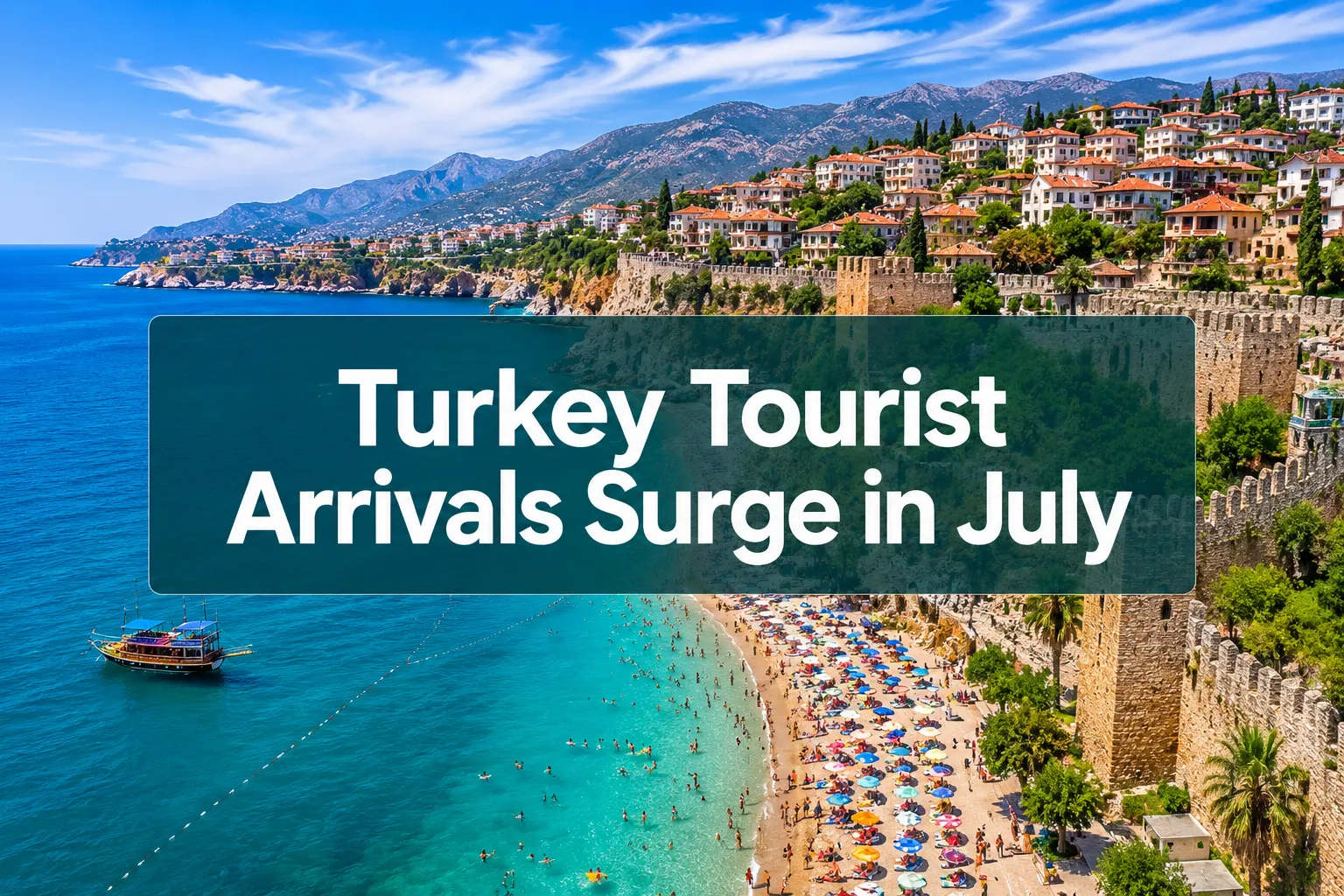
Turkey welcomed a record-breaking wave of tourists in July 2026, signaling exciting changes ahead for future travelers. Last updated: August 16, 2026
Quick Answer: Turkey’s tourism industry recorded a significant rebound in July 2026, with arrivals returning to year-on-year growth after a soft start to the year. Antalya alone had welcomed more than 6.5 million foreign visitors by July 20, with projections pointing toward 8 million by month’s end. For anyone planning a trip, this surge means higher hotel occupancy, tighter availability on popular routes, and a need to book earlier than you might expect.
Key Takeaways
- Turkey welcomed approximately 25.8 million international visitors in the first half of 2026, generating around $25.75 billion in tourism revenue, nearly flat year-on-year despite a 2.4% dip in visitor numbers [6][10]
- January through May 2026 saw arrivals down 2.56% year-on-year, but June hit a record monthly high of approximately 5.54 million visitors, signaling a strong summer rebound [4][14]
- July 2026 confirmed the turnaround, with the Ministry of Culture and Tourism reporting a return to year-on-year growth [6][10]
- Antalya surpassed 6.5 million foreign arrivals by July 20, 2026, with local projections nearing 8 million by month’s end [3]
- Russia, Germany, and the United Kingdom remain the top source markets, with Ukrainian visitor numbers also growing [3]
- Cruise tourism hit its strongest first-half performance on record, with 756,455 passengers in H1 2026 [13]
- Higher per-capita spending (despite slightly fewer total visitors) means Turkey’s hospitality sector is prioritizing mid-to-upper-tier offerings over heavy discounting [6][10]
- Travelers visiting in late July and August should book flights and accommodation well in advance, especially for Cappadocia, Antalya, and Istanbul
Why Are So Many Tourists Going to Turkey in July 2026?
Turkey’s July surge is driven by a combination of strong European demand for sun-and-sea holidays, competitive pricing relative to Western Mediterranean alternatives, and a recovery in traveler confidence after a slower spring. Russia, Germany, and the UK continue to send the largest volumes of visitors, and the Ukrainian market is growing year-on-year [3].
The country’s geography does most of the heavy lifting: July delivers near-guaranteed sunshine across the Aegean and Mediterranean coasts, water temperatures perfect for swimming, and long daylight hours. Add in Turkey’s extraordinary range of experiences (Ottoman history, Cappadocian landscapes, Turquoise Coast beaches, world-class food) and you have a destination that genuinely competes with anywhere in Europe at a fraction of the cost.
Here’s what nobody tells you about the July spike: it’s not just leisure travelers. The cruise segment is booming too. Turkey recorded approximately 756,455 cruise passengers in the first half of 2026 alone, the strongest H1 cruise performance on record [13]. Ports like Kuşadası, Istanbul, and Izmir are noticeably busier on ship days, which can mean unexpected queues at sites like Ephesus.
How Does the Turkey Tourist Arrivals Surge in July 2026 Compare to the Rest of the Year?

2026 is shaping up as a classic “dip then rebound” year. Foreign arrivals were down 2.56% year-on-year in January through May, with May alone recording 4.86 million visitors, a 3.58% decline [4]. Then June exploded: approximately 5.54 million arrivals in a single month, described in macroeconomic reviews as a record monthly high [14][15]. July confirmed the recovery, with the Ministry of Culture and Tourism reporting a return to year-on-year growth [6][10].
The 2026 monthly pattern at a glance:
| Period | Arrivals | Trend |
|---|---|---|
| Jan, May 2026 | 15.23 million | Down 2.56% YoY |
| May 2026 (alone) | 4.86 million | Down 3.58% YoY |
| June 2026 | ~5.54 million | Record monthly high |
| July 2026 | Rebound confirmed | YoY growth returns |
| H1 2026 total | ~25.8 million | Down ~2.4% vs H1 2025 |
For travelers, the practical takeaway is this: late summer and autumn 2026 will feel close to the record-breaking 2024-2025 crowd levels, not like a quiet off-season. Plan accordingly.
Is July a Good Time to Visit Turkey, or Should You Go Another Month?
July is genuinely spectacular in Turkey, but it’s also the most demanding month to visit. Coastal resorts are at peak occupancy, temperatures in inland cities like Ankara or Cappadocia can exceed 35°C, and popular attractions run long queues.
Choose July if:
- Beach and sea are your priority (the Aegean and Mediterranean are at their warmest and most inviting)
- You’re booking an all-inclusive resort package and want the full summer atmosphere
- You’re flexible enough to visit major sites at opening time (before 9am) or late afternoon
Consider April, May, or September, October if:
- You prefer cooler temperatures for city sightseeing and hiking
- You want shorter queues at Cappadocia, Pamukkale, or Ephesus
- You’re traveling on a tighter budget (shoulder season rates can be meaningfully lower)
- You’re planning a hot air ballooning experience in Cappadocia, spring and autumn offer better flight conditions and smaller crowds
Fair warning: September is no longer the “secret” shoulder month it once was. As Turkey’s tourism profile has grown, September has become nearly as busy as July in some coastal areas.
What Cities in Turkey Are Most Crowded in July?
Antalya is the undisputed epicenter of the July surge. By July 20, 2026, the city had already welcomed more than 6.5 million foreign tourists since January 1, with local tourism leaders projecting the figure could approach 8 million by month’s end as hotels neared full occupancy [3]. That’s not a typo, Antalya is processing roughly the population of Switzerland in a single summer season.
Most crowded destinations in July:
- Antalya and the Turkish Riviera (Belek, Kemer, Side, Alanya): All-inclusive resort zone at maximum capacity
- Istanbul: Year-round busy, but July adds cruise ship days and peak European holiday traffic; check our guide to Istanbul’s top must-see sites in 2026 for timing tips
- Cappadocia (Göreme, Ürgüp): Hot air balloon slots sell out weeks ahead; accommodation in the cave hotel belt books solid
- Pamukkale: Cruise day crowds can be intense, especially mid-morning
- Bodrum and Fethiye: Popular with European yacht charter crowds and independent travelers; adventure sports in Fethiye are in full swing
How Does the Turkey Tourist Surge Affect Hotel Prices and Availability?
Higher per-capita spending in 2026 (even with slightly fewer total visitors) signals that Turkey’s hospitality sector is moving upmarket rather than discounting [6][10]. Budget travelers should not expect the rock-bottom deals that were available in quieter years.
What this means in practice:
- Book at least 6-8 weeks ahead for July and August stays in Antalya, Cappadocia, or Bodrum
- All-inclusive packages from European source markets (especially Germany, Russia, and the UK) lock up large resort blocks early [3]
- Mid-range and boutique hotels in popular areas are filling faster than in 2024-2025
- Last-minute deals are rare in peak season; flexible cancellation policies are worth paying a small premium for
- Cruise port days in Istanbul, Kuşadası, and Izmir create micro-surges in local accommodation demand; check port schedules before booking nearby stays
Pro move: If your dates are flexible, arriving on a Tuesday or Wednesday (rather than Saturday) can still yield better rates and shorter airport queues.
Are There Less Touristy Places to Visit in Turkey During July?
Absolutely, and this is where it gets fun. Turkey is enormous (roughly the size of Texas and California combined), and the tourist surge is heavily concentrated in a handful of coastal and heritage hotspots. Venture slightly off the well-worn path and you’ll find yourself with ancient ruins, dramatic landscapes, and genuine Turkish hospitality all to yourself.
Seriously underrated July alternatives:
- Safranbolu: A UNESCO-listed Ottoman townscape in northern Turkey with almost no international crowds; the wooden konak houses are a chef’s kiss
- Kastamonu and Amasya: Riverside Ottoman towns that history buffs will adore; see our guide to destinations in Turkey best for history buffs
- Trabzon and the Black Sea coast: Cooler temperatures, lush green mountains, and a completely different cultural flavor from the Mediterranean
- Mardin: Honey-colored stone city near the Syrian border with extraordinary Syriac Christian heritage
- Iztuzu Beach (Dalyan): Protected loggerhead turtle nesting beach, far quieter than Bodrum or Marmaris
- The Kaçkar Mountains: Trekking terrain that rivals the Alps, with a fraction of the foot traffic
Steal this tip: Turkey’s archaeological sites outside the main tourist circuit (think Aphrodisias, Hierapolis, or Ani) are often deserted even in peak season.
Turkey Travel Tips for Avoiding Crowds in Summer

The Turkey tourist arrivals surge in July 2026 is real, but it’s manageable with a few smart moves. Here’s what the crowds can’t take away from you if you plan well.
Practical crowd-avoidance strategies:
- Visit major sites at opening time (usually 8am or 8:30am). The difference between 8am and 10am at Hagia Sophia or Ephesus is genuinely staggering.
- Book Cappadocia balloon flights at least 3-4 weeks ahead. Slots are finite and sell out; read our full guide to hot air ballooning in Turkey before you go.
- Check cruise ship schedules for Kuşadası and Istanbul. When three ships dock simultaneously, Ephesus can feel like a theme park. Visit on non-ship days for a completely different experience.
- Travel between cities on overnight buses or trains. You save a night’s accommodation and arrive fresh.
- Eat dinner at 7pm rather than 9pm. Restaurants are quieter, staff are less stretched, and the food is just as good.
- Pack lightweight, breathable clothing. July temperatures in coastal areas average 30-35°C; in Cappadocia, evenings can still drop sharply. Layers are your friend.
- Stay hydrated obsessively. Turkish summers are no joke. Carry a refillable bottle; most mosques and public fountains have potable water.
If you’re visiting religious sites, review the dos and don’ts for religious site visits in Turkey before you arrive, modest dress and quiet behavior go a long way toward a more genuine experience.
Turkey Visa Requirements and Processing Times for Summer Travel
Most travelers need to obtain an e-Visa before arriving in Turkey. The process is entirely online through the official Turkish e-Visa portal and typically takes minutes to complete, though processing can extend to 24-72 hours during peak periods.
Key points for summer 2026:
- E-Visa eligible nationalities (including most EU, UK, and US passport holders) should apply at least 72 hours before departure
- Visa on arrival is no longer available for most nationalities; do not arrive without a pre-approved e-Visa or relevant exemption
- Validity: Most e-Visas allow a 30-day or 90-day stay within a 180-day window, depending on nationality
- Cost: Varies by nationality; check the official Turkish e-Visa website for current fees
- Passport validity: Turkey requires at least six months of remaining passport validity beyond your entry date
Common mistake: Travelers sometimes confuse the official Turkish e-Visa portal with third-party sites that charge service fees on top of the visa cost. Always use the official government portal (evisa.gov.tr).
How Does the July Surge Impact Local Infrastructure and Services?
The surge creates real pressure on Turkey’s transport and hospitality infrastructure, particularly in Antalya, where hotels were approaching full occupancy by mid-July 2026 [3]. Airports, roads, and popular beaches all feel the strain.
What travelers should anticipate:
- Antalya Airport handles enormous volumes in July; allow extra time for arrivals and departures
- Intercity buses on popular routes (Istanbul, Cappadocia, Antalya, Fethiye) book up; reserve seats in advance
- Pamukkale and Cappadocia have introduced (or expanded) timed entry systems; check current requirements before visiting
- Water and electricity supply in smaller coastal towns can be stressed during peak weeks; this is rare but worth knowing if you’re staying in a boutique guesthouse rather than a large resort
- Turkish hospitality is no joke, even under pressure, service standards remain high, but patience and a few words of Turkish (teşekkür ederim, thank you) go a very long way
What Should Travelers Pack and Prepare for During Turkey’s Peak Tourism Season?
Turkey in July demands a specific packing strategy. The coast is hot and sunny; Cappadocia nights are cool; mosques require covered shoulders and legs; and the terrain ranges from marble ruins to cobblestone bazaars.
The essential July packing list:
- Lightweight, modest clothing (linen or moisture-wicking fabrics; a scarf doubles as sun protection and mosque cover)
- Comfortable walking shoes with grip (ancient sites have uneven, slippery marble)
- High-SPF sunscreen (harder to find locally in the brands you trust)
- Reusable water bottle (stay hydrated; Turkish tap water is generally safe in cities but bottled is standard in rural areas)
- Power adapter (Turkey uses Type F sockets, 220V)
- Offline maps (Google Maps works well; download your regions before you travel)
- Cash in Turkish lira for markets, small restaurants, and tips (cards are widely accepted in cities but not universal in bazaars)
For those planning to stay healthy and active throughout the trip, our guide to staying healthy and fit while traveling in Turkey covers everything from food safety to heat management.
Common Mistakes Tourists Make When Visiting Turkey in Summer
The Turkey tourist arrivals surge in July 2026 brings a fresh wave of first-time visitors, and some patterns repeat every year.
Avoid these classic errors:
- Booking non-refundable accommodation without checking cruise ship calendars. A ship day at Kuşadası means Ephesus is a different experience entirely.
- Underestimating travel distances. Turkey is large. Istanbul to Cappadocia is roughly a 1.5-hour flight or 10-hour overnight bus, not a day trip.
- Visiting Pamukkale at midday in July. The white travertine terraces reflect heat ferociously. Go early morning or late afternoon.
- Ignoring the shoulder hours at Hagia Sophia. Arriving at 10am means joining thousands of others. The 8am opening is a completely different, almost meditative experience.
- Exchanging currency at the airport. Rates are consistently worse than ATMs or licensed exchange offices (döviz bürosu) in town.
- Assuming everywhere is equally crowded. The surge is real but geographically concentrated. Thirty minutes from any major tourist site, you can often find yourself completely alone.
FAQ
Q: How many tourists visited Turkey in July 2026? A: Exact July 2026 totals are preliminary, but the Ministry of Culture and Tourism confirmed a return to year-on-year growth in July 2026 after several months of decline. Antalya alone was on track to approach 8 million foreign visitors by month’s end [3][6].
Q: Is Turkey too crowded to visit in summer 2026? A: Popular coastal resorts and heritage sites are genuinely busy, but Turkey is large enough that less-visited destinations remain uncrowded. Smart timing (early morning visits, mid-week arrivals) makes a significant difference even in hotspots.
Q: What are the top nationalities visiting Turkey in July 2026? A: Russia, Germany, and the United Kingdom are the dominant source markets, with Ukraine also showing year-on-year growth [3].
Q: How far in advance should I book for July travel to Turkey? A: At least 6-8 weeks ahead for accommodation in Antalya, Cappadocia, and Bodrum. Cappadocia hot air balloon flights should be booked 3-4 weeks out minimum.
Q: Do I need a visa to visit Turkey in summer 2026? A: Most nationalities require a pre-approved e-Visa obtained online before travel. Apply at least 72 hours before departure through the official Turkish e-Visa portal (evisa.gov.tr).
Q: Is Turkey’s tourism revenue growing in 2026? A: Revenue held nearly flat at approximately $25.75-25.8 billion in H1 2026, even as visitor numbers dipped slightly by around 2.4%. This reflects higher per-capita spending rather than a revenue decline [6][10].
Q: What is the best alternative to visiting Turkey in July? A: September and October offer similar weather with smaller crowds and often lower prices. April and May are excellent for sightseeing and hiking without the heat.
Q: Are cruise ports in Turkey busy in summer 2026? A: Yes. Turkey recorded approximately 756,455 cruise passengers in H1 2026 alone, the strongest first-half cruise performance on record. Istanbul, Kuşadası, and Izmir see significant cruise traffic [13].
Q: Is Cappadocia crowded in July 2026? A: Yes. Hot air balloon slots sell out weeks in advance, and cave hotels in Göreme and Ürgüp fill quickly. Book both well ahead and visit major sites at opening time to avoid peak queues.
Q: What is the cheapest time to visit Turkey? A: November through March offers the lowest prices for flights and accommodation, though coastal resorts are largely closed. April, May and October are the best balance of good weather, reasonable prices, and manageable crowds.
Conclusion
The Turkey tourist arrivals surge in July 2026 is a clear signal: Turkey’s summer season is back at full strength, and the country is one of the world’s most compelling travel destinations for good reason. With approximately 25.8 million visitors in the first half of 2026 [10], record cruise numbers [13], and Antalya alone approaching 8 million arrivals by late July [3], the data tells a story of genuine demand, not just statistical noise.
For travelers, this means one thing above all else: plan ahead. Book flights and accommodation early, check cruise ship schedules before locking in dates near major ports, and consider whether shoulder-season travel (April, May or September, October) might deliver a richer experience with fewer logistical headaches.
Your next steps:
- Decide on your core destinations and check availability now, especially for Cappadocia balloon flights and Antalya resorts
- Apply for your e-Visa through the official Turkish government portal well before departure
- Build in at least one “surprise gem” destination beyond the obvious circuit, Turkey rewards the curious traveler disproportionately
- Pack smart for the heat, respect local customs at religious sites, and arrive at major attractions at opening time
Consider this your sign. Future you, standing on a Cappadocian ridge at sunrise with a glass of çay, will absolutely thank you for doing the research now.
References
[1] Tourist Arrivals – https://tradingeconomics.com/turkey/tourist-arrivals [3] Türkiye’s Antalya Surpasses 6.5M Tourists As Summer Season Peaks – https://www.dailysabah.com/business/economy/turkiyes-antalya-surpasses-65m-tourists-as-summer-season-peaks [4] Foreign Tourist Arrivals To Türkiye Decline 2.6 Percent In January-May – https://www.hurriyetdailynews.com/foreign-tourist-arrivals-to-turkiye-decline-2-6-percent-in-january-may-223554 [6] Tourism Revenue Holds Steady Despite Regional Wars Impact – https://www.hurriyetdailynews.com/amp/tourism-revenue-holds-steady-despite-regional-wars-impact-225096 [10] Türkiye Welcomes 25.8mln International Visitors In H1 2026 – https://www.zawya.com/en/business/turkiye-welcomes-25.8mln-international-visitors-in-h1-2026-422164