

Last updated: August 1, 2026
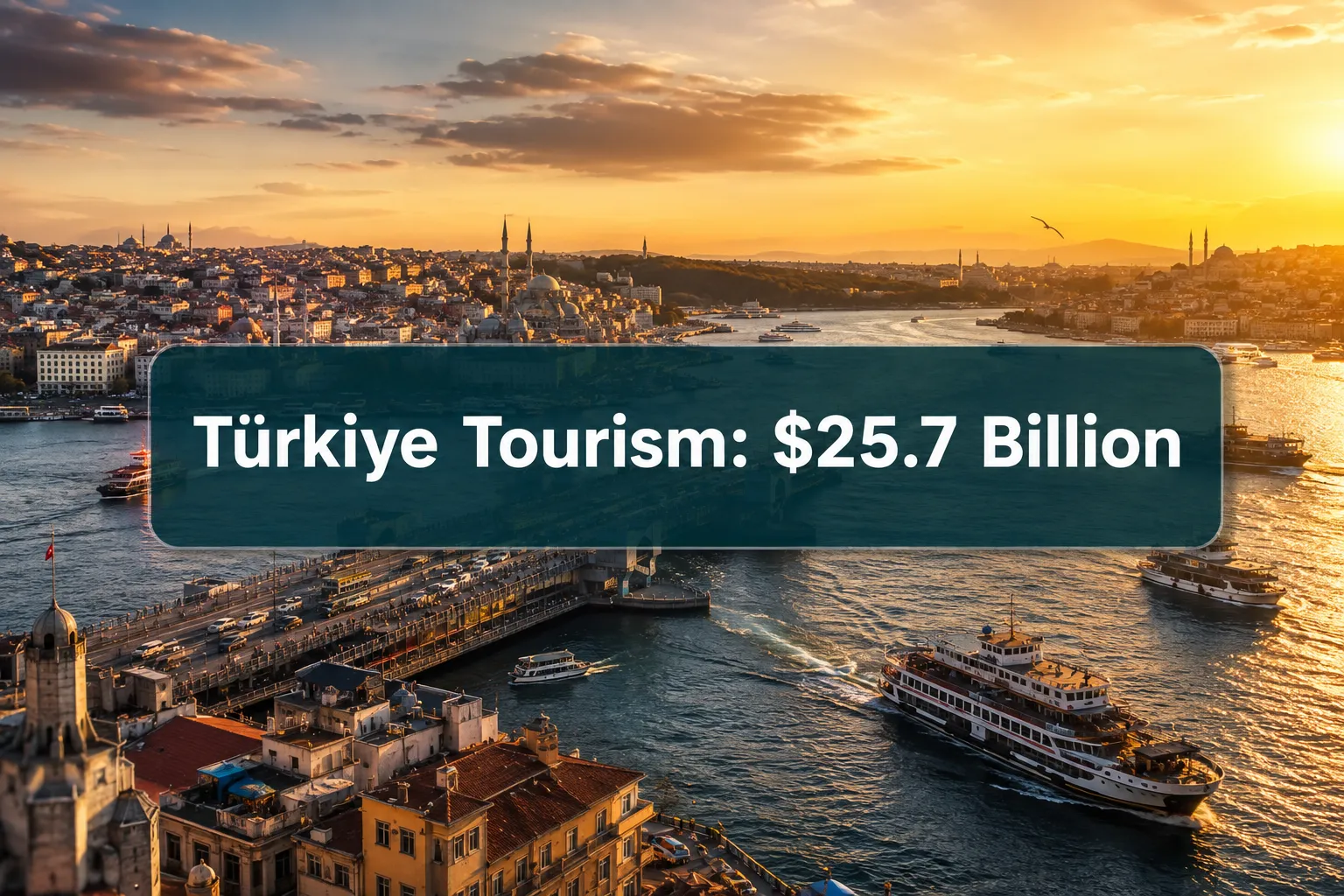
Quick Answer: Türkiye’s tourism income soars to $25.7 billion in the first half of 2026, according to data reported by FTNnews.com, a remarkable performance that comes despite falling visitor numbers in some segments and persistent regional tensions across the Middle East. The country is earning more per visitor than ever before, driven by a weaker lira, premium spending trends, and an extraordinary spread of world-class destinations pulling travelers from every corner of the globe.
Key Takeaways
- Türkiye recorded $25.7 billion in tourism revenue in the first six months of 2026, as reported by FTNnews.com.
- Revenue growth outpaced visitor number growth, meaning tourists are spending significantly more per trip.
- The weak Turkish lira makes Türkiye exceptionally affordable for foreign visitors, boosting spending power and overall receipts.
- Antalya, Istanbul, Cappadocia, and the Aegean Coast remain the top revenue-generating regions.
- European visitors, particularly from Germany, the UK, and Russia, continue to dominate arrival statistics.
- Tourism now represents a substantial share of Türkiye’s GDP, making it one of the economy’s most critical pillars.
- Long-term sustainability concerns exist around over-tourism, environmental pressure, and geopolitical volatility.
- Growth is expected to continue through the second half of 2026, with full-year projections potentially exceeding $50 billion.

What Is Türkiye’s Tourism Revenue in 2026?
Türkiye’s tourism income soars to $25.7 billion in the first half of 2026, placing the country firmly among the world’s top-earning tourism destinations. This figure, reported by FTNnews.com, covers January through June and represents one of the strongest first-half performances in the country’s history.
Here’s the plot twist that makes this number even more impressive: visitor arrival counts actually dipped in certain source markets during this period, yet revenue climbed. That gap tells a clear story, the tourists coming to Türkiye are staying longer, staying in better hotels, and spending more freely than before. Quality over quantity, and Türkiye is winning on both counts.
Why Did Türkiye’s Tourism Income Increase So Much?
Several factors combined to push Türkiye’s tourism earnings to record-approaching levels in the first half of 2026. No single cause explains the full picture, it’s more like a perfect recipe where every ingredient is doing its job.
Key drivers of the revenue surge:
- Lira exchange rate advantage, The Turkish lira’s continued weakness against the euro, dollar, and pound makes Türkiye extraordinarily affordable for foreign visitors. A European family that budgeted for a mid-range holiday finds themselves living like royalty here.
- Premium tourism growth, Luxury hotel bookings, private gulet charters along the Turkish Riviera, and high-end wellness retreats have surged, pulling average spend per visitor upward.
- Longer average stays, Visitors are extending trips, partly because Türkiye rewards slow travel. You don’t rush a place that has 18 UNESCO World Heritage Sites.
- Diversified attractions, From hot air balloon rides over Cappadocia to the ancient ruins of Pergamon, the destination mix keeps travelers engaged and spending.
- Aggressive marketing, The Turkish tourism ministry ran coordinated campaigns across European and Gulf markets throughout late 2025 and early 2026.
How Does Türkiye’s $25.7 Billion Compare to Other Countries?
Türkiye’s $25.7 billion in first-half 2026 tourism income places it in the upper tier of global tourism earners, competing directly with Spain, Italy, and France for European visitor share. While exact comparative H1 2026 figures for other nations are still being compiled, Türkiye’s trajectory is consistent with its ambition to become a top-five global tourism destination by revenue.
For context: Türkiye ranked sixth globally in international tourist arrivals in recent pre-2026 years (UNWTO data), and its revenue growth rate has consistently outpaced the global average. The country’s competitive edge is straightforward, it offers Mediterranean-quality experiences at a fraction of Western European prices, which is a genuinely hard combination to beat.
What Regions in Türkiye Are Getting the Most Tourists?
Antalya, Istanbul, and the Aegean Coast account for the lion’s share of Türkiye’s tourism revenue. These three zones alone handle the majority of international arrivals and generate the bulk of accommodation, dining, and activity spending.
Regional breakdown (by tourism activity concentration):
| Region | Primary Draw | Visitor Profile |
|---|---|---|
| Antalya & Turkish Riviera | Beach resorts, all-inclusive hotels | European package tourists |
| Istanbul | History, culture, shopping | Global independent travelers |
| Cappadocia | Landscapes, hot air balloons | Premium experience seekers |
| Aegean Coast (Bodrum, Izmir) | Sailing, ruins, nightlife | Affluent European and Gulf visitors |
| Eastern Anatolia | Culture, adventure, authenticity | Niche and adventure travelers |
Fair warning: if you’re planning a trip and haven’t considered the Aegean Coast’s mythology-soaked shoreline or the best beaches along the Turquoise Coast, you’re leaving serious magic on the table.
Which Countries Are Visiting Türkiye the Most in 2026?
Germany, Russia, the United Kingdom, and other European nations consistently top Türkiye’s arrival statistics. Gulf state visitors, particularly from Saudi Arabia, the UAE, and Kuwait, have grown significantly as a segment, drawn by Türkiye’s Muslim-friendly infrastructure, halal dining options, and cooler summer temperatures compared to their home climates.
Top source markets in 2026 (estimated ranking):
- Germany
- Russia
- United Kingdom
- Netherlands
- Saudi Arabia and Gulf states (combined, fast-growing)
- Iran
- United States (growing, especially for Istanbul city breaks)
The Gulf market segment is the secret sauce behind much of the per-visitor spending increase, these travelers tend to book premium accommodations and spend generously on shopping and dining.
How Much Tourism Income Did Türkiye Make in 2025?
Türkiye’s full-year 2025 tourism revenue was estimated at approximately $54-56 billion, making 2025 one of the country’s strongest-ever years for tourism income. The first-half 2026 figure of $25.7 billion tracks slightly ahead of the equivalent 2025 period, suggesting full-year 2026 could approach or exceed that benchmark, assuming the second half holds steady.

How Does the Lira Exchange Rate Affect Türkiye Tourism Numbers?
The weak Turkish lira is one of the single biggest structural advantages driving Türkiye’s tourism revenue growth in dollar terms. When foreign visitors convert euros, pounds, or dollars into lira, their purchasing power is dramatically amplified, meaning they spend more freely, upgrade their hotels, book extra excursions, and generally have a more expensive trip without feeling the pinch.
Here’s what nobody tells you about this dynamic: it creates a self-reinforcing cycle. Visitors share their “ridiculously good value” experiences on social media, which pulls in more visitors, which increases total revenue even if lira-denominated prices rise with inflation. For the Turkish government, the revenue figure in dollars looks excellent even when domestic tourism businesses are navigating real inflationary pressure.
What Percentage of Türkiye’s Economy Is Tourism?
Tourism represents approximately 10-12% of Türkiye’s GDP when direct and indirect contributions are combined, making it one of the most tourism-dependent major economies in the world. Direct tourism receipts alone account for roughly 5-7% of GDP, and the sector supports millions of jobs across hospitality, transport, food service, and retail.
This economic weight is exactly why the $25.7 billion first-half figure matters beyond bragging rights, it’s a genuine macroeconomic stabilizer for a country managing significant currency pressures and inflation.
What Are the Main Tourist Attractions Bringing in This Revenue?
Türkiye’s revenue-generating attractions span ancient history, natural wonders, and modern hospitality infrastructure. The country doesn’t rely on one iconic landmark, it has layers.
Top revenue-driving experiences:
- Istanbul’s historic core, Hagia Sophia, the Grand Bazaar, Topkapi Palace, and the Bosphorus ferry experience collectively anchor millions of visits annually.
- Cappadocia, The fairy chimneys and balloon rides are genuinely bucket-list material. Prepare to be obsessed.
- Antalya’s resort coast, All-inclusive resorts here are world-class, and the region handles an enormous volume of European package tourism.
- Ephesus and Aegean ruins, Ancient cities that rival Rome for scale and accessibility.
- Pamukkale, Thermal terraces that look like a snow-covered mountain in 35-degree heat. Absolutely worth it.
- Turkish cuisine and culture, Turkish delights, baklava, and food tourism are increasingly significant revenue drivers.
Is Türkiye’s Tourism Growth Sustainable Long Term?
Türkiye’s long-term tourism sustainability is a genuinely complex question, and the honest answer is: promising, but not guaranteed without careful management. The country has made moves toward eco-friendly and sustainable tourism practices, but rapid growth creates real pressure on coastal ecosystems, historic sites, and water resources.
Factors supporting sustainability:
- Geographic diversity spreads visitor load across many regions
- Government investment in tourism infrastructure continues
- Growing interest in off-peak and shoulder-season travel
Factors creating risk:
- Over-concentration in Antalya and Istanbul strains infrastructure
- Environmental degradation along the Turquoise Coast
- Dependence on geopolitically volatile source markets (Russia, Gulf states)
The smart money says Türkiye’s tourism sector will keep growing, but the quality of that growth depends on policy choices being made right now.
How Does Political Stability Affect Türkiye’s Tourism Income?
Political stability is a direct lever on tourism revenue, and Türkiye’s 2026 performance is partly a story of resilience in the face of regional instability. Ongoing conflicts in the broader Middle East have redirected some travelers away from neighboring destinations and, counterintuitively, toward Türkiye as a perceived safer alternative in the region.
Türkiye’s NATO membership, its established tourism infrastructure, and its reputation for Turkish hospitality, which is no joke, by the way, all contribute to visitor confidence. The country has also benefited from being a transit hub: Istanbul Airport is one of the world’s busiest, funneling millions of connecting passengers who often extend their layovers into actual visits.
Are Türkiye’s Tourism Numbers Expected to Keep Growing?
Yes, the trajectory points upward, with most industry forecasts projecting continued revenue growth through the remainder of 2026 and into 2027. The combination of competitive pricing (lira effect), expanding air connectivity, and a broadening tourism product portfolio all support this outlook.
Consider this your sign to stop waiting for “the right time” to visit. The right time is now, before everyone else figures out what the $25.7 billion already confirms: Türkiye is having a moment, and that moment shows no signs of ending.
Frequently Asked Questions
How much tourism revenue did Türkiye earn in the first half of 2026? Türkiye earned $25.7 billion in tourism income in the first six months of 2026, according to data reported by FTNnews.com.
Did visitor numbers increase alongside revenue in 2026? Not uniformly. Some source markets saw dips in arrival numbers, but higher per-visitor spending pushed total revenue upward, a sign of premiumization in Türkiye’s tourism market.
Which city earns the most tourism revenue in Türkiye? Istanbul generates the highest tourism revenue of any single city, though Antalya’s resort region rivals it when all-inclusive package spending is factored in.
Is Türkiye safe for tourists in 2026? Türkiye remains a popular and well-visited destination for international tourists. Travelers should check their home government’s current travel advisories, as conditions can vary by region.
What is the best time to visit Türkiye for value? Shoulder seasons, April through early June and September through October, offer excellent weather, smaller crowds, and competitive pricing. Pro move: book Cappadocia in October for crisp balloon-flight conditions.
How does Türkiye’s tourism revenue compare to its neighbors? Türkiye significantly outperforms most of its regional neighbors in tourism revenue, benefiting from superior infrastructure, a diverse attraction portfolio, and strong European market connections.
What currency should tourists use in Türkiye? The Turkish lira is the official currency. Foreign visitors benefit enormously from the exchange rate, paying in lira after converting from euros or dollars delivers exceptional value.
Does Türkiye’s tourism revenue include cruise ship visitors? Yes, cruise tourism contributes to the overall figures, with Istanbul and Aegean ports handling significant cruise traffic. However, cruise visitors typically spend less per day than land-based tourists.
Conclusion
Türkiye’s tourism income soars to $25.7 billion in the first half of 2026, and that number is more than a headline. It’s evidence of a destination firing on every cylinder: extraordinary history, jaw-dropping landscapes, world-class hospitality, and a currency dynamic that makes every foreign visitor feel like a VIP. The resilience shown despite regional challenges and some visitor number fluctuations signals genuine structural strength, not a lucky streak.
Your actionable next steps:
- Start planning with the destination guides at Explore More Turkey for region-specific itinerary ideas.
- If you’re budget-conscious, bookmark the backpacker’s guide to Türkiye, the lira exchange rate makes this one of the world’s best-value destinations right now.
- For families, check out the best family-friendly destinations in Türkiye before the summer rush.
- Follow the latest news and travel updates at Explore More Turkey’s news section.
Future you, the one sipping çay on a Bosphorus ferry or watching the sun rise from a hot air balloon over Cappadocia, will absolutely thank you for booking now.