

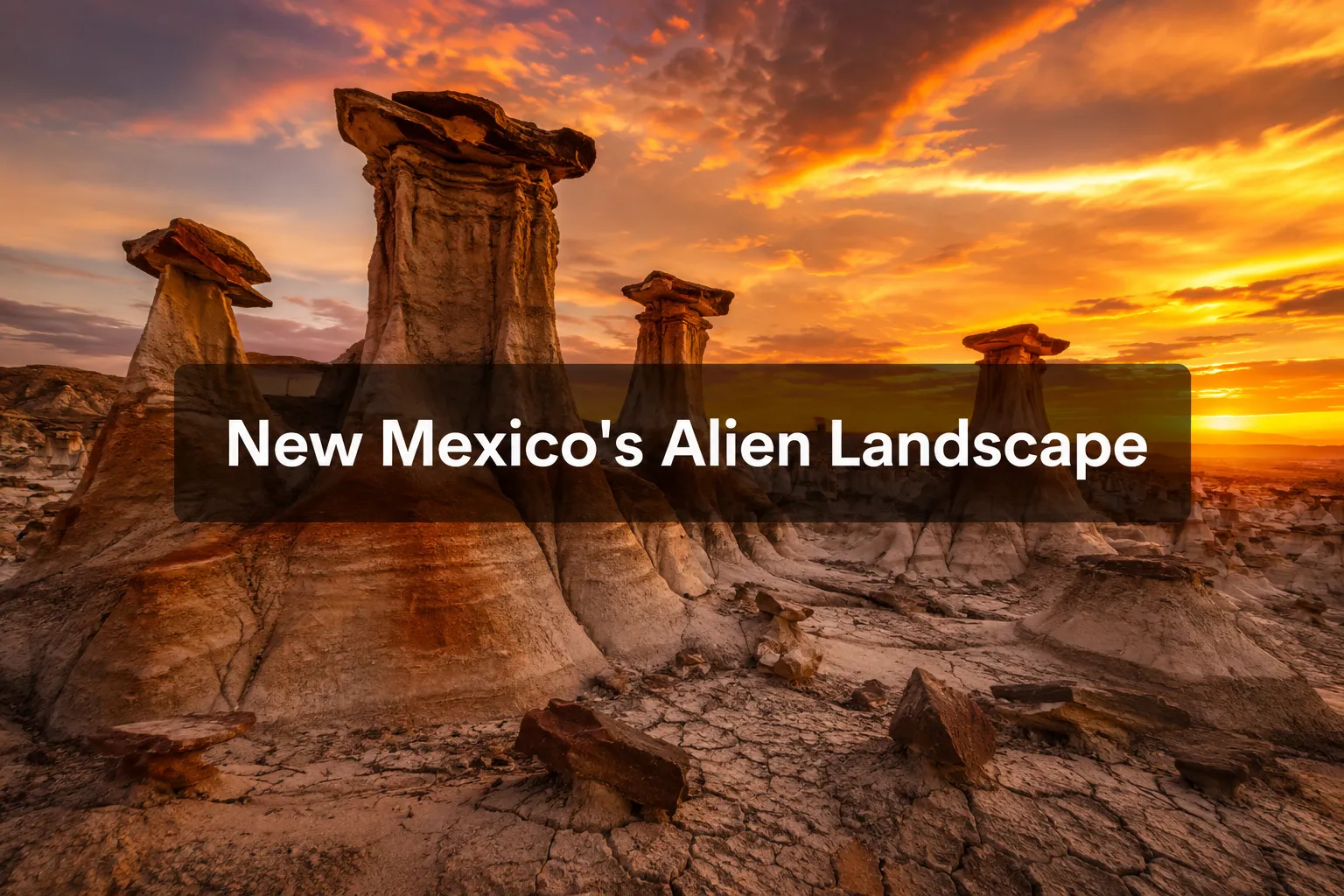
When I first glimpsed New Mexico’s otherworldly rock formations, I immediately thought of Türkiye’s famous Cappadocia region. Last updated: July 25, 2026
Quick Answer: The Bisti/De-Na-Zin Wilderness in northwestern New Mexico is the specific site being called the most alien landscape in the United States and a domestic dupe for Cappadocia, Türkiye. This 45,000-acre BLM-managed badlands area features dramatic hoodoos, eroded shale labyrinths, and petrified wood that visually echo Cappadocia’s fairy chimneys, and it costs nothing to enter. [1]
Key Takeaways
- Bisti/De-Na-Zin Wilderness in northwestern New Mexico is the primary “alien landscape” being compared to Cappadocia, Türkiye, by Travel + Leisure and other major outlets in 2026. [1]
- The wilderness is free to access, open year-round, and managed by the Bureau of Land Management, no entrance fees, no reservations required.
- Nearby Ah-Shi-Sle-Pah Wilderness (home to the Valley of Dreams and the “Alien Throne” hoodoo) adds to a broader cluster of surreal New Mexico landscapes that rival Cappadocia’s fairy chimneys. [7]
- The Bisti Badlands Trail holds a 4.6 rating on AllTrails with over 2,000 reviews, with hikers consistently describing the scenery as “otherworldly” and “like another planet.” [1]
- Unlike Cappadocia, there are no hot air balloon tours, cave hotels, or dense tourist infrastructure, making this a better fit for independent hikers and photographers than for resort-style travelers.
- The best times to visit are spring (April-May) and fall (September-October) to avoid summer heat extremes and winter mud.
- The site is approximately 2.5 hours from Albuquerque and about 3 hours from Santa Fe.
- Visitors must be entirely self-sufficient, no water, no facilities, no cell service in most areas.
- The geology preserves late Cretaceous fossils and petrified wood, giving it scientific depth beyond its photogenic surface. [10]
- For travelers who want the real Cappadocia experience, nothing fully replaces it, but Bisti is a seriously underrated domestic adventure worth booking on its own merits.

What Is the Alien Landscape in New Mexico Called?
The specific site is the Bisti/De-Na-Zin Wilderness Area (pronounced “BIS-tie / deh-NAH-zin”), a federally protected badlands region in San Juan County, northwestern New Mexico. Atlas Obscura describes it as “one of the closest approximations of an unknown alien world” on Earth, featuring massive hoodoos, mushroom-shaped sandstone caps, and labyrinths of eroded ash and shale. [10]
The “alien landscape” label has stuck firmly in travel media. A Travel + Leisure feature published in April 2026 called it the “most alien landscape” in the U.S. and directly named it a dupe for Cappadocia, Türkiye, which is how New Mexico’s ‘Alien Landscape’ Offers a Domestic Dupe for Türkiye’s Cappadocia became a genuine travel conversation in 2026. [1]
The broader cluster also includes the Ah-Shi-Sle-Pah Wilderness Study Area, home to the Valley of Dreams, featuring named formations like the Alien Throne, King of Wings, the Lizard, and the Sentinel. TheTravel.com describes the Valley of Dreams as arguably “an even better alternative to Cappadocia” for formation-hunters. [7]
Where Exactly Is the Alien Landscape in New Mexico?
Bisti/De-Na-Zin Wilderness sits in San Juan County, northwestern New Mexico, roughly 37 miles south of Farmington near the Four Corners region. The main trailhead is accessed via NM Highway 371.
Getting there from major cities:
- From Albuquerque: approximately 2.5 hours (about 170 miles north via US-550)
- From Santa Fe: approximately 3 hours (about 200 miles northwest)
- From Farmington: approximately 37 miles south, under an hour
The Ah-Shi-Sle-Pah Wilderness (Valley of Dreams) is located about 20 miles southeast of Bisti, making a combined day trip or overnight loop entirely possible for dedicated visitors.
Pro move: Download offline maps before you leave cell range. GPS coordinates for the Bisti trailhead: approximately 36.7°N, 108.1°W. Road conditions on the final unpaved stretch can deteriorate after rain, so a high-clearance vehicle is strongly recommended.
What Makes New Mexico’s Landscape Look Alien?
The geology is the secret sauce here. The Bisti/De-Na-Zin formations date to the late Cretaceous period (roughly 70 million years ago), when the region was a coastal swamp at the edge of an inland sea. Layers of mudstone, shale, sandstone, and volcanic ash were deposited over millennia, then exposed by millions of years of wind and water erosion. [10]
The result is a terrain that looks like it was designed by a science fiction concept artist:
- Hoodoos: Tall, narrow rock spires capped by harder stone that resisted erosion while softer material eroded below
- Badlands topography: Deeply furrowed, nearly barren terrain with almost no vegetation
- Petrified wood: Ancient tree trunks turned to stone, scattered across the surface
- Eroded ash formations: Pale, chalky shapes that glow silver in certain light
The lack of vegetation amplifies the effect. Without trees or grass softening the view, the raw geology dominates completely, which is exactly why hikers keep reaching for “another planet” as their go-to description. [1]
For context on Cappadocia’s equally dramatic geology, the must-visit natural wonders in Cappadocia share a similar origin story: volcanic eruptions, erosion, and time.
How Does New Mexico’s Alien Landscape Compare to Cappadocia, Türkiye?
New Mexico’s ‘Alien Landscape’ Offers a Domestic Dupe for Türkiye’s Cappadocia in terms of raw visual drama, but the two experiences are genuinely different in character. Here’s what the comparison actually looks like:
| Feature | Bisti/De-Na-Zin, New Mexico | Cappadocia, Türkiye |
|---|---|---|
| Entry cost | Free | Göreme Open-Air Museum fee applies |
| Rock formations | Hoodoos, badlands, petrified wood | Fairy chimneys, tuff valleys, cave dwellings |
| Hot air balloons | None | World-famous balloon flights |
| Tourist infrastructure | Minimal, self-sufficient required | Extensive, cave hotels, restaurants, tours |
| Crowds | Very low | High, especially April-October |
| Historical depth | Geological/paleontological | Byzantine, early Christian, Hittite history |
| Best for | Photographers, hikers, solitude-seekers | Multi-day cultural + adventure travelers |
The honest verdict: Cappadocia has cultural layers, balloon flights, cave hotels, and millennia of human history baked into its rocks. Bisti has raw, unfiltered geological drama and almost nobody else around. They scratch different itches, but if the fairy chimneys are what you’re chasing, Bisti’s hoodoos will genuinely satisfy that craving. [1][7]
Is the Alien Landscape New Mexico Worth Visiting Instead of Cappadocia?
For U.S.-based travelers who want dramatic hoodoo scenery without international flights, visa logistics, or budget pressure, yes, Bisti/De-Na-Zin is absolutely worth it as a standalone destination. [1]
Choose New Mexico if:
- You’re based in the American Southwest and want a weekend or short road trip
- Solitude and raw wilderness are priorities over amenities
- Photography is the main goal (golden-hour light on those formations is ridiculously good)
- Budget is a factor, free entry, no cave hotel rates
Choose Cappadocia if:
- The hot air balloon experience is non-negotiable (it genuinely is life-changing)
- You want cave hotels, wine valleys, underground cities, and Byzantine frescoes
- You’re already planning a trip to Türkiye
Fair warning: calling Bisti a “dupe” undersells it. It’s not a consolation prize. It’s a world-class geological wonder that happens to be free, uncrowded, and wildly underappreciated. [10] Consider this your sign to book both, eventually.
Curious about what makes Cappadocia so hard to replicate? Explore Türkiye’s best-kept secret destinations for more context on just how deep that country’s landscape goes.
Best Time to Visit New Mexico’s Alien Landscape
Spring (April-May) and fall (September-October) are the best times to visit Bisti/De-Na-Zin. Summer temperatures in the San Juan Basin regularly exceed 95°F (35°C), and afternoon thunderstorms can make the clay-heavy terrain dangerously slippery. Winter visits are possible but cold, and unpaved access roads can become impassable after snow or rain.
Season-by-season breakdown:
- Spring (April-May): Ideal temperatures (55-75°F), occasional wildflowers, soft morning light for photography
- Summer (June-August): Possible but demanding, start before 7am, carry extra water, watch for flash flood warnings
- Fall (September-October): Best overall window, comfortable temps, golden light, dry trails
- Winter (November-March): Dramatic skies and rare snow dusting on formations, but road access is unpredictable
Steal this tip: The formations look most otherworldly at golden hour, roughly 45 minutes before sunset. Time your hike to be deep in the badlands by 5pm in fall, and prepare to be obsessed with what the light does to those rust-and-grey hoodoos.
How Much Does It Cost to Visit the Alien Landscape New Mexico?
Entry to Bisti/De-Na-Zin Wilderness is completely free. The Bureau of Land Management (BLM) manages the area with no entrance fee, no permit requirement, and no reservation system as of 2026. [1]
Realistic trip budget breakdown (per person, day trip from Albuquerque):
- Entrance fee: $0
- Gas (round trip from Albuquerque, ~340 miles): $35-50 depending on vehicle
- Food and water (bring everything): $15-25
- Accommodation (if overnight near Farmington): $70-130/night for budget motels
Compare that to a Cappadocia trip, where cave hotel rooms alone can run $150-400/night during peak season, and the cost difference becomes very obvious very fast.
Can You Hike the Alien Landscape in New Mexico?
Yes, hiking is the primary way to experience Bisti/De-Na-Zin, and it’s genuinely rewarding. The main Bisti Badlands Trail carries a 4.6 rating on AllTrails with over 2,000 reviews, with hikers consistently describing the terrain as otherworldly. [1]
Key hiking details:
- Bisti Badlands Trail: Approximately 5 miles, rated moderate, no marked trail (navigation by landmarks and GPS)
- Valley of Dreams Trail (Ah-Shi-Sle-Pah): Approximately 2.2 miles out-and-back, moderate difficulty, features named hoodoos including the Alien Throne and King of Wings [7]
- Terrain: Cracked clay, soft shale, uneven badlands, ankle-support footwear is essential
- Navigation: No trail markers. Download offline topo maps before arrival.
Common mistake: Underestimating the navigation challenge. The badlands all start to look similar once you’re inside them. Mark your trailhead coordinates before you walk in. Future you will thank us.
How Far Is the Alien Landscape from Albuquerque?
Bisti/De-Na-Zin Wilderness is approximately 170 miles from Albuquerque, making it a roughly 2.5-hour drive via US-550 North through Cuba and Nageezi. The final stretch involves unpaved roads, so factor in extra time and check road conditions before departure.
From Santa Fe, the drive is closer to 3 hours (about 200 miles). From Farmington, it’s under an hour, making Farmington the logical base for a multi-day exploration of the broader alien landscape cluster.
What Should I Bring When Visiting New Mexico’s Alien Landscape?
The single most important rule: bring everything you need, because nothing is available on-site. No water, no facilities, no cell service, no rangers. This is genuine wilderness. [1]
Essential packing list:
- Water: minimum 1 liter per hour of hiking, plus emergency reserve
- Navigation: downloaded offline maps, GPS device or phone with topo app, compass
- Sun protection: hat, sunscreen SPF 50+, UV-protective clothing
- Footwear: sturdy hiking boots with ankle support (the terrain is uneven and sharp)
- Snacks and a full meal if staying past midday
- First aid kit
- Camera and extra batteries (the light here is ridiculously good)
- High-clearance vehicle for the access road
What to leave behind: Expectations of trail markers, crowds, or phone signal.
Are There Hotels Near New Mexico’s Alien Landscape?
There are no hotels at or near Bisti/De-Na-Zin itself, the wilderness is remote and undeveloped by design. Farmington, New Mexico (about 37 miles north) is the closest town with lodging options, ranging from budget chain motels to mid-range hotels. Bloomfield, about 25 miles north, offers additional options.
For campers, dispersed camping is permitted within the BLM wilderness area at no cost, with no designated sites, pack out everything you bring in.
Nearest towns with accommodation:
- Farmington, NM: Full range of hotels, restaurants, gas stations
- Bloomfield, NM: Budget motels, basic amenities
- Aztec, NM: Small town, limited but functional options

Why Is New Mexico’s Landscape Compared to Cappadocia, and What’s the Real Difference?
The comparison works because both landscapes share a specific geological recipe: soft volcanic or sedimentary rock eroded into tall, narrow formations that look nothing like conventional mountains or canyons. Cappadocia’s fairy chimneys formed from volcanic tuff; Bisti’s hoodoos formed from layered shale and sandstone. The visual result, spires, mushroom caps, labyrinthine passages, is strikingly similar. [1][10]
Here’s what nobody tells you about the comparison, though: Cappadocia is a civilization layered onto a landscape. The fairy chimneys contain Byzantine cave churches with frescoes, entire underground cities carved by early Christians, and a rich archaeological heritage that goes thousands of years deep. Bisti is purely geological, ancient, silent, and entirely non-human in its drama.
That’s not a weakness. It’s a different kind of wonder. But travelers expecting the full Cappadocia package, the scenic hikes through rose valleys, the cave hotels, the balloon flights at dawn, will find New Mexico delivers the geology without the culture. Both are worth experiencing. They just tell very different stories.
The broader New Mexico “alien landscape” cluster, Bisti, Ah-Shi-Sle-Pah, and nearby Kasha-Katuwe Tent Rocks, represents a seriously underrated corner of American wilderness that travel media is only now starting to cover with the attention it deserves. [5][7]
Conclusion: Book the Badlands, Then Book Cappadocia
New Mexico’s ‘Alien Landscape’ Offers a Domestic Dupe for Türkiye’s Cappadocia in the best possible way: it’s free, uncrowded, geologically spectacular, and genuinely unlike anything most travelers have seen. The Bisti/De-Na-Zin Wilderness and the nearby Valley of Dreams in Ah-Shi-Sle-Pah are not runner-up prizes for people who couldn’t afford Türkiye, they’re world-class destinations that happen to share a visual language with Cappadocia’s fairy chimneys.
Actionable next steps:
- Plan your visit for April-May or September-October for the best trail conditions and light
- Download offline maps for the Bisti trailhead before leaving cell range
- Base yourself in Farmington the night before for an early start
- Combine both sites, Bisti and Valley of Dreams, into a two-day itinerary for the full alien landscape experience
- Then start planning Cappadocia, because once you’ve seen what geology can do in New Mexico, you’ll want to see what it looks like with 3,000 years of human history carved into it
For everything you need to plan the Cappadocia side of that equation, the natural wonders of Cappadocia guide is the place to start.
Frequently Asked Questions
What is the alien landscape in New Mexico officially called?
The primary site is the Bisti/De-Na-Zin Wilderness Area, a 45,000-acre BLM-managed badlands region in San Juan County, northwestern New Mexico. The nearby Ah-Shi-Sle-Pah Wilderness Study Area (home to the Valley of Dreams) is part of the same broader “alien landscape” cluster. [10]
Is Bisti/De-Na-Zin really free to visit?
Yes. As of 2026, there is no entrance fee, no permit requirement, and no reservation system for Bisti/De-Na-Zin Wilderness. It is managed by the Bureau of Land Management and open year-round. [1]
How difficult is hiking at Bisti Badlands?
The terrain is rated moderate on AllTrails, but the real challenge is navigation, there are no marked trails. Hikers must use GPS or downloaded topo maps. The ground is uneven cracked clay and shale, so sturdy ankle-support footwear is essential.
Can you see hot air balloons at Bisti like in Cappadocia?
No. There are no commercial hot air balloon operations at Bisti/De-Na-Zin. If balloon flights are a priority, Cappadocia remains the definitive destination for that experience.
What is the Alien Throne in New Mexico?
The Alien Throne is a named hoodoo formation in the Ah-Shi-Sle-Pah Wilderness Study Area (Valley of Dreams), located about 20 miles southeast of Bisti. It’s one of several named formations, along with King of Wings, the Lizard, and the Sentinel, that draw photographers and hikers. [7]
Is there cell service at Bisti/De-Na-Zin?
Cell service is minimal to nonexistent in most of the wilderness area. Download offline maps, share your itinerary with someone before you go, and carry a personal locator beacon (PLB) if hiking solo.
How does the geology of Bisti compare to Cappadocia’s fairy chimneys?
Both formed through erosion of soft volcanic or sedimentary rock into tall, narrow formations. Cappadocia’s fairy chimneys are carved from volcanic tuff; Bisti’s hoodoos formed from layered shale, sandstone, and ash. The visual result is strikingly similar, though the geological processes differ slightly. [1][10]
What’s the closest major city to Bisti/De-Na-Zin?
Farmington, New Mexico is the closest city with full services, about 37 miles north. Albuquerque is approximately 2.5 hours south via US-550.
Are there guided tours of Bisti Badlands?
Some local outfitters in Farmington and the Four Corners region offer guided photography and hiking tours of Bisti, which can be valuable given the navigation challenges. Check with the BLM Farmington Field Office for current recommendations.
Is New Mexico’s alien landscape better than Cappadocia?
They serve different purposes. Bisti is better for solitude, free access, and raw geological drama. Cappadocia is better for cultural immersion, cave hotels, balloon flights, and multi-day exploration. Both are worth experiencing on their own terms. [1][7]
References
[1] New Mexico Wilderness Domestic Dupe For Cappadocia Turkey – https://www.travelandleisure.com/new-mexico-wilderness-domestic-dupe-for-cappadocia-turkey-11926434
[3] Travel + Leisure via Flipboard – https://flipboard.com/@travelleisure/this-new-mexico-wilderness-has-been-called-the-most-alien-landscape-in-the-u-s/a-BAOCPivtTW2_IASUXAFuBg:a:788475352-10e9016be1%2Ftravelandleisure.com
[5] Cappadocia No New Mexico – https://www.cheapestdestinationsblog.com/2009/04/06/cappadocia-no-new-mexico/
[7] Skip Turkey Cappadocia For Underrated New Mexico Destination – https://www.thetravel.com/skip-turkey-cappadocia-for-underrated-new-mexico-destination/
[10] Bisti Badlands – Atlas Obscura – https://www.atlasobscura.com/places/bisti-badlands