

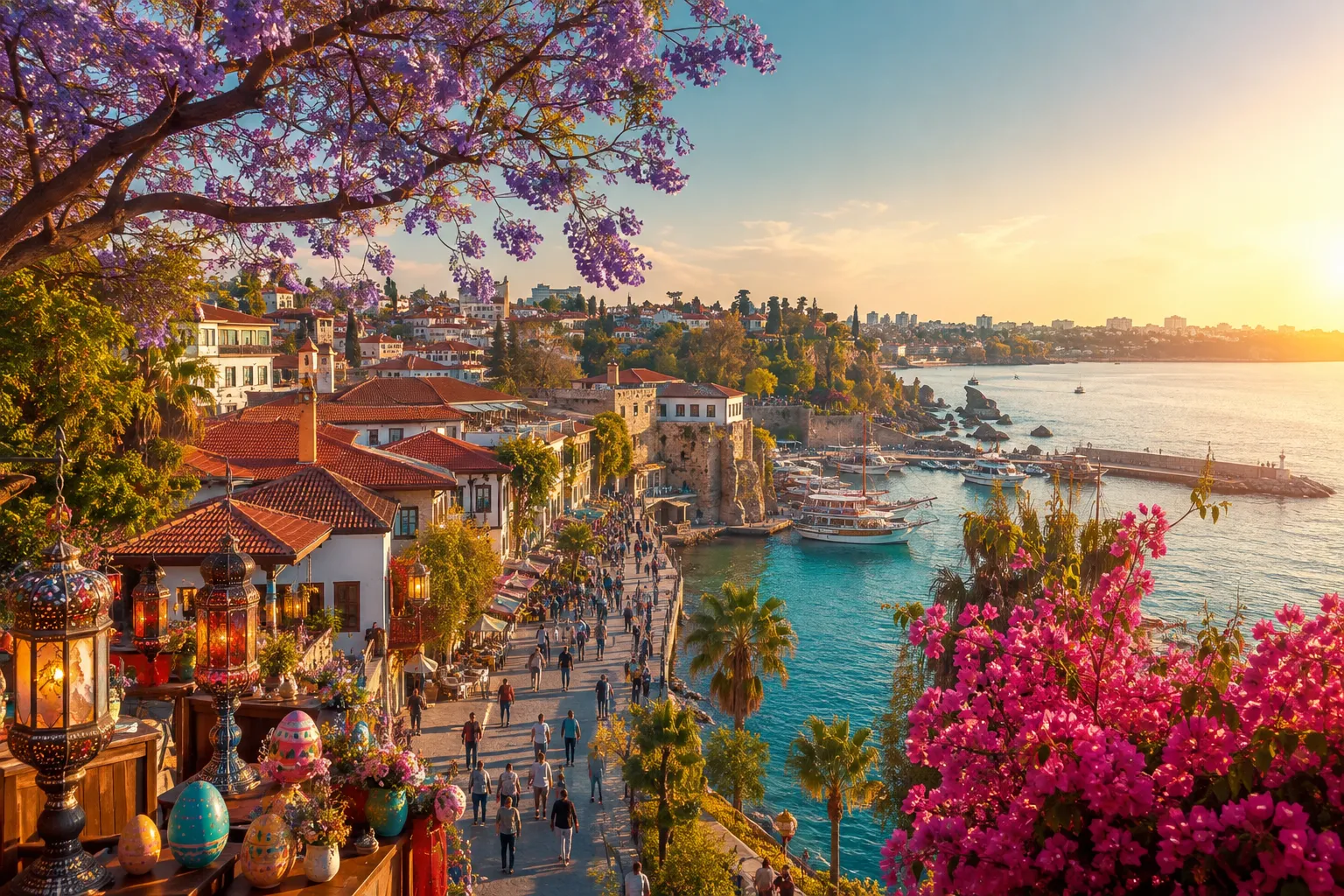

In spring 2026, Antalya faces an unprecedented convergence of Ramadan, Eid al-Fitr, Nowruz, and Easter travelers. Last updated: August 17, 2026
Quick Answer: Spring 2026 created a once-in-a-generation tourism surge in Antalya because Ramadan Bayram (Eid al-Fitr), Nowruz, Turkey’s school mid-term break, and the lead-up to Easter all landed within the same narrow window in mid-to-late March. Turkish media dubbed it the altın çakışma (“golden overlap”), and the results were staggering: Antalya welcomed 3.5 million foreign air arrivals in just the first five months of 2026 [5][10]. If you’re planning a spring trip to Antalya in the future, or just trying to understand what happened this year, here’s the full breakdown.
Key Takeaways
- Ramadan Bayram (Eid al-Fitr) fell on March 20-22, 2026, overlapping almost exactly with Turkey’s school mid-term break (March 16-20) and Nowruz (March 21) [5].
- Easter 2026 landed on April 5, extending the high-demand window through early April for European visitors.
- This overlap created what Turkish tourism officials called an altın çakışma, a “golden overlap” of holidays that hadn’t aligned this way in recent memory [5].
- Hotel occupancy in Antalya soared past 90% during peak spring weeks, with many properties fully booked weeks in advance [7].
- Flight and hotel prices jumped 20-40% above typical spring rates during the overlap period.
- Antalya surpassed 6.5 million foreign visitors by late July 2026, building on the momentum from this spring surge [7].
- Restaurants, attractions, and beaches in Antalya remained fully operational during Ramadan, this is a tourism-oriented city, and visitors of all backgrounds were well accommodated.
- The best strategy for avoiding spring 2026 crowds was booking early or targeting the last week of April, after Easter and before summer pricing kicked in.
What Are the Ramadan 2026 Dates and How Does Ramadan Affect Travel to Antalya?
Ramadan in 2026 ran from approximately February 18 through March 20, with the fasting month concluding just as the Eid al-Fitr celebrations began. For travelers, the key thing to understand is that Antalya is not Mecca, it’s a Mediterranean resort city built around international tourism, and daily life for visitors barely changes during Ramadan.

Here’s what actually shifts during Ramadan in Antalya:
- Hotels and resorts continue serving breakfast, lunch, and dinner to guests without interruption. Buffets run on their normal schedules.
- Some smaller, family-run restaurants in the old town (Kaleiçi) may adjust hours or close during daylight, but tourist-facing establishments stay open.
- The atmosphere after sunset is genuinely magical. Iftar (the evening meal breaking the fast) transforms neighborhoods into communal dining experiences. Street vendors set up special Ramadan stalls with pide bread, dates, and lentil soup.
- Alcohol is available at hotels, bars, and licensed restaurants throughout Ramadan, no restrictions for tourists.
Common mistake: Assuming Antalya “shuts down” during Ramadan. It doesn’t. The city has decades of experience hosting international guests year-round. If anything, the Ramadan atmosphere adds a layer of cultural richness that makes visiting what makes Antalya a top tourist destination even more rewarding.
Pro move: Visit a local mosque at iftar time. Many communities welcome respectful visitors to share the meal. Turkish hospitality is no joke, and this is one of those experiences that turns a vacation into a story you’ll tell for years.
When Is Eid al-Fitr 2026 and What Celebrations Happen in Antalya?
Eid al-Fitr (called Ramazan Bayramı in Turkish) fell on March 20-22, 2026, a three-day national holiday that effectively gave Turkish families a week-long vacation when combined with the school mid-term break running March 16-20 [5]. That’s nine consecutive days off for families. Consider this your sign that millions of domestic tourists had the same idea: head to the coast.
During Eid in Antalya, expect:
- Festive street celebrations with live music, children in new clothes, and families gathering in parks and along the waterfront
- Special holiday menus at restaurants featuring traditional sweets like baklava and Turkish delights
- Crowded but joyful public spaces, Konyaaltı Beach, the Antalya Marina, and Kaleiçi’s narrow streets fill up with a warm, celebratory energy
- Fireworks and cultural performances organized by the municipality, often along the clifftop promenades
The domestic tourism surge during Eid is the single biggest driver of spring demand. When Turkish families travel, they travel hard, extended family groups booking multiple rooms, multi-generational gatherings at all-inclusive resorts. Hotels know this, and they price accordingly.
What Is Nowruz and Why Do People Travel to Antalya for It?
Nowruz, the Persian New Year, falls on March 21 every year, marking the spring equinox. It’s celebrated by an estimated 300 million people across Iran, Central Asia, the Caucasus, and Kurdish communities in Turkey. And here’s the plot twist that made spring 2026 so extraordinary: Nowruz landed right between Eid al-Fitr (March 20-22) and the school break, creating a triple overlap [5].
Antalya has become a preferred Nowruz destination for Iranian tourists in particular, thanks to:
- Direct flights from Tehran, Isfahan, and Shiraz to Antalya Airport
- Visa accessibility, Turkey’s relatively open visa policies for Iranian nationals make it one of the easiest international destinations to reach
- Familiar cultural touchstones, Persian-speaking staff at many hotels, Iranian restaurants in the Lara and Konyaaltı districts, and a general cultural warmth between Turkish and Iranian visitors

During Nowruz, you’ll spot haft-sin tables (the traditional spread of seven symbolic items) set up in hotel lobbies and on restaurant terraces. Some hotels host special Nowruz galas with live Persian music and traditional dance performances. It’s a beautiful collision of cultures that makes Antalya feel genuinely cosmopolitan.
Edge case: If you’re not celebrating Nowruz but happen to be in Antalya on March 21, lean into it. Ask your hotel if they’re hosting any events. The food alone, sabzi polo (herbed rice with fish), kuku sabzi (herb frittata), and mountains of baklava, is absolutely worth it.
Easter 2026 Dates and Spring Break Tourism in Antalya
Easter Sunday in 2026 falls on April 5 (Western churches), with Good Friday on April 3. Orthodox Easter follows on April 20. This means European spring break travelers, particularly from Germany, the UK, the Netherlands, and Scandinavia, flood into Antalya from late March through mid-April [2].
Germany alone sends more tourists to Antalya than any other country, and German school holidays (which vary by state but cluster around Easter) are a massive demand driver. Add British half-term breaks, Dutch voorjaarsvakantie, and Russian spring travel, and you’ve got a European invasion of sun-seekers hitting the Turkish Riviera.
Why Easter tourism looks different from Eid tourism in Antalya:
| Factor | Eid al-Fitr Tourism | Easter/Spring Break Tourism |
|---|---|---|
| Primary markets | Domestic Turkish + Gulf states | Germany, UK, Netherlands, Russia, Scandinavia |
| Accommodation style | All-inclusive resorts, family apartments | Mix of all-inclusive, boutique hotels, Airbnbs |
| Peak dates (2026) | March 16-24 | March 28, April 13 |
| Cultural activities | Mosque visits, family gatherings, festive dining | Beach days, archaeological sites, boat tours |
| Spending patterns | Domestic prices, group bookings | International rates, couples and small families |
The result? Antalya’s spring 2026 demand wasn’t one big spike, it was a rolling wave that started in mid-March and didn’t truly recede until after Orthodox Easter on April 20. Nearly five continuous weeks of elevated occupancy [3].
Why Does Antalya Get So Crowded in Spring 2026 With All These Holidays?
The short answer: calendar math. The long answer involves understanding that these holidays operate on different calendar systems (Islamic lunar, solar Persian, Gregorian Christian) and only rarely land in the same week. When they do, the combined demand from Turkish domestic travelers, Iranian Nowruz celebrants, Gulf state visitors, and European spring breakers all hits Antalya simultaneously [2][3].

Here’s the specific 2026 timeline that created the altın çakışma:
- March 16-20: Turkish school mid-term break begins. Families start arriving.
- March 20-22: Eid al-Fitr (Ramazan Bayramı). Domestic tourism peaks.
- March 21: Nowruz. Iranian and Central Asian visitors arrive.
- March 28, April 5: Easter week. European charter flights ramp up.
- April 20: Orthodox Easter. Russian and Eastern European visitors extend the season.
This kind of overlap is genuinely rare. The Islamic calendar shifts roughly 10-11 days earlier each Gregorian year, so Eid al-Fitr won’t fall this close to Easter again for over a decade. Turkish tourism officials recognized the opportunity early and prepared accordingly, but even with preparation, demand outstripped supply at many properties [5][6].
Fair warning for future travelers: While this exact alignment won’t repeat soon, Eid al-Adha (Kurban Bayramı) landed in late May 2026, providing yet another tourism boost and extending what was already a record-breaking spring season [8].
Will Antalya Hotels Be Fully Booked During Ramadan, Eid, and Easter 2026?
Yes, many already were. During the peak overlap weeks (March 16-24), hotel occupancy in Antalya’s resort corridors (Lara, Kundu, Belek, Kemer) exceeded 90%, and premium all-inclusive properties were reporting full bookings as early as January 2026 [7]. By late July, Antalya had already welcomed 6.5 million foreign tourists, a pace that put the city on track to challenge its all-time annual records [7].
Booking realities for spring 2026:
- 5-star all-inclusive resorts in Belek and Lara: Sold out 4-8 weeks before the overlap period
- Boutique hotels in Kaleiçi: Available with 2-3 weeks’ notice, but at premium rates
- Budget accommodation: Hostels and guesthouses had availability closer to the dates, but selection was limited
- Airbnb/vacation rentals: Prices surged 30-50% above February levels
Steal this tip for future spring trips: Book at least 6-8 weeks ahead if your travel dates fall near any major holiday overlap. Set price alerts on booking platforms in January. And consider Antalya’s less-famous neighboring towns, Side, Alanya, and Kaş, which offer similar Mediterranean magic with slightly more breathing room.
How Much More Expensive Are Flights and Hotels to Antalya in Spring 2026?
Expect to pay 20-40% more for flights and 25-50% more for hotels compared to a typical non-holiday spring week. The premium varies by origin market and how far in advance you book.
Approximate price increases during the March 2026 overlap (estimates based on market reporting):
- Flights from Germany: €180-250 round trip (vs. €120-160 in a normal March week)
- Flights from the UK: £200-300 round trip (vs. £140-200 normally)
- All-inclusive resort (per night, double occupancy): $150-280 (vs. $100-180 normally)
- Boutique hotel in Kaleiçi: $80-150 (vs. $50-100 normally)
These aren’t outrageous by Mediterranean resort standards, Antalya still offers significantly better value than comparable destinations in Greece, Spain, or Italy during peak periods. Turkey’s favorable exchange rate continues to make it a ridiculously good deal for visitors paying in euros, pounds, or dollars [4].
Pro move: Fly midweek (Tuesday or Wednesday) instead of Friday/Saturday to save 15-25% on airfare. Also, consider flying into Gazipaşa Airport (GZP) instead of Antalya’s main airport, it serves the eastern coast and sometimes has cheaper charter options.
Best Time to Visit Antalya in Spring 2026 to Avoid Crowds
If dodging the spring 2026 crowds is the priority, target the last week of April (April 21-30). By then, Orthodox Easter has passed, Eid celebrations are a month old, and summer charter season hasn’t fully ramped up. Weather in late April is gorgeous, daytime highs around 22-25°C (72-77°F), sea temperatures warming to swimmable levels, and wildflowers carpeting the Taurus Mountain foothills.
Choose late April if:
- You want beach time without fighting for a sunbed
- You prefer lower hotel rates (back to near off-season pricing)
- You enjoy hiking, the Lycian Way is at its absolute best in late April
Choose the overlap period (March 16, April 5) if:
- You want the festive energy and cultural celebrations
- You’ve already booked accommodation
- You enjoy people-watching and vibrant street life
Choose early March if:
- You want pre-Ramadan calm with mild weather
- You’re interested in Antalya’s archaeological sites without crowds at Perge, Aspendos, or Termessos
- Budget is a primary concern
For more ideas on navigating Turkey’s waters and coastline during shoulder season, the quieter weeks offer the best conditions for boat trips along the Turquoise Coast.
Can You Enjoy Antalya If You’re Not Celebrating Ramadan or Easter?
Absolutely, and honestly, this might be the best way to experience it. Being a curious observer during overlapping celebrations means getting to sample all the festive energy without the obligations. You can break fast at an iftar spread one evening, hunt for chocolate Easter eggs at a German-run hotel brunch the next morning, and stumble into a Nowruz celebration with Persian music and dancing by afternoon.
Antalya’s identity as a tourism city means it caters to everyone simultaneously. The infrastructure exists to serve secular sun-seekers, devout pilgrims, party-loving spring breakers, and cultural explorers all at once. Turkey’s long tradition of interfaith dialogue and multicultural hospitality is on full display during these overlapping celebrations.
Here’s what nobody tells you: The overlap period is actually one of the best times to experience Turkish culture at its most generous. Locals are in a celebratory mood during Bayram, hotel staff go above and beyond with special programming, and there’s a palpable sense of joy in the air. Prepare to be obsessed with the energy.
How Do Local Customs During Nowruz and Eid Affect Tourists in Antalya?
The honest answer: minimally, and mostly in positive ways. Neither Eid nor Nowruz customs create restrictions for tourists. Instead, they add layers of experience.
During Eid (Ramazan Bayramı):
- Expect heavier traffic on highways connecting Antalya to inland cities (families driving to the coast)
- Banks and government offices close for three days, but ATMs, exchange offices, and tourist services operate normally
- Tipping culture intensifies, it’s customary to be a bit more generous with service staff during Bayram
- Learning a few basic Turkish phrases like “Bayramınız kutlu olsun” (Happy Bayram!) will earn you enormous goodwill
During Nowruz:
- No impact on Turkish public services (Nowruz is not an official Turkish holiday, though it’s celebrated by Kurdish communities)
- Hotels with large Iranian guest populations may host special events, these are usually open to all guests
- You might notice more Persian-language signage in shopping areas and bazaars
During Easter:
- No local impact whatsoever, Easter is not observed in Turkey, but resort hotels catering to European guests organize egg hunts, special brunches, and holiday decorations
The secret sauce of Antalya’s spring 2026 phenomenon is that these celebrations coexist without friction. It’s a city that has spent decades learning to be everything to everyone, and spring 2026 was its masterclass.
Is Spring 2026 a Good Time to Visit Antalya, or Should You Go Another Season?
Spring 2026 was an exceptional time to visit Antalya, if you booked early and embraced the festive chaos. The weather was ideal (18-24°C, minimal rain), the cultural calendar was overflowing, and the city was buzzing with an energy that the quieter months simply can’t match [9].
But it’s not for everyone. Here’s a decision framework:
Spring 2026 is perfect for: Culture enthusiasts, festival lovers, families during school breaks, travelers who thrive in busy environments, anyone wanting to experience multiple celebrations in one trip.
Consider summer instead if: You prioritize guaranteed hot beach weather (30°C+), want the full range of water sports and boat excursions operating at capacity, or prefer longer daylight hours for sightseeing.
Consider autumn (September, November) if: You want warm weather with dramatically fewer crowds, lower prices, and the sea at its warmest after months of summer sun. Seriously underrated season.
Consider winter if: You’re interested in Turkey’s ski resorts and snowy destinations or want Antalya’s archaeological sites essentially to yourself.
The data backs up spring’s appeal: Antalya recorded 3.5 million foreign air arrivals in just the first five months of 2026, setting the foundation for what became a record-breaking tourism year [10]. That momentum carried through summer, with August occupancy rates climbing above 90% [7].
Conclusion
Antalya’s spring 2026 phenomenon was a calendar miracle that brought Ramadan, Eid al-Fitr, Nowruz, Easter, and Turkey’s school break into a single explosive window. The result was a city operating at full capacity, full energy, and full cultural richness, a total game-changer for Turkey’s tourism narrative.
Your actionable next steps:
- For future spring trips: Watch the Islamic calendar. Eid al-Fitr shifts earlier each year, and the next time it lands near Easter will create similar demand. Book 2-3 months ahead.
- For budget-conscious travelers: Target late April or early May for the best balance of weather, crowds, and pricing.
- For cultural immersion: Time your visit to overlap with at least one major celebration. The festive atmosphere transforms Antalya from a beach destination into something far more memorable.
- Bookmark this and start checking flight prices in January for the following spring. Future you will thank us.
Whether you’re drawn by the Mediterranean sun, the call to prayer echoing over ancient stone, the smell of Nowruz herbs on a hotel terrace, or simply the promise of a ridiculously good Turkish breakfast overlooking the sea, Antalya in spring proved it can hold all of these things at once, beautifully.
FAQ
Q: Is it safe to visit Antalya during Ramadan? A: Yes. Antalya is one of Turkey’s safest cities for tourists year-round, including during Ramadan. There are no restrictions on non-Muslim visitors, and the city’s tourism infrastructure operates normally.
Q: Can I drink alcohol in Antalya during Ramadan? A: Yes. Licensed hotels, bars, and restaurants serve alcohol throughout Ramadan without restriction. It’s courteous to avoid drinking in front of people who are fasting in public spaces, but tourist areas are fully accommodating.
Q: How far in advance should I book an Antalya hotel for spring holiday periods? A: For peak overlap periods like spring 2026, book 6-8 weeks in advance minimum. For 5-star all-inclusive resorts in Belek or Lara, 2-3 months ahead is safer.
Q: Do I need a visa to visit Antalya? A: It depends on your nationality. Many countries qualify for Turkey’s e-visa (applied online in minutes) or visa-free entry. Check the Turkish Ministry of Foreign Affairs website for your specific country.
Q: What’s the weather like in Antalya in March and April? A: March averages 15-20°C (59-68°F) with occasional rain. April warms to 18-24°C (64-75°F) with more sunshine. Sea temperatures hover around 17-19°C, swimmable for the brave, comfortable by late April.
Q: Will the same holiday overlap happen again soon? A: Not this exact combination. The Islamic calendar shifts roughly 10-11 days earlier each Gregorian year, so Eid al-Fitr won’t fall this close to Easter and Nowruz again for approximately 10-12 years.
Q: Are Antalya’s archaeological sites open during Eid and Ramadan? A: Yes. Major sites like Perge, Aspendos, and the Antalya Museum maintain regular hours, though they may be busier with domestic visitors during the Bayram holiday.
Q: Is Antalya good for families during spring? A: Excellent. The weather is warm but not scorching, resort kids’ clubs are fully operational, and the festive atmosphere gives children a unique cultural experience. Many all-inclusive resorts offer children’s Bayram activities.
Q: What currency should I bring to Antalya? A: Turkish lira is the local currency, but euros and US dollars are widely accepted at hotels and tourist shops. ATMs are everywhere. Credit cards work at most establishments.
Q: How do I get from Antalya Airport to my hotel? A: Options include the Havaş airport shuttle bus (affordable, runs to major hotel zones), private transfers (bookable through your hotel), taxis (metered, approximately 400-600 TL to Lara/Konyaaltı), and rental cars. During peak spring periods, pre-booking a transfer is a pro move, taxi queues can be long.
References
[2] Antalya Braces For Tourism Boom With Ramadan Easter Holidays – https://www.hurriyetdailynews.com/antalya-braces-for-tourism-boom-with-ramadan-easter-holidays-219261
[3] Overlapping Holiday Dates To Boost Antalya Tourism Figures – https://www.turkiyetoday.com/lifestyle/overlapping-holiday-dates-to-boost-antalya-tourism-figures-3218792
[4] Turkey’s Tourism Expects Growing Numbers Of Visitors – https://www.tourism-review.com/turkeys-tourism-expects-growing-numbers-of-visitors-news15344
[5] Bayram Nevruz Paskalya Ve Ara Tatil Ayni Potada – https://www.antalya3t.com/bayram-nevruz-paskalya-ve-ara-tatil-ayni-potada
[6] EuropeSays – https://www.europesays.com/turkiye/37821/
[7] Antalya Reaches 6.5 Million Tourists As Hotels Fill Up – https://www.propertyturkey.com/news/antalya-reaches-65-million-tourists-as-hotels-fill-up
[8] CGTN News – https://news.cgtn.com/news/2026-06-03/VHJhbnNjcmlwdDkwOTMx/index.html
[9] Antalya Positioning Itself As A Global Stage For Events In 2026 – https://travelmedia.in/2026/07/09/Antalya-positioning-itself-as-a-global-stage-for-events-in-2026.html
[10] Antalya 3.5 Million Tourists 2026 – https://restproperty.ru/news/turizm/antalya-35-mln-turistov-2026/