



In Turkey, the rhythmic clink of tulip-shaped glasses filled with çay punctuates every conversation, meal, and moment of hospitality. Last updated: May 3, 2026
Quick Answer: Turkish çay (pronounced “chai”) is a strong black tea brewed in a two-tiered kettle and served in iconic tulip-shaped glasses — no milk, just sugar cubes on the side. Turkey ranks among the world’s highest per-capita tea-consuming nations, and çay is offered everywhere from ferry terminals to carpet shops. This guide covers traditional çay, herbal alternatives, brewing basics, and the best spots to drink it like a local.
Key Takeaways
- 🍵 Çay is black tea (Camellia sinensis) grown mainly in Turkey’s Rize province on the Black Sea coast, known for bold, slightly astringent flavor [3]
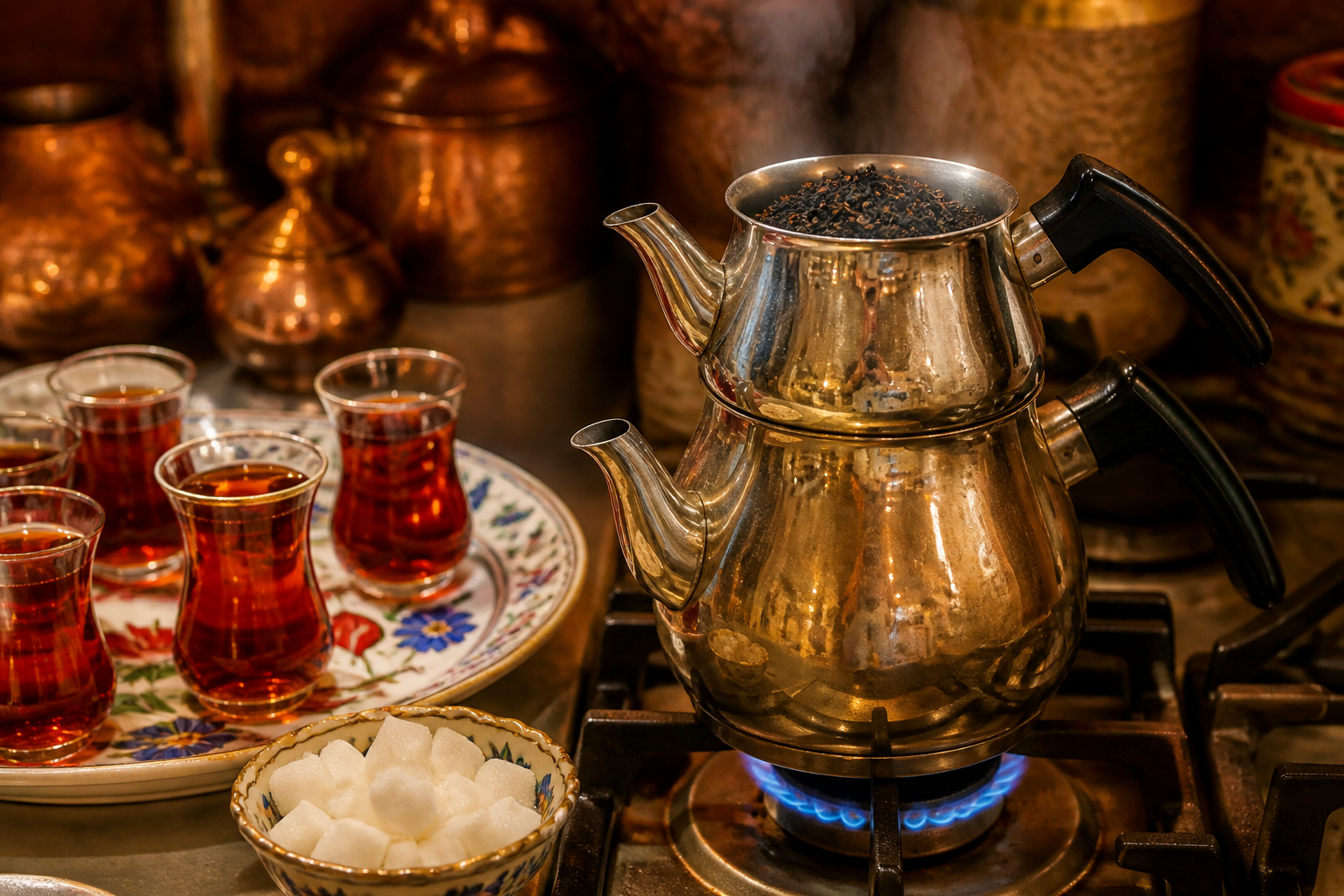
- 🫖 Brewing uses a çaydanlık — a double-kettle system where the bottom boils water and the top steeps concentrated tea, letting each person control their strength [1]
- 🍬 Served in tulip-shaped glasses with sugar cubes on the side, never milk — a tradition rooted in Ottoman-era tea culture [7]
- 🌿 Popular herbal alternatives include sage tea (adaçayı), rose hip tea (kuşburnu), linden flower (ıhlamur), and apple tea (elma çayı) [1][5]
- 📍 Best places to drink it: çay bahçesi (tea gardens), bazaars, ferry docks, and neighborhood tea houses across every Turkish city
- 💡 Strength is personal: “açık” means light (more water), “koyu” means dark (more concentrate) — always ask for your preference
- 🏔️ Rize is the heartland — visiting the tea terraces there is a seriously underrated travel experience
- ☕ Turkish tea differs from Turkish coffee — tea is the everyday drink; coffee is the occasion drink. Both matter deeply. The Turkish Coffee Festival is a whole separate obsession
What Exactly Is Turkish Çay and Why Is Everyone Drinking It?
Turkish çay is black tea brewed strong, diluted to taste, and consumed in quantities that would alarm most Western doctors. It is the social glue of the entire country.
Turkey is one of the world’s largest tea consumers per capita — and it shows. Çay appears at business meetings, on ferry boats, after every meal, before negotiations, and as the first thing a host offers any guest. Refusing it is mildly baffling to most Turks. Accepting it is the beginning of every good conversation.
The tea itself is Camellia sinensis — the same plant behind English Breakfast and Darjeeling — but the Turkish variety has a distinctly bold, slightly astringent character that sets it apart from other black teas [4]. It’s grown almost entirely in the Rize region along the eastern Black Sea coast, where the combination of fertile volcanic soil, high rainfall, and mild temperatures creates ideal growing conditions [3].
“Çay is not just a drink in Turkey. It’s a pause button on the day — a signal that whatever’s happening can wait five minutes.”
The flavor profile: Deep amber to brick-red in color, with a robust, slightly tannic taste. No smokiness (that’s Russian Caravan territory). No floral notes (that’s Darjeeling). Just clean, strong black tea that wakes you up and keeps you company.
How Is Traditional Turkish Tea Brewed? (The Çaydanlık Method)
Traditional Turkish tea uses a çaydanlık — two stacked kettles that work as a system [1]. This is not optional equipment; it’s the whole point.
Here’s how it works:
- Fill the bottom kettle with fresh, cold water and bring it to a boil
- Add loose-leaf tea to the upper kettle — roughly 2 to 3 tablespoons per 4 to 6 cups of water [1]
- Pour some boiling water from the bottom kettle over the tea leaves in the upper kettle
- Let both kettles sit on low heat for 15 to 20 minutes — the bottom continues to simmer, the upper steeps slowly
- Pour to taste: a splash of concentrate from the upper kettle, topped up with hot water from the lower one
The magic here is that everyone at the table gets their tea exactly how they like it. Koyu (dark) means more concentrate, less water. Açık (light) means the reverse. Pro move: learn these two words before you arrive. Future you will thank us.
Common mistake: Using tea bags. Turkish tea culture is built on loose leaf. Bags exist, but they’re considered a compromise at best.
Choose this method if: You’re staying somewhere with a kitchen and want the full experience. For travel, a small çaydanlık costs very little at any bazaar and makes a brilliant souvenir.
What Are the Main Types of Turkish Tea?
Turkish tea culture covers far more than one black tea. Here’s the full landscape — from classic çay to the herbal teas locals actually drink at home.
Classic Black Çay
The default. Served everywhere, all day. Look for brands like Çaykur (the state tea cooperative, based in Rize) or Doğadan in supermarkets. Çaykur’s “Altın” (Gold) blend is a solid benchmark for quality [3].
Apple Tea (Elma Çayı)
Fair warning: this is what tourist shops push hardest, and it’s genuinely enjoyable — a sweetened, fruity infusion with apple flavor. But here’s what nobody tells you: most locals don’t drink it daily. It’s more of a hospitality tea offered to guests, especially in carpet shops and tourist areas. Still worth trying. Just don’t mistake it for the authentic çay experience [1].
Sage Tea (Adaçayı)
This one is seriously underrated. Dried sage leaves steeped for 5 to 7 minutes produce an amber-colored tea with an earthy, slightly bitter, deeply aromatic flavor [1]. Locals drink it for colds, digestion, and general wellbeing. You’ll find it in village restaurants and herbal shops (aktarlar) across Anatolia. Bookmark this one for when you need a break from black tea.
Rose Hip Tea (Kuşburnu Çayı)
Bright red, tart, and loaded with vitamin C. Rose hips are harvested wild across Turkey’s highlands, and the tea has a pleasant cranberry-adjacent flavor. Excellent cold or hot [5].
Linden Flower Tea (Ihlamur Çayı)
Turkey’s answer to chamomile. Linden blossoms steeped in hot water make a pale golden tea that’s genuinely calming — and the scent alone is worth it. A classic remedy for stress and sleeplessness [5][6].
Other Herbal Options Worth Knowing
| Tea Name | Turkish Name | Flavor Profile | Common Use |
|---|---|---|---|
| Chamomile | Papatya çayı | Mild, floral, gentle | Relaxation, digestion |
| Yarrow | Civanperçemi | Slightly bitter, herbal | Cold relief |
| Eucalyptus | Okaliptüs çayı | Menthol, sharp | Respiratory support |
| Mint | Nane çayı | Fresh, cooling | Digestion, summer drink |
| Love Tea blend | Aşk çayı | Floral, sweet, layered | Gift, novelty |
Sources: [1][5][6]
What’s the Difference Between Turkish Tea and Turkish Coffee?
Turkish tea is the everyday drink; Turkish coffee is the ceremonial one. Both are essential — they just serve different social functions.
Çay is consumed constantly throughout the day, in small tulip glasses, refilled repeatedly. It costs almost nothing at a local çay bahçesi (sometimes as little as 5-10 Turkish lira). Turkish coffee is thicker, stronger, unfiltered, and served in small cups with grounds at the bottom. It’s offered after meals, during formal visits, and at significant moments.
The role of coffee houses in Turkish literature and culture is its own fascinating rabbit hole — and the tradition of storytelling in Turkish coffee houses goes back centuries. But for sheer volume and daily ritual? Tea wins every time.
Choose tea if: You want to blend in, make friends, and keep going all afternoon. Choose coffee if: You want a specific experience, post-meal, with intention.
Where Are the Best Places to Drink Turkish Tea?
The best tea experiences in Turkey aren’t in fancy hotels — they’re in specific, often overlooked spots that locals actually use.
Çay Bahçesi (Tea Gardens)
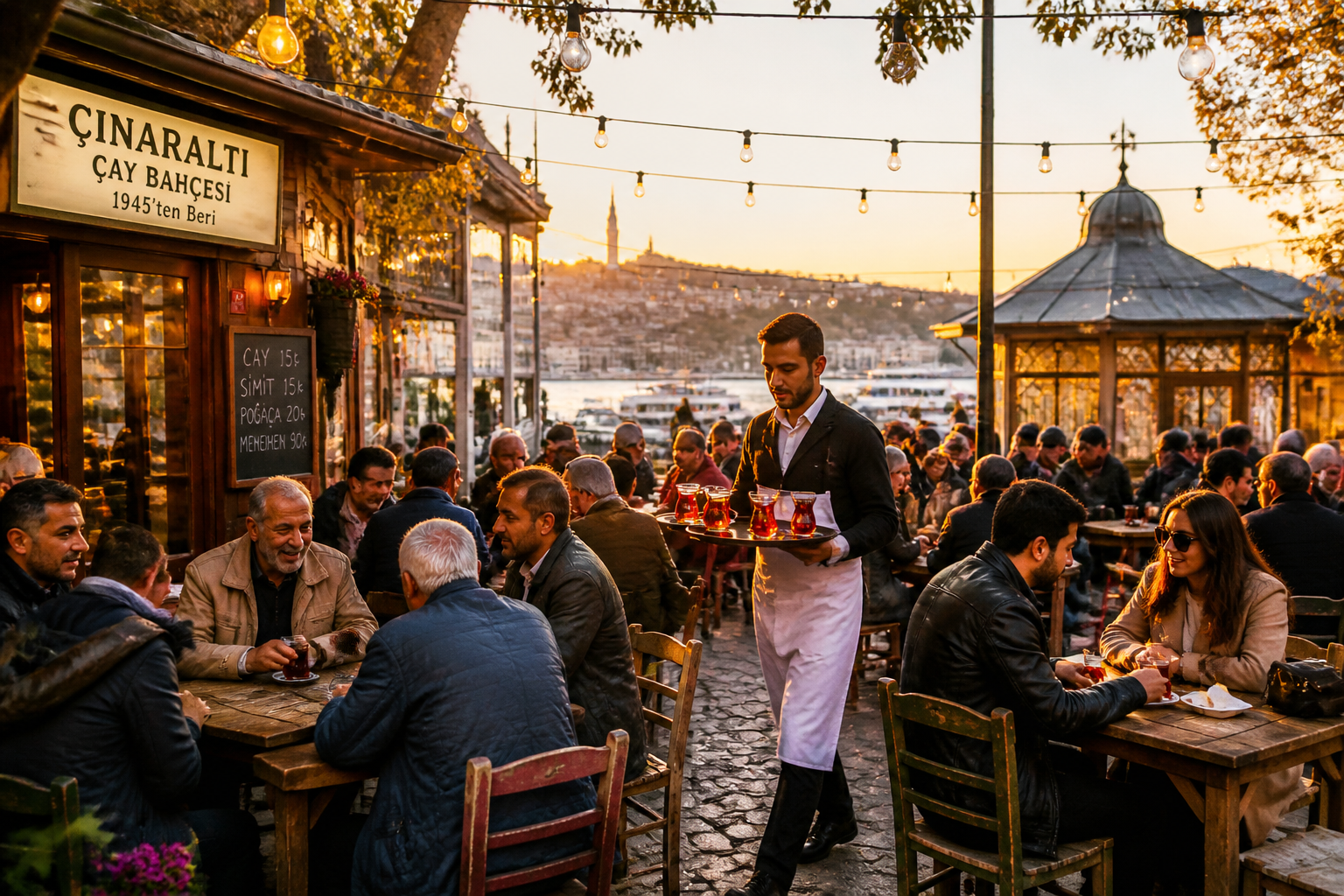
Every Turkish city has them — outdoor gardens with simple tables, plastic chairs, and a constant flow of tea. Pierre Loti Çay Bahçesi in Istanbul sits on a hilltop above the Golden Horn and is absolutely worth the cable car ride up. Emirgan Park in Istanbul has several scattered through its grounds. In smaller cities, just follow locals after lunch.
The Grand Bazaar and Spice Bazaar, Istanbul
Vendors will offer you tea constantly — and you should accept. It’s part of the shopping ritual, not a sales trap (well, sometimes both). The Spice Bazaar experience pairs perfectly with picking up herbal teas to take home. The aktarlar (herbalists) inside sell loose sage, rose hip, linden, and dozens of other dried herbs by weight.
Ferry Docks and the Bosphorus
Here’s the magic: the tea sellers on Istanbul’s Bosphorus ferries, carrying trays of tulip glasses through the crowd, are one of the city’s most cinematic experiences. The 8:30am ferry from Eminönü to Kadıköy — that specific one — catches the morning light on the water perfectly. Tea costs almost nothing. The view is free.
Rize Province
If you’re serious about this Turkish Tea Guide, Rize is the pilgrimage destination. The tea terraces cascade down hillsides toward the Black Sea, and small family-run tea houses serve fresh-brewed çay surrounded by the plants it came from. The Rize Tea Museum (Çay Müzesi) is a genuinely interesting stop.
Village Restaurants Across Anatolia
Order any meal in a rural Turkish restaurant and tea appears automatically at the end — sometimes before the bill, sometimes instead of it. The quaintest villages in rural Turkey are where herbal teas shine brightest: fresh sage, wild mint, and mountain herbs brewed to order.
How Should Visitors Drink Tea the Right Way?
Turkish tea etiquette is simple, warm, and forgiving — but a few details make the experience feel more genuine.
The basics:
- Accept tea when offered. Refusing is fine, but accepting opens conversations
- Hold the glass by the rim, not the body — it’s hot, and that’s the local technique
- Sugar cubes go in separately; stir gently or let them dissolve slowly
- Don’t add milk. Ever. (This will genuinely confuse people)
- Drink it while it’s hot — Turkish tea cools fast in those small glasses
Ordering tips:
- “Bir çay lütfen” = one tea, please
- “Koyu” = dark/strong
- “Açık” = light/weak
- “Şekersiz” = without sugar
The refill culture: In a çay bahçesi, your glass will be refilled without asking. This is hospitality, not upselling. It’s completely normal to sit for an hour over three or four glasses.
Turkish hospitality is no joke — and tea is its most common expression. Accepting a glass is accepting a small piece of that culture. Exploring Turkish delicacies alongside your tea sessions makes the whole food culture click into place.
Can You Buy Turkish Tea to Take Home?
Yes — and it’s one of the best souvenirs going. Here’s what to look for.
Best options for taking home:
- Çaykur loose-leaf black tea — the gold standard, widely available in supermarkets and the Spice Bazaar
- Doğadan herbal tea bags — excellent quality, great variety, easy to pack
- Loose dried herbs from aktarlar — sage, rose hip, linden, chamomile, sold by weight and absurdly affordable
- A small çaydanlık — the double kettle, available in copper or stainless steel, makes a functional and beautiful souvenir
Avoid: Fancy tourist-packaged “apple tea” powder from airport shops. It’s fine, but the price is inflated and the quality isn’t better than what you’ll find in any supermarket for a fraction of the cost.
Customs note: Dried herbs and packaged teas are generally fine to bring back to most countries, but check your home country’s agricultural import rules before packing a kilo of loose sage.
Turkish Tea Guide: FAQ
Q: Is Turkish tea the same as chai? No. “Çay” simply means “tea” in Turkish — it refers to black tea, not the spiced milk tea called chai in South Asian tradition. Turkish çay contains no spices or milk [4].
Q: How much caffeine is in Turkish çay? Turkish çay is brewed strong, so caffeine content is comparable to other black teas — roughly 40 to 70mg per small glass, depending on concentration. Drinking five or six glasses in a day (very normal in Turkey) adds up [6].
Q: Is apple tea actually Turkish? Apple tea exists in Turkey and is genuinely enjoyed, but it’s primarily a hospitality drink for guests rather than an everyday staple. Most locals drink black çay daily [1].
Q: Can I drink Turkish tea if I’m sensitive to tannins? Order it “açık” (light) — more water, less concentrate. Herbal options like linden or chamomile are naturally tannin-free [5].
Q: What food pairs well with Turkish tea? Simit (sesame bread rings), börek (flaky pastry), Turkish delight, and baklava are the classic pairings. See our guide to Turkish delicacies for the full picture.
Q: Is Turkish tea good for health? Black tea contains antioxidants. Herbal teas like sage, rose hip, and linden have traditional medicinal uses for immunity, digestion, and relaxation [5][6]. No extraordinary health claims — just genuinely good ingredients.
Q: Where can I learn more about how Turkish tea differs from other teas? Our dedicated piece on how Turkish tea differs from other teas goes deep on the flavor, brewing, and cultural distinctions.
Q: How much does tea cost in Turkey? At a local çay bahçesi, a glass typically costs 10 to 30 Turkish lira (2026 estimate). Tourist areas charge more. It’s always affordable by any international standard.
Q: What’s the best time of day to visit a çay bahçesi? Late morning (10am to noon) and mid-afternoon (3pm to 5pm) are peak times — you’ll find the most atmosphere and the freshest brew.
Q: Can I find Turkish herbal teas outside Turkey? Yes. Doğadan and Çaykur export widely, and Turkish grocery stores in most major European and North American cities stock both brands [5].
Conclusion: Your Turkish Tea Adventure Starts Now
Consider this your sign. Whether you’re planning a week in Istanbul, a road trip through Anatolia, or a longer slow-travel stint across the country, Turkish tea is going to be part of your story — whether you seek it out or not.
Here’s your action plan:
- Learn three words: çay, koyu, açık. That’s enough to navigate 90% of tea situations
- Say yes when tea is offered — every single time, at least once
- Find a çay bahçesi in whatever city you’re in and sit for at least 45 minutes
- Visit an aktarlar (herbalist shop) and smell everything before buying
- If you make it to Rize, go to the tea terraces. Seriously. Ridiculously good
- Bring home loose-leaf Çaykur and a small çaydanlık — you’ll use both
And when you’re back home, brewing your slightly imperfect version of çay in a regular kettle, watching the color bloom in the cup — you’ll understand why Turkey runs on this stuff. It’s not about the tea, exactly. It’s about what happens around it.
For more on Turkey’s food culture, check out A Gastronome’s Guide to Istanbul — the tea fits right into a much bigger, delicious picture.
Interactive Turkish Tea Finder
Related Turkey food and planning guides: If Turkish tea is part of your food-focused trip, compare our 7-day Turkey itinerary, 10-day Turkey itinerary, Turkey budget travel guide, and must-do Turkey experiences.