

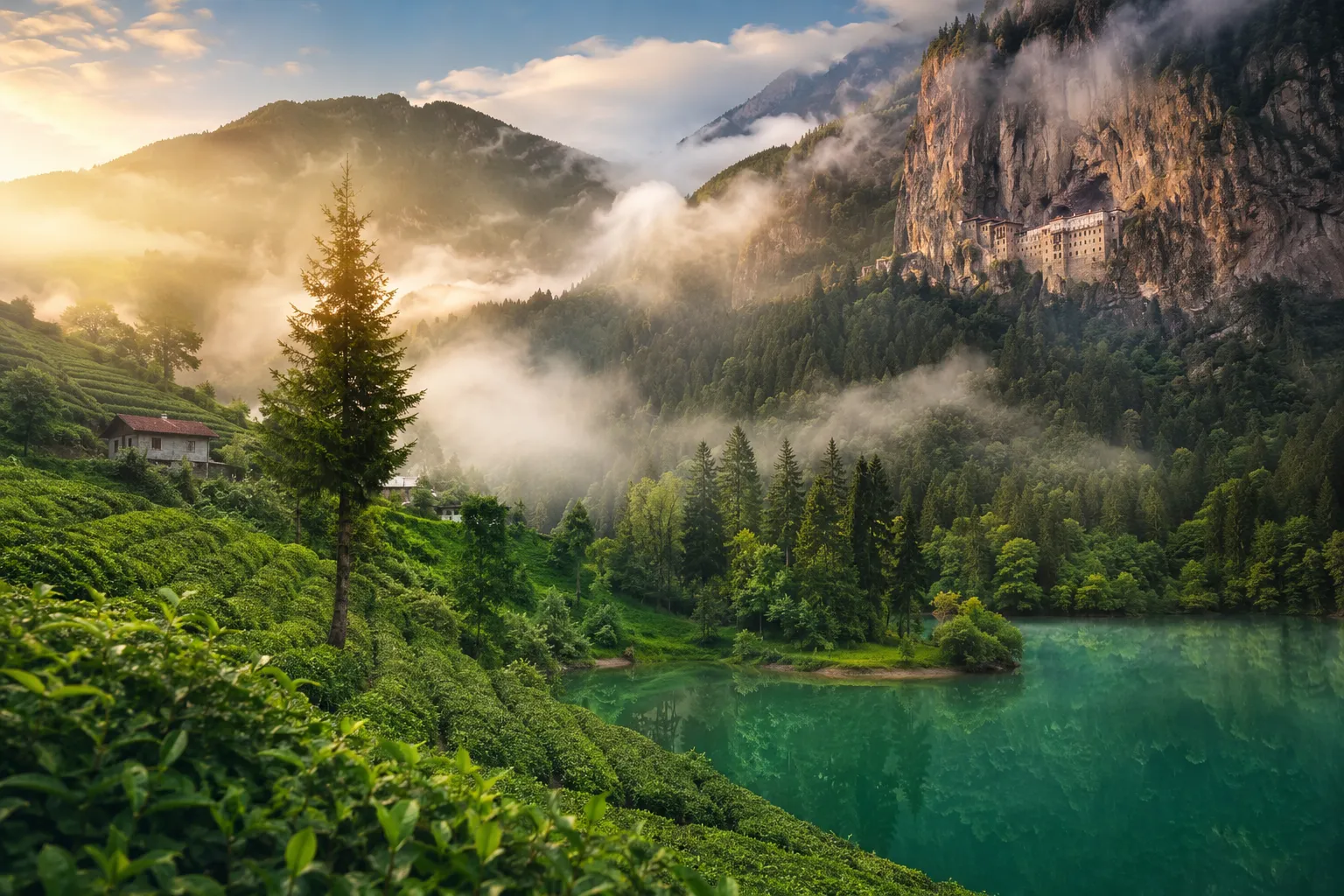

Turkey’s black sea coast offers misty mountains, ancient monasteries, and emerald tea gardens waiting to be explored in 2026. Last updated: August 21, 2026
Quick Answer: Turkey’s Black Sea coast, centered on Trabzon, Rize, and the village of Uzungöl, offers a cooler, greener, and dramatically less crowded alternative to the Mediterranean in 2026. Sumela Monastery has drawn over 2 million visitors since its 2021 reopening and just completed new rockfall-safety upgrades [1][3]. Rize’s tea plantations peak during the May-to-August harvest. And Uzungöl’s alpine lake sits tucked away in a spruce-forested valley that feels more Swiss Alps than stereotypical Turkey. Together, they make one of the most seriously underrated travel corridors in the country.
Key Takeaways
- Sumela Monastery reopened June 25, 2026 after new cliff-safety works, making this the safest hiking season yet [3]
- The monastery has welcomed over 2,030,272 visitors since its post-restoration reopening in July 2021 [1]
- Rize tea harvest runs May through August, with the first flush (late May to mid-June) producing the most prized leaves
- Uzungöl is best for sightseeing and lakeside walks, not swimming (water temperatures hover around 10-15°C even in summer)
- A 5-7 day itinerary comfortably covers all three destinations, with Trabzon as your base
- Budget travelers can manage on roughly 800-1,200 TL per day (approximately $25-35 USD) including accommodation and meals
- The Black Sea coast is 5-10°C cooler than Turkey’s Mediterranean and Aegean coasts in summer, a total game-changer for hikers
- You don’t need a guide for the main Sumela trail, but one adds significant historical context [2]
- Direct flights connect Trabzon to Istanbul in about 1 hour 45 minutes, with multiple daily departures
What Is Sumela Monastery and Why Is It Worth Visiting?
Sumela Monastery (Sümela Manastırı) is a 1,600-year-old Greek Orthodox monastery built directly into a cliff face at roughly 1,200 meters elevation in the Altındere Valley, about 46 kilometers south of Trabzon. It’s worth visiting because nothing else in Turkey, and very little anywhere in the world, looks quite like it.

Founded around 386 AD during the reign of Emperor Theodosius I, the monastery was dedicated to the Virgin Mary and served as one of the most important religious sites in the Pontic Greek world for over 1,500 years. Here’s the magic: the complex includes a rock church adorned with Byzantine-era frescoes (some dating to the 14th century), multiple chapels, a kitchen, a library, and student rooms, all carved into and clinging to a sheer limestone cliff.
After years of painstaking restoration, Sumela reopened to visitors in July 2021. Since then, annual visitor numbers have climbed steadily, from 153,994 in 2021 to 514,596 in 2025 [1]. The monastery attracted 128,311 visitors in just the first five months of 2026, pushing its post-restoration total past 2 million [1].
Plot twist: The monastery isn’t just a building to look at. The entire journey through the Altındere National Park, with its waterfalls, pine forests, and mountain streams, is half the experience. If you’ve been to Turkey’s Byzantine and Ottoman architectural heritage sites in Istanbul, Sumela offers something completely different: sacred architecture fused with raw wilderness.
Best Time to Hike Sumela Monastery in 2026
The best months to hike to Sumela Monastery in 2026 are late June through September, when trails are dry, temperatures are comfortable (15-25°C), and the monastery is fully open. Fair warning: the Black Sea coast gets rain year-round, so pack a light waterproof layer regardless of when you visit.
Here’s what nobody tells you about seasonal timing:
- Late June 2026 is particularly significant because the monastery just reopened on June 25 after completing the first phase of new rockfall-protection works [3]. That means safer access than any previous year.
- July and August bring the warmest weather and longest daylight hours, but also the highest visitor numbers. Arrive before 9:00 AM to beat the tour bus crowds.
- September is the sweet spot: fewer visitors, stable weather, and the surrounding forests start showing early autumn color.
- October works but gets increasingly rainy and misty. Some visitors actually prefer this atmospheric quality (and the near-empty trails).
- November through April: the monastery may be partially closed or access limited due to snow and ice on the approach road.
Pro move: Visit on a weekday morning in September. You’ll share the frescoes with maybe a dozen other people instead of a hundred.
Sumela Monastery Hike: How Many Hours and Distance?
The main trail from the Altındere Valley floor to Sumela Monastery covers approximately 3.5 to 4 kilometers one way, with an elevation gain of around 300 meters. Most hikers complete the ascent in 1 to 1.5 hours at a moderate pace, making the round trip (including time exploring the monastery) a 3 to 5 hour experience [2].
There are currently three ways to reach the monastery:
| Access Method | Time to Monastery | Difficulty | Best For |
|---|---|---|---|
| Forest hiking trail | 60-90 minutes up | Moderate | Active hikers, nature lovers |
| Shuttle bus + short walk | 20-30 minutes total | Easy | Families, limited mobility |
| Cable car (when operating) | ~10 minutes | Very easy | Quick visits, accessibility |
The forest path follows a well-maintained trail through dense pine and spruce forest alongside a rushing stream. It’s not technical climbing, but the steady uphill grade means you’ll want decent shoes (not flip-flops, trust us on this) and water.
Steal this tip: Take the forest trail up and the shuttle down. Future you will thank us. Your legs get the workout and the views on the ascent, and you skip the knee-punishing descent.
How Difficult Is the Sumela Monastery Trail for Beginners?
The Sumela trail is beginner-friendly with one caveat: you need a basic level of fitness for the sustained uphill walk. There are no exposed ridges, scrambling sections, or technical obstacles. The path is mostly packed earth and stone steps, with handrails in the steeper sections near the monastery itself.
Choose the hiking trail if: You can walk uphill for 60-90 minutes without stopping, you enjoy forest scenery, and you want the full experience.
Choose the shuttle if: You have knee problems, are traveling with very young children, or simply prefer to save energy for exploring the monastery interior.
Common mistake: Wearing brand-new hiking boots. The trail is moderate enough for well-worn sneakers with good grip. Break-in blisters at 1,000 meters elevation are nobody’s idea of fun.
The 2026 safety upgrades specifically addressed rockfall risk along the cliff approach [3][8], so the final section near the monastery is now better protected than in previous years.
Do I Need a Guide for the Sumela Monastery Hike, or Can I Go Alone?
You absolutely can visit Sumela Monastery independently. The trail is well-marked, the shuttle system is straightforward, and signage is available in Turkish and English [2]. That said, a guide transforms the visit from “wow, cool old building on a cliff” to a genuinely layered historical experience.
Go solo if: You’re comfortable navigating simple trails, you’ve done some background reading on Byzantine history, and you prefer your own pace.
Hire a guide if: You want to understand the frescoes (who’s depicted, what stories they tell, why certain sections were deliberately defaced), learn about the monastery’s role in Pontic Greek culture, and hear the legends about the icon of the Virgin Mary supposedly painted by the Apostle Luke himself.
Guided day tours from Trabzon typically cost between 600-1,500 TL per person (approximately $18-45 USD) and usually include transport, the guide, and sometimes lunch [7]. For practical planning tips, check the Explore More Turkey travel tips page.
Rize Tea Plantations on the Black Sea Coast: Tours and What to Expect
Rize province produces approximately 65% of all tea grown in Turkey, making it the undisputed heart of Turkish tea culture. Tea plantation tours here typically last 2-4 hours and include walking through terraced hillside gardens, learning about processing methods, and drinking ridiculously good fresh çay while staring at views that look Photoshopped.

Here’s what a typical visit looks like:
- Arrival at a family-run plantation (usually in the hills above Rize city or in nearby Çamlıhemşin)
- Walking the terraces while a farmer explains the two-leaves-and-a-bud picking technique
- Visiting a processing facility to see withering, rolling, oxidation, and drying stages
- Tea tasting of multiple varieties, from standard black çay to regional specialties
- A meal featuring local Black Sea cuisine (think muhlama, a stretchy cheese-and-cornmeal dish that’s basically fondue’s cooler cousin)
The Çaykur Tea Factory in Rize city offers free tours and has a small museum explaining Turkey’s tea history. The country didn’t start commercial tea production until the 1940s, which means the entire industry is younger than some people’s grandparents.
For a deeper dive into Turkey’s Black Sea region as a hidden gem, the area around Rize is the perfect starting point.
Can You Pick Tea at Rize Plantations Yourself?
Yes, many family-run plantations and agritourism operations in Rize allow visitors to pick tea leaves during harvest season (May through August). This is a hands-on experience, not just a photo opportunity. You’ll get a basket, learn the proper technique, and discover that picking tea quickly is far harder than it looks.
Here’s the secret sauce: The first harvest (birinci sürgün), typically late May through mid-June, produces the most flavorful leaves. If you time your visit for this window, you’re picking premium tea. The second and third harvests continue through August but yield progressively milder leaves.
Prepare to be obsessed with the contrast between hand-picked artisanal tea and the standard stuff. Once you’ve tasted tea processed from leaves you picked yourself, the tulip-shaped glass hits different forever.
Best Time to Visit Rize Tea Plantations for Harvest Season
The optimal window is late May through July, with the absolute peak experience during the first flush in late May to mid-June. The plantations are at their most photogenic and active during this period, with workers moving through the bright-green terraces daily.
- May-June: First harvest, best leaf quality, moderate temperatures, lush green landscapes
- July-August: Second and third harvests, warmer weather, more tourists, still beautiful
- September-October: Post-harvest, quieter, autumn colors beginning, factories still processing
- November-April: Plants dormant, most tours unavailable, but tea houses still serve excellent çay
Rize Tea Plantations vs. Other Tea Regions in Turkey
Rize dominates Turkish tea production, but it’s not the only place tea grows. Here’s how it compares:
| Region | % of Turkish Tea | Elevation | Unique Quality |
|---|---|---|---|
| Rize | ~65% | 0-800m | Classic Turkish black tea, largest production |
| Artvin | ~15% | 200-1000m | Slightly wilder terrain, organic options |
| Trabzon | ~10% | 0-600m | Coastal influence, milder flavor profiles |
| Giresun/Ordu | ~10% | 0-500m | Smaller scale, less tourist infrastructure |
Choose Rize if: You want the most authentic, well-organized tea tourism experience with the widest range of plantation visits and the deepest cultural connection to Turkish çay.
Choose Artvin if: You prefer off-the-beaten-path adventures and want to combine tea with the stunning Kaçkar Mountains.
The reason Rize wins for most visitors is infrastructure. There are more tour options, more English-speaking guides, and more family operations set up to welcome guests. It’s the difference between visiting Napa Valley and a random vineyard in rural Oregon. Both are great, but one is built for the experience.
Uzungöl Lake: How to Get There and What to Do
Uzungöl (literally “Long Lake”) is a small alpine lake about 99 kilometers southeast of Trabzon and 19 kilometers south of the town of Çaykara, sitting at approximately 1,090 meters elevation. Getting there takes about 1.5 to 2 hours by car from Trabzon, or you can catch a minibus (dolmuş) from Trabzon’s bus terminal to Çaykara and then a local service to the lake.

Once there, here’s what fills a perfect day:
- Lakeside boardwalk stroll (about 3 km around the lake, flat and easy)
- Hike to the Demirkapı Plateau for panoramic views of the lake and valley
- Visit the lakeside mosque, one of Turkey’s most photographed buildings
- Try local trout (alabalık) at one of the waterside restaurants, grilled fresh and absolutely worth it
- Explore the surrounding yayla (highland pastures) by renting a car or joining a local tour
- Photograph the morning mist that rolls across the lake surface at dawn (seriously, set an alarm)
The village has grown significantly as a tourist destination, particularly popular with visitors from the Gulf states and increasingly with domestic Turkish travelers. Accommodation ranges from simple pensions to mid-range hotels right on the lakeshore.
For more ideas on unmissable spots in the Black Sea region, Uzungöl is consistently at the top of every list.
Is Uzungöl Good for Swimming or Just Sightseeing?
Uzungöl is primarily a sightseeing destination, not a swimming spot. The lake water stays cold year-round (roughly 10-15°C even in peak summer), and there are no designated swimming areas or lifeguard services. The lakebed drops off steeply in places, and the water is murky enough that visibility is limited.
That said, the lake’s appeal was never about swimming. It’s about the setting: a mirror-still body of water reflecting dense spruce forests and mountain peaks, often draped in low clouds that give the whole scene a dreamlike quality. Consider this your sign to bring a good camera instead of a swimsuit.
Surprise gem nearby: The Şerah Waterfall, about 15 minutes’ drive from Uzungöl, offers a more refreshing (if bracingly cold) water experience during summer months.
What’s the Difference Between Uzungöl and Other Lakes Near Trabzon?
Uzungöl is the most famous, but the Trabzon region has several other lakes worth knowing about:
- Uzungöl: Most developed, easiest access, best dining and accommodation options, most crowded
- Sera Gölü (Sera Lake): Only 25 km from Trabzon center, smaller and quieter, good for a half-day trip
- Limni Gölü (Limni Lake): Higher elevation (near Borçka in Artvin), more remote, spectacular autumn colors, minimal infrastructure
- Çakırgöl: A crater lake in the Kaçkar Mountains, requires a proper hike to reach, rewards with total solitude
Choose Uzungöl if: You want comfort, restaurants, easy access, and the iconic postcard view. Choose the others if: You’re seeking solitude and don’t mind basic facilities or longer drives.
Trabzon Black Sea Coast 2026 Travel Guide and Itinerary
A well-paced Black Sea Coast escape covering Trabzon, Sumela, Rize, and Uzungöl works beautifully in 5 to 7 days. Here’s a suggested itinerary:
Day 1: Arrive in Trabzon Explore the city center, visit Hagia Sophia of Trabzon (yes, Trabzon has one too), wander the bazaar, eat a Trabzon pide (boat-shaped, with a runny egg on top, chef’s kiss).
Day 2: Sumela Monastery Early departure for Altındere Valley. Hike the forest trail, explore the monastery, lunch at a valley restaurant. Return to Trabzon by evening.
Day 3: Drive to Rize About 1.5 hours east along the coast. Tea plantation tour, Çaykur factory visit, overnight in Rize or Çamlıhemşin.
Day 4: Rize Deep Dive Morning tea picking (if in season), afternoon exploring the Fırtına Valley and its Ottoman bridges. Try muhlama for dinner.
Day 5: Uzungöl Drive from Rize to Uzungöl (about 2 hours). Afternoon lakeside walk, sunset photography, overnight at a lakeshore hotel.
Day 6: Uzungöl Highlands Morning hike to a yayla (highland plateau), afternoon at leisure, trout lunch by the lake.
Day 7: Return to Trabzon Drive back to Trabzon for your flight, with a stop at Sera Lake if time allows.
This itinerary works as part of a larger Turkey trip. If you’re also planning time in Istanbul, check out the top 10 must-see sites from Hagia Sophia to the Grand Bazaar for that leg of your journey. And for broader coastal planning, the guide to coastal towns that should be on your itinerary covers the full Turkish shoreline.
Trabzon Black Sea Escapes: Budget and Accommodation Options
The Black Sea coast is significantly cheaper than Istanbul, Cappadocia, or the Turquoise Coast. Here’s a realistic daily budget breakdown for 2026:
| Category | Budget | Mid-Range | Comfort |
|---|---|---|---|
| Accommodation | 400-700 TL | 800-1,500 TL | 1,500-3,000 TL |
| Meals (3/day) | 200-400 TL | 400-800 TL | 800-1,500 TL |
| Transport | 100-200 TL | 200-400 TL | 400-800 TL (car rental) |
| Activities | 50-150 TL | 150-500 TL | 500-1,500 TL |
| Daily Total | ~750-1,450 TL | ~1,550-3,200 TL | ~3,200-6,800 TL |
Approximate USD equivalents: Budget $22-42, Mid-Range $45-95, Comfort $95-200
Accommodation highlights:
- Trabzon: Wide range from hostels to business hotels. The city center near Atatürk Alanı (main square) puts everything within walking distance.
- Uzungöl: Lakeside hotels and pensions. Book ahead for July-August weekends.
- Rize/Çamlıhemşin: Boutique yayla hotels and family-run pensions with breakfast included (and Turkish hospitality is no joke, the breakfast spreads alone are worth the stay).
For seamless travel planning including transport logistics, booking support can simplify the multi-destination routing.
FAQ
How do I get to Trabzon? Trabzon Airport (TZX) receives multiple daily flights from Istanbul (both airports), plus connections from Ankara and Izmir. Flight time from Istanbul is approximately 1 hour 45 minutes. There’s also a long-distance bus option (about 12-14 hours from Istanbul), which is cheaper but only for the truly committed.
Is the Black Sea coast safe for solo travelers? Yes. The region is generally very safe, with low crime rates and famously welcoming locals. Standard travel precautions apply, but solo travelers (including women) regularly report positive experiences.
Do I need to speak Turkish? Not necessarily, but it helps enormously. English is less widely spoken here than in Istanbul or Antalya. Download an offline translation app, learn basic pleasantries (merhaba, teşekkürler, çay lütfen), and you’ll be fine. Locals appreciate any effort.
What’s the weather like on the Black Sea coast in summer? Expect 20-28°C in coastal areas, cooler at elevation. Rain is possible any day of the year (this is the wettest part of Turkey), so always carry a light rain jacket. Mornings are often misty, afternoons clearer.
Can I combine the Black Sea coast with other Turkish destinations? Absolutely. A common route is Istanbul > Trabzon (fly) > Black Sea loop > fly to Cappadocia or back to Istanbul. Some travelers continue east to Artvin and the Georgian border region.
Is Uzungöl worth visiting, or is it too touristy? It’s developed, yes, but the natural setting remains stunning. Visit on weekdays or in shoulder season (September-October) for a quieter experience. The surrounding highlands remain largely untouched.
What food should I try on the Black Sea coast? Trabzon pide, muhlama (cheese fondue with cornmeal), karalahana çorbası (black cabbage soup), hamsi (Black Sea anchovies, prepared about 40 different ways), and kuymak. Bookmark this list.
Are there ATMs in Uzungöl and Rize? Yes, both have ATMs, though Uzungöl has fewer. Carry some cash as a backup, especially for smaller pensions and village restaurants.
How crowded is Sumela Monastery in 2026? With 128,311 visitors in just the first five months of 2026 [1], the monastery is popular but manageable. Early morning visits (before 10 AM) and weekdays offer the most comfortable experience.
What should I wear to Sumela Monastery? Comfortable walking shoes with grip, layers (it’s cooler at elevation), and rain protection. There’s no strict dress code since it functions as a museum, not an active place of worship.
Conclusion
The Black Sea coast remains one of Turkey’s best-kept secrets for travelers who want dramatic landscapes, genuine cultural encounters, and cooler temperatures without the Mediterranean crowds. In 2026, with Sumela Monastery’s new safety upgrades complete [3], Rize’s tea plantations in full swing, and Uzungöl’s alpine serenity waiting, there’s never been a better time to explore this green, misty, ridiculously beautiful corner of the country.
Your next steps:
- Book flights to Trabzon (aim for late May through September for the best conditions)
- Reserve Uzungöl accommodation early if visiting July-August weekends
- Check Sumela Monastery’s current opening status before your trip, as seasonal closures can shift [3]
- Pack layers and rain gear, because the Black Sea plays by its own weather rules
- Download offline maps for the drive between Rize and Uzungöl, where mobile signal gets spotty
This is one of those trips where the research phase genuinely gets you excited. And the reality? Even better. Consider this your sign.
References
[1] Sumela Monastery attracts over 2M visitors in NE Turkiye – https://www.dailysabah.com/turkiye/sumela-monastery-attracts-over-2m-visitors-in-ne-turkiye/news
[2] Sumela Monastery Visit Guide 2026 – https://myturkeyadventure.com/blog/sumela-monastery-visit-guide-2026
[3] Sumela Monastery Reopens To Visitors After First Phase Of Safety Work – https://www.turkiyetoday.com/culture/sumela-monastery-reopens-to-visitors-after-first-phase-of-safety-work-3222658
[7] Sumela Monastery Tour – https://tur.tr/en/sumela-monastery-tour.html
[8] Monastyr Sumela v Trabzone vnov otkrylsya posle rabot po zashite ot kamnepadov – https://mk-turkey.ru/tourism/2026/06/29/monastyr-sumela-v-trabzone-vnov-otkrylsya-posle-rabot-po-zashite-ot-kamnepadov.html