


If you’ve conquered Istanbul, eastern Turkey awaits with ancient temples, stone cities, and stories waiting to be discovered. Last updated: August 3, 2026
Quick Answer: Eastern Turkey in 2026 is the most rewarding “second trip” destination for travelers who’ve already explored Istanbul, Cappadocia, and the Aegean coast. The triangle of Göbekli Tepe, Şanlıurfa, and Mardin offers 12,000 years of continuous human heritage, a Neolithic archaeological revolution still being excavated, and a food scene that makes Istanbul’s look like an appetizer. You can combine all three in a realistic 5-7 day itinerary, and new infrastructure, protective roofing at excavation sites, and direct flights make 2026 the best year yet to go.
Key Takeaways
- Göbekli Tepe drew 781,000 visitors in 2025 and is on track to approach 1 million in 2026, with a newly opened excavation area (GT2) letting visitors see T-shaped pillars up close [1][2]
- Mardin logged over 4 million total visitors and 1 million overnight stays in 2025, with the 7th Mardin Biennial (May, June 2026) turning the city into an open-air gallery
- Spring (April, May) and autumn (September, October) are the sweet spots for visiting, dodging both the 45°C summer heat and winter rains
- Budget flights from Istanbul to Şanlıurfa (GAP Airport) start around 600-900 TL one-way, making the cheapest route a domestic flight rather than an overland bus
- You do not need a guided tour to visit Göbekli Tepe, but a knowledgeable guide transforms the experience from “cool rocks” to “existential rethinking of human civilization”
- Eastern Turkey is safe for tourists in 2026, with the Şanlıurfa-Mardin corridor well-established on the tourism circuit
- The Taş Tepeler (Stone Hills) Project now connects Göbekli Tepe with Karahantepe, Sayburç, and Sefertepe into a multi-site Neolithic route
- Mardin’s boutique hotel scene in restored Artukid-era stone mansions is seriously underrated and far cheaper than comparable stays in Cappadocia
What Is Göbekli Tepe and Why Is It Important?
Göbekli Tepe is a 12,000-year-old ceremonial complex in southeastern Turkey that rewrote the timeline of human civilization. Built around 9600 BCE, roughly 7,000 years before Stonehenge and 6,000 years before the earliest known writing, it proved that hunter-gatherers could organize monumental construction before they even invented farming.
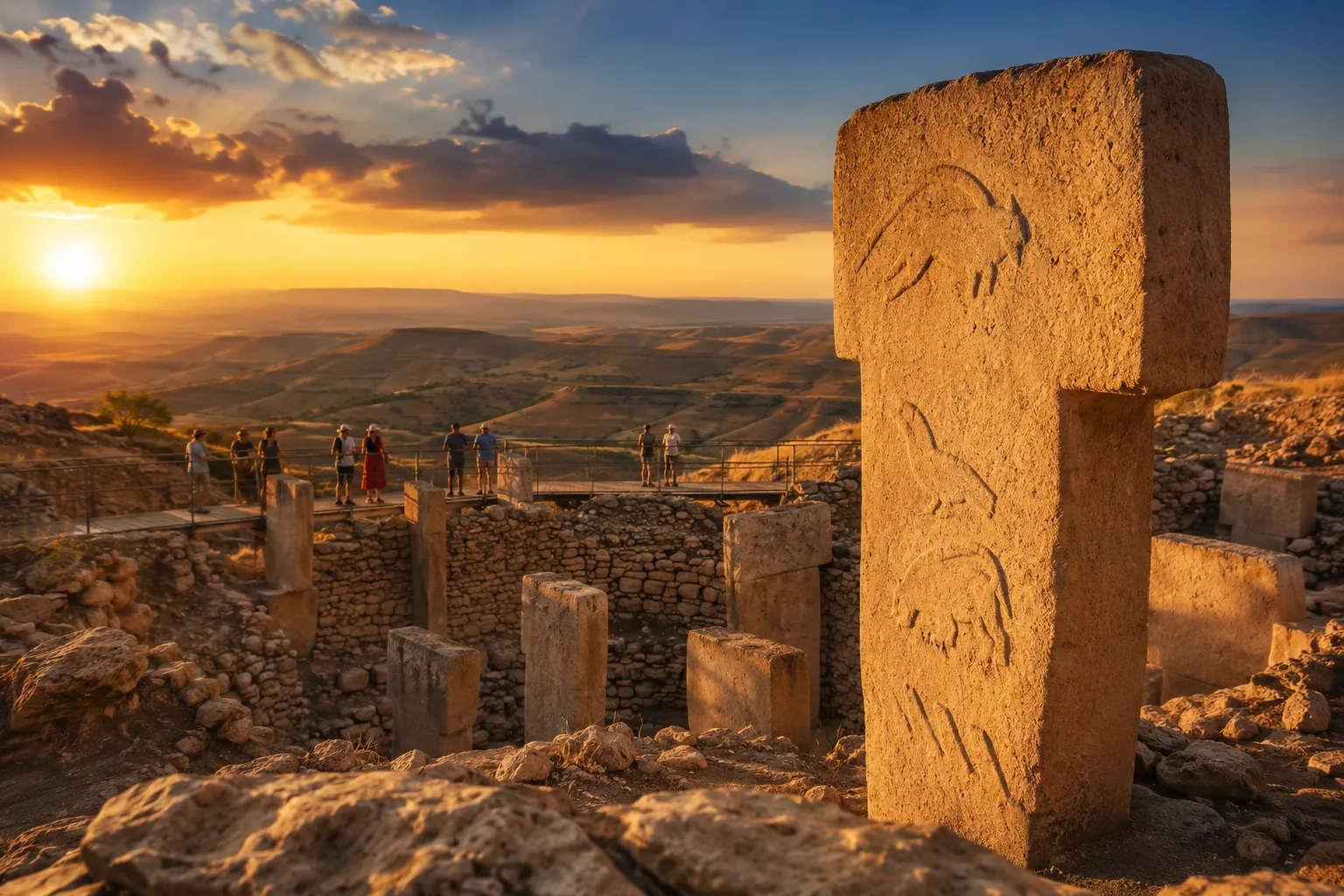
Here’s what nobody tells you: before Göbekli Tepe’s discovery by German archaeologist Klaus Schmidt in 1994, the academic consensus was that agriculture came first, then religion and monumental architecture. Göbekli Tepe flipped that story completely. The massive T-shaped limestone pillars, some standing 5.5 meters tall and weighing up to 10 tons, are carved with animals (foxes, vultures, scorpions, wild boar) that appear to have ritual significance. And only about 5% of the site has been excavated.
The site earned UNESCO World Heritage status in 2018, and in the eight years since, it has drawn a cumulative 4,409,590 visitors [1]. A new excavation area called GT2, protected by a green roof, opened to visitors in 2026, allowing much closer views of the pillars while archaeologists continue digging [7]. Fair warning: once you understand what you’re looking at, this place will rearrange your brain a little.
For deeper context on Turkey’s archaeological wealth, check out our guide to archaeological sites across Turkey.

Best Time to Visit Eastern Turkey in 2026
April through May and September through October are the ideal windows. Summer temperatures in Şanlıurfa regularly hit 40-45°C, which turns a Göbekli Tepe visit into an endurance test rather than a cultural experience. Winter (December, February) brings cold rain and occasional snow to Mardin’s hilltop.
Here’s the 2026 calendar worth bookmarking:
- 25 April, 3 May: Şanlıurfa Culture Route Festival, with exhibitions, concerts, gastronomy events, and workshops across the city [8]
- 15 May, 21 June: 7th Mardin Biennial, featuring 41 artists from 20 countries using historic sites as exhibition spaces
- 30 September, 4 October: TEKNOFEST at GAP Airport in Şanlıurfa, expected to drive a major tourism boost [5]
Pro move: Visit in late April to catch the Culture Route Festival, then head to Mardin while temperatures are still in the comfortable mid-20s°C. The landscape is green, the light is golden, and the crowds haven’t peaked yet.
How Many Days Do You Need in Eastern Turkey’s Şanlıurfa and Mardin?
Plan for 5-7 days total to do the Şanlıurfa-Mardin triangle properly. A rushed 3-day version is possible but means skipping sites that are absolutely worth it.
Here’s a realistic breakdown:
| Destination | Minimum Days | Ideal Days | What You’ll Cover |
|---|---|---|---|
| Şanlıurfa | 2 | 3 | Göbekli Tepe, Balıklıgöl (Pool of Abraham), Şanlıurfa Archaeology Museum, bazaar, Karahantepe day trip |
| Mardin | 2 | 3 | Old town, Deyrulzafaran Monastery, Kasımiye Medrese, Dara ancient city, artisan workshops |
| Transit | 1 | 1 | Şanlıurfa to Mardin (about 3 hours by car or bus) |
Common mistake: Treating Şanlıurfa as just a launchpad for Göbekli Tepe. The city itself is one of the oldest continuously inhabited places on Earth. The Archaeology Museum alone, home to the famous “Urfa Man” statue (the oldest known life-sized human sculpture), deserves a solid half-day. And the evening atmosphere around Balıklıgöl, with families feeding sacred carp under string lights, is pure magic.
Göbekli Tepe vs Other Ancient Sites in Turkey
Turkey has an embarrassment of archaeological riches, but Göbekli Tepe occupies a category of its own. Here’s how it stacks up:
| Site | Age | What It Is | Best For |
|---|---|---|---|
| Göbekli Tepe | ~12,000 years | Pre-agricultural ceremonial complex | Rewriting everything you thought about early humans |
| Ephesus | ~3,000 years | Greco-Roman city | Classical architecture, Library of Celsus |
| Troy | ~5,000 years | Legendary Bronze Age city | Mythological connections, layered excavations |
| Çatalhöyük | ~9,000 years | Neolithic settlement | Understanding early urban life |
| Karahantepe | ~11,000 years | Neolithic ritual site | Göbekli Tepe’s newly accessible “sibling” |
Plot twist: Göbekli Tepe isn’t even the only mind-blowing Neolithic site in the area anymore. The Taş Tepeler (Stone Hills) Project has identified multiple related sites, with Karahantepe emerging as the second major destination. Karahantepe features a chamber with carved human heads emerging from stone benches that is genuinely eerie and wonderful. Infrastructure including a research building, protective roofing, and a welcome center is being developed there in 2026.
For comparisons with Turkey’s classical sites, our coverage of the ancient city of Ephesus and the legendary city of Troy adds useful context.
Can You Visit Göbekli Tepe on Your Own or Do You Need a Tour?
You can absolutely visit Göbekli Tepe independently. The site is about 15 km northeast of Şanlıurfa, there’s a visitor center with exhibits and a café, and the walking paths are well-marked with information panels. Admission is covered by the Museum Pass or costs a modest fee.
That said, here’s the magic: a good guide transforms the experience entirely. Without one, you’ll see impressive carved stones. With one, you’ll understand why those particular animals are depicted, what the circular enclosures might have been used for, and why archaeologists deliberately re-buried most of what they found.
Options for getting there:
- Taxi/private car: About 150-200 TL each way from Şanlıurfa city center. Negotiate a wait time.
- Organized day tour: Typically 800-2,000 TL per person depending on group size, including transport, guide, and often a stop at Karahantepe or Harran. Some include lunch.
- Rental car: The most flexible option if you want to hit Karahantepe and Harran in the same day. Roads are good.
- Dolmuş (shared minibus): Available but schedules are irregular. Not the most reliable option for a time-sensitive visit.
Steal this tip: Visit early morning (the site opens at 8:00 AM) to beat both the heat and the tour bus crowds. The light on the pillars in the first hour is ridiculously good for photos.

What’s the Difference Between Mardin and Other Southeastern Turkey Towns?
Mardin is architecturally unique in all of Turkey. Built entirely of honey-colored limestone on a hilltop overlooking the Mesopotamian plain toward Syria, it looks like a city carved from a single piece of amber. No other Turkish city has this specific combination of Artukid, Syriac Christian, Arab, Kurdish, and Ottoman heritage layered into every street.
Where Şanlıurfa feels like a bustling, lived-in Anatolian city with ancient bones underneath, Mardin is more immediately cinematic. The old town’s stone alleyways, carved doorways, and rooftop terraces deliver that “I can’t believe this place exists” feeling within about five minutes of arrival.
What makes Mardin special for culture seekers:
- Deyrulzafaran Monastery: A 1,600-year-old Syriac Orthodox monastery still in active use, where monks will walk you through rooms where the liturgical language is Aramaic (the language scholars believe Jesus spoke)
- Kasımiye Medrese: A 15th-century theological school with a courtyard so perfectly proportioned it could make an architect weep
- Dara ancient city: A Mesopotamian fortress city 30 km from Mardin with massive underground cisterns and a necropolis, often called “the Ephesus of Mesopotamia”
- Living artisan culture: Silversmiths, coppersmiths, and soap makers working in the bazaar using techniques passed down for centuries
The 7th Mardin Biennial (May, June 2026) used 41 artists from 20 countries to turn these historic spaces into contemporary art venues, which is a total game-changer for visitors who want both ancient and modern cultural experiences.
For insights into the craftsmanship you’ll encounter, see our piece on the cultural significance of Turkish rugs.
How to Get from Istanbul to Şanlıurfa the Cheapest Way
The cheapest and fastest option is a domestic flight, not a bus. Direct flights from Istanbul (both IST and SAW airports) to Şanlıurfa GAP Airport take about 2 hours and cost 600-1,200 TL one-way when booked 2-3 weeks ahead on Turkish Airlines, Pegasus, or AnadoluJet.
Transport comparison:
| Method | Time | Cost (approx.) | Best For |
|---|---|---|---|
| Flight | 2 hours | 600-1,200 TL | Most travelers, best value for time |
| Bus | 12-14 hours | 400-700 TL | Budget travelers who enjoy overland journeys |
| Rental car | 12+ hours | 800-1,500 TL/day + fuel | Flexible itineraries, multiple stops |
| Train | No direct route | Varies | Not practical for this route |
Pro move: Book flights on Tuesday or Wednesday for the lowest fares. Pegasus Airlines frequently runs sales that drop Şanlıurfa flights below 500 TL if you’re flexible on dates. Also check Turkey’s visa-free travel policies before planning, as recent changes may affect your entry.
What Should Culture Travelers Know Before Visiting Eastern Turkey?
Eastern Turkey operates at a different rhythm than Istanbul or the Aegean coast, and that’s exactly the point. Here’s what to prepare for:
Cultural norms:
- Dress modestly when visiting mosques, monasteries, and conservative neighborhoods. This means covered shoulders and knees for everyone, and a headscarf for women entering mosques.
- Turkish hospitality is no joke in the southeast. Expect to be invited for tea (or full meals) by strangers. Accepting graciously is both polite and one of the best parts of traveling here.
- Learn a few Kurdish phrases alongside Turkish. Şanlıurfa and Mardin have significant Kurdish populations, and even a “spas” (thank you in Kurmancî) earns enormous goodwill.
Practical details:
- ATMs are available in both cities, but carry cash for smaller shops, village visits, and dolmuş rides
- English is less widely spoken than in western Turkey, though hotels and tour operators generally manage fine
- The food is different from what most visitors expect from “Turkish food.” Southeastern cuisine leans heavily on spice, raw preparations like çiğ köfte, and flavors influenced by Arab and Kurdish traditions. Prepare to be obsessed.
For a deeper dive into regional flavors, our guide to how Turkish cuisine varies by region is essential reading.
Is Eastern Turkey Safe for Tourists in 2026?
Yes. The Şanlıurfa-Mardin corridor is well-established on Turkey’s tourism circuit, with significant government investment in infrastructure, security, and visitor services. Mardin exceeded 4 million visitors in 2025, and Göbekli Tepe is on track for 1 million in 2026 [2]. These are not off-the-grid destinations.
Standard travel precautions apply: stay aware of your surroundings, follow local advice about any areas to avoid (particularly near the Syrian border, which is not part of the tourist route), and register with your embassy if that gives you peace of mind. Solo female travelers report positive experiences in both cities, though conservative dress is more important here than in Istanbul or Antalya.
The Turkish government’s heavy investment in the region’s tourism infrastructure, including the Taş Tepeler Project and events like TEKNOFEST, reflects confidence in the area’s stability and growth [5][8].

What’s Included in a Typical Göbekli Tepe Tour and What Does It Cost?
A standard guided day tour from Şanlıurfa costs between 800 and 2,000 TL per person (roughly $25-60 USD) and typically includes transport, a licensed guide, and 1-2 additional stops.
Here’s what most tours include:
- Hotel pickup and drop-off in Şanlıurfa
- Göbekli Tepe visit (1.5-2 hours with guide explanation)
- Karahantepe (increasingly included as the site develops)
- Harran (the ancient beehive houses and ruins of the world’s first university)
- Lunch (sometimes included, sometimes at your expense)
Choose a private tour if: you want flexibility on timing, deeper explanations, and the ability to linger at GT2’s newly opened excavation area [7]. Private tours run 2,500-5,000 TL for 1-4 people.
Choose a group tour if: budget is the priority and you’re comfortable with a fixed schedule. Groups of 8-15 are standard.
The Göbekli Tepe visitor center, which opened in recent years, includes exhibits, a gift shop, and a café, so build in time before or after the site walk [9].
Best Hotels in Mardin for Cultural Travelers
Mardin’s restored stone mansions (konaks) offer some of the most atmospheric accommodation in all of Turkey, often at half the price of comparable boutique stays in Cappadocia.
Top picks by category:
- Splurge: Erdeba Konakları and Artuklu Kervansarayı, both in restored historic buildings with rooftop terraces overlooking the Mesopotamian plain. Expect 2,500-5,000 TL per night.
- Mid-range: Maridin Butik Otel and Antik Tatlıdede Konağı offer carved stone rooms, courtyard breakfasts, and genuine character for 1,000-2,500 TL per night.
- Budget: Smaller family-run pensions in the old town offer clean rooms with views for 500-1,000 TL per night.
The secret sauce: Book a room with a south-facing terrace. Watching the sun set over the Mesopotamian plain from your hotel rooftop, tea in hand, is chef’s kiss. Mardin is pushing to reach 1.5 million overnight stays in 2026, so booking ahead during biennial and festival periods is smart.
For those who want to compare luxury options across Turkey, our roundup of top luxury resorts provides broader context.
Common Mistakes People Make Visiting Eastern Turkey
Even experienced Turkey travelers trip up on these:
- Underestimating distances and heat. Göbekli Tepe has minimal shade. Bring water, sunscreen, and a hat. Seriously.
- Skipping the Şanlıurfa Archaeology Museum. The museum provides context that makes Göbekli Tepe 10x more meaningful. Visit the museum first, then the site. Future you will thank us.
- Only budgeting one day for Mardin. The old town rewards slow exploration. Rush it and you’ll miss the hidden courtyards, artisan workshops, and monastery visits.
- Not trying the local food. Southeastern cuisine is distinct from what most visitors know as “Turkish food.” Lebeni soup, mırra (bitter coffee), küncü helvası, and the local çiğ köfte are all surprise gems.
- Visiting in July or August. Unless you genuinely enjoy 45°C heat, avoid midsummer. The sites don’t go anywhere, but your enthusiasm might evaporate.
- Ignoring Karahantepe. Many visitors still treat Göbekli Tepe as a standalone stop. The Taş Tepeler network, especially Karahantepe with its carved heads chamber, is a total game-changer.
Can You See Göbekli Tepe and Mardin in One Trip?
Absolutely, and you should. Şanlıurfa and Mardin are about 180 km apart (roughly 2.5-3 hours by car or bus), making them natural companions on a single eastern Turkey itinerary.
A suggested 6-day route:
- Day 1: Fly into Şanlıurfa. Explore Balıklıgöl and the old bazaar. Evening çiğ köfte mission.
- Day 2: Şanlıurfa Archaeology Museum in the morning. Göbekli Tepe in the afternoon (or reverse, depending on tour timing).
- Day 3: Day trip to Karahantepe and Harran.
- Day 4: Morning bus or car to Mardin. Afternoon exploring the old town and Kasımiye Medrese.
- Day 5: Deyrulzafaran Monastery and Dara ancient city day trip.
- Day 6: Morning in Mardin’s bazaar for silver and soap shopping. Afternoon flight out from Mardin Airport (or return to Şanlıurfa for your flight).
Consider this your sign to stop treating eastern Turkey as “someday” and start treating it as “next trip.”
What Else Is Near Şanlıurfa Worth Visiting?
The area around Şanlıurfa is dense with sites that most western travelers have never heard of.
- Harran: About 44 km south of Şanlıurfa, famous for its beehive-shaped adobe houses and the ruins of what’s considered the world’s first university. Seriously underrated.
- Karahantepe: 35 km from Göbekli Tepe, this sibling site features a carved chamber with human heads emerging from stone that is unlike anything else in archaeology. Infrastructure is expanding rapidly in 2026.
- Sayburç: Another Taş Tepeler site with remarkable relief carvings, including what may be the oldest narrative scene ever found.
- Halfeti: A partially submerged town on the Euphrates, about 2 hours north, known for its black roses (yes, actual dark-colored roses) and boat trips past sunken minarets.
- Mount Nemrut (Nemrut Dağı): About 3-4 hours north, the giant stone heads at the summit sanctuary of an ancient king make for one of Turkey’s most iconic sunrise experiences.
For a broader view of Turkey’s UNESCO-listed treasures, our guide to Turkey’s top religious sites covers several destinations that pair well with an eastern itinerary.
Conclusion
Eastern Turkey in depth in 2026 is not a consolation prize for travelers who’ve “done” the western highlights. Göbekli Tepe, Mardin, and Şanlıurfa represent something fundamentally different: a chance to stand at the literal starting point of human civilization, eat food that hasn’t been diluted for tourist palates, and experience Turkish hospitality at its most genuine. With Göbekli Tepe approaching 1 million annual visitors [2][6], new excavation areas opening [7], the Mardin Biennial animating ancient streets with contemporary art, and TEKNOFEST bringing fresh energy to Şanlıurfa in autumn [5], 2026 is the year this region fully arrives.
Your next steps:
- Book flights early to Şanlıurfa GAP Airport for the best fares (aim for April, May or September, October)
- Visit the Şanlıurfa Archaeology Museum before Göbekli Tepe for essential context
- Budget 5-7 days to do the Şanlıurfa-Mardin triangle without rushing
- Reserve a stone mansion hotel in Mardin with a south-facing terrace
- Add Karahantepe to your Göbekli Tepe day because the Neolithic story is bigger than one site
Bookmark this, start checking flight prices, and prepare to be obsessed. The oldest story humanity ever told is waiting in southeastern Turkey, and 2026 is the year to hear it in person.
Frequently Asked Questions
How long does a Göbekli Tepe visit take? Most visitors spend 1.5-2 hours at Göbekli Tepe, including the visitor center exhibits. With a guide and the newly opened GT2 area, allow 2.5-3 hours for a thorough visit.
Do I need a visa to visit eastern Turkey? Visa requirements depend on your nationality. Many countries qualify for e-visas or visa-free entry. Check Turkey’s latest visa policies before booking.
Is there a combined ticket for Göbekli Tepe and Karahantepe? The Museum Pass Turkey covers Göbekli Tepe and many other sites. Karahantepe access policies are evolving as infrastructure develops in 2026, so check current status before your trip.
What language is spoken in Şanlıurfa and Mardin? Turkish is the official language, but Kurdish (Kurmancî) is widely spoken. In Mardin, you’ll also hear Arabic and Syriac in some communities. English is limited outside hotels and tour operators.
Can I use credit cards in eastern Turkey? Major hotels, restaurants, and shops accept cards, but carry cash (Turkish lira) for bazaars, small eateries, local transport, and village visits.
Is the food in eastern Turkey spicy? Southeastern Turkish cuisine uses more spice than western Turkish food, including isot pepper (a smoky, dark chili flake unique to Şanlıurfa). It’s flavorful rather than burning hot, but ask about spice levels if you’re sensitive.
How far is Göbekli Tepe from Şanlıurfa city center? About 15 km northeast, roughly a 20-minute drive. Taxis, tours, and rental cars all make the trip easy.
Is Mardin worth visiting without the biennial? Absolutely. The biennial is a bonus, but Mardin’s architecture, monasteries, food, and views are spectacular year-round. The city exceeded 4 million visitors in 2025 for good reason.
Can I fly directly to Mardin? Yes, Mardin Airport has domestic flights from Istanbul. Alternatively, fly into Şanlıurfa and travel overland to Mardin as part of a combined itinerary.
What should I pack for eastern Turkey? Comfortable walking shoes (cobblestones in Mardin are unforgiving), modest clothing for religious sites, sun protection, a light scarf, and layers for cool evenings in spring and autumn.
References
[1] Gobeklitepe Draws 4.4M Visitors in 8 Years Since UNESCO Listing – https://www.dailysabah.com/life/gobeklitepe-draws-44m-visitors-in-8-years-since-unesco-listing/news
[2] Gobeklitepe Draws 781k Visitors in 2025, Eyes 1M in 2026 – https://www.turkiyetoday.com/culture/gobeklitepe-draws-781k-visitors-in-2025-eyes-1m-in-2026-3212603
[5] Göbekli Tepe Etkisiyle Şanlıurfa 2026’da Turizmde Yeni Rekor Beklentisi – https://www.arkeolojikhaber.com/haber-gobeklitepe-etkisiyle-sanliurfa-2026da-turizmde-yeni-rekor-beklentisi-43370/
[6] The Number of Visitors to the Gobekli Tepe Temple Complex in Turkiye Could Reach 1 Million – https://zamanturkmenistan.com.tm/en/the-number-of-visitors-to-the-gobekli-tepe-temple-complex-in-turkiye-could-reach-1-million/
[7] New Excavation Area in Gobeklitepe to Open to Visitors Soon – https://www.hurriyetdailynews.com/new-excavation-area-in-gobeklitepe-to-open-to-visitors-soon-215018
[8] Şanlıurfa Poised for Record Tourism Boom in 2026 – https://www.thetraveler.org/sanliurfa-poised-for-record-tourism-boom-in-2026/
[9] Gobeklitepe Prepares to Welcome Visitors With Its New Look – https://www.hurriyetdailynews.com/gobeklitepe-prepares-to-welcome-visitors-with-its-new-look-205353
SEO Meta Title: Eastern Turkey 2026: Göbekli Tepe, Mardin & Şanlıurfa Guide