

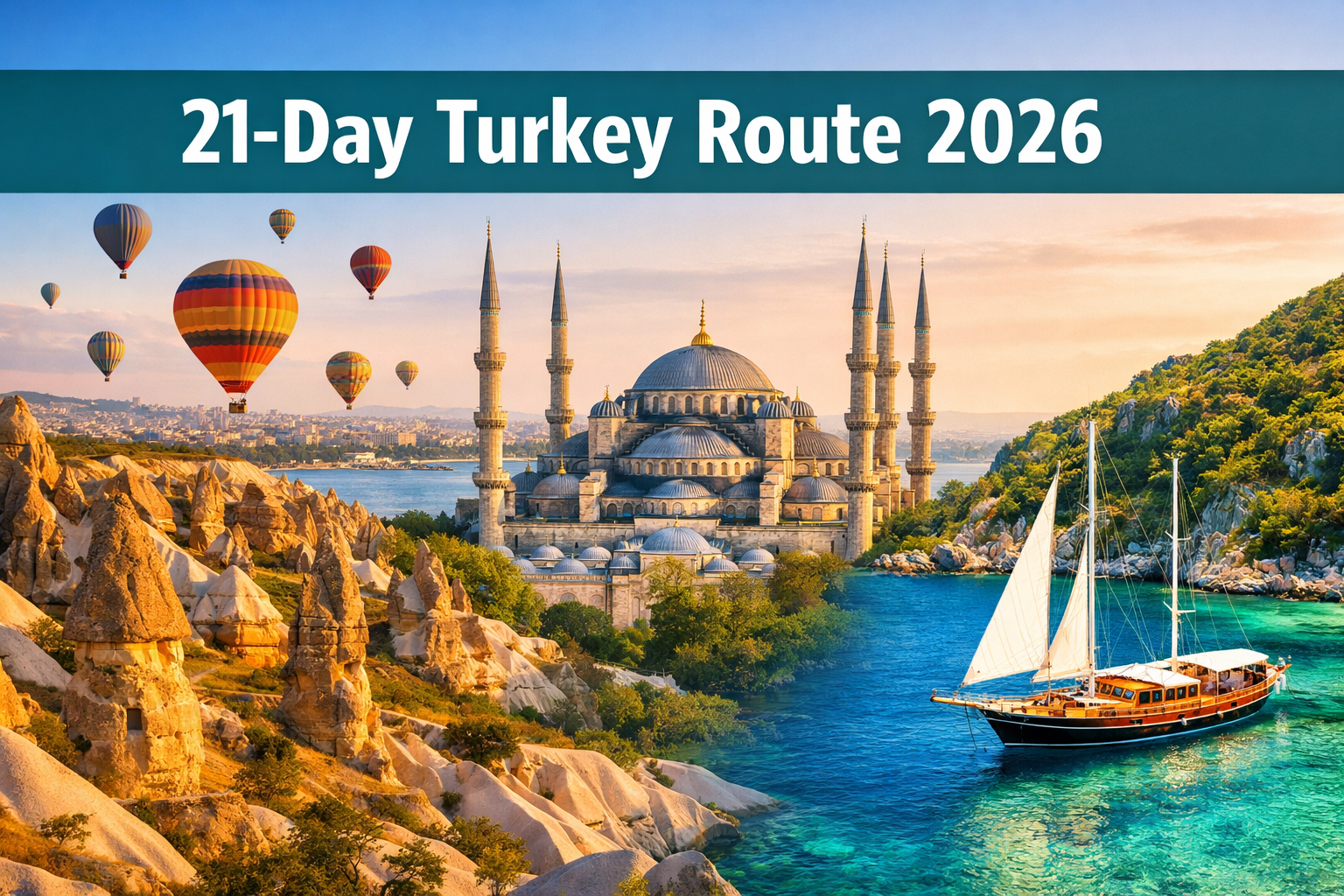

Planning the perfect Turkey itinerary for three weeks lets you experience ancient ruins, vibrant bazaars, and stunning landscapes. Last updated: July 13, 2026
Quick Answer: A 3-week Turkey itinerary typically covers Istanbul (4-5 nights), Cappadocia (3 nights), Pamukkale (2 nights), the Aegean coast including Ephesus and Bodrum (4-5 nights), and the Mediterranean coast around Antalya and Fethiye (4-5 nights). Twenty-one days is genuinely enough time to hit Turkey’s greatest hits without feeling like you’re speed-running a video game, as long as you plan your transport connections in advance.
Key Takeaways
- 21 days is the sweet spot for Turkey: enough time to do Istanbul, Cappadocia, the Aegean, and the Mediterranean coast without sacrificing depth for breadth.
- Domestic flights save serious time, the Istanbul-to-Cappadocia flight is 1.5 hours vs. 12 hours by bus. Use them strategically.
- Budget estimate for 21 days: roughly $1,800,$3,500 USD per person (mid-range), depending on accommodation choices and whether you join tours.
- Best months in 2026: April, May and September, October for weather, crowds, and price balance.
- The classic route (Istanbul → Cappadocia → Pamukkale → Aegean → Mediterranean) works brilliantly for first-timers; experienced travelers can swap Pamukkale for Konya or add the Black Sea.
- Yes, you can see both the Aegean and Mediterranean in 3 weeks, they’re connected by a logical coastal route.
- Book Cappadocia cave hotels and hot air balloon rides at least 2-3 months ahead in peak season.
- The U.S. State Department has a Level 2 advisory for Turkey; western and coastal regions are considered safe for tourism. [1]
- The southeast near the Syrian border (within 10km) carries a higher risk rating, skip it and stick to the classic tourist corridor. [2]
- First-timers: lean on a mix of guided tours and independent travel; experienced travelers can go fully independent with ease.

What’s the Best Route for 3 Weeks in Turkey?
The best 3-week Turkey route flows west to east and then south, using Istanbul as your gateway and working your way through Cappadocia before looping back along the coast. This geography makes logical sense and avoids expensive backtracking.
Here’s the classic 21-day framework that works beautifully for most travelers:
Days 1-5: Istanbul, Hagia Sophia, the Grand Bazaar, Bosphorus ferry, Beyoğlu neighborhood wandering. [Check out our Istanbul hidden gems guide for spots beyond the obvious.] Four to five nights here feels right, Istanbul rewards slow exploration.
Days 6-8: Cappadocia, Fly from Istanbul (1.5 hours). Three nights minimum for a hot air balloon ride, underground cities, and the Rose Valley. [Our complete Cappadocia 3-4 day guide has the exact breakdown.]
Days 9-10: Pamukkale, Bus or fly to Denizli. Two nights for the travertine terraces and ancient Hierapolis.
Days 11-13: Ephesus & Selçuk, One of the best-preserved Roman cities on earth. Two nights in Selçuk, day trip to Ephesus.
Days 14-15: Bodrum, Aegean vibes, a crusader castle, and the best fish restaurants of your life.
Days 16-18: Fethiye & Ölüdeniz, The Blue Lagoon, the Lycian Way, a gulet cruise if you can swing it.
Days 19-21: Antalya, The old city (Kaleiçi), Roman harbor, and day trips to Aspendos or the Düden Waterfalls.
Pro move: Fly Istanbul → Cappadocia on Day 6, then use buses and minibuses (dolmuş) along the coast. You’ll save time on the inland stretch and enjoy the scenic coastal roads at a human pace.
Can You Do a Turkey Itinerary in 3 Weeks, or Is It Too Rushed?
Three weeks is genuinely enough time, and it’s actually the ideal length for Turkey. You won’t feel rushed if you resist the urge to visit every single site in every single city.
Turkey is enormous (roughly the size of Texas and California combined), so the key is choosing a coherent corridor rather than trying to zigzag across the whole country. The classic western and coastal route is self-contained and flows naturally. [4]
What you can realistically do in 21 days:
- 2-3 major cities (Istanbul, Antalya, Izmir area)
- 1-2 inland highlights (Cappadocia, Pamukkale)
- 3-4 coastal towns or beach bases
- 1 optional boat experience (gulet day trip or Blue Cruise)
What you should NOT try to cram in:
- Eastern Turkey (Van, Kars, Nemrut), that’s a separate trip entirely; see our Eastern Turkey itinerary guide
- Istanbul AND Ankara AND Konya AND Cappadocia AND the full coast, pick your battles
Fair warning: travelers who try to visit 10+ destinations in 21 days consistently report that the trip felt exhausting rather than exhilarating. Two to three nights per stop is the minimum that lets a place actually sink in.
What’s the Difference Between the Classic Route vs. Off the Beaten Path?
The classic Turkey route (Istanbul → Cappadocia → Aegean coast → Mediterranean) is popular for a reason: it’s logistically smooth, visually stunning, and hits the sites that genuinely deserve their reputations. The off-the-beaten-path version swaps or adds destinations that most tourists never reach.
Classic route: Istanbul, Cappadocia, Pamukkale, Ephesus, Bodrum, Fethiye, Antalya. Excellent infrastructure, easy transport, tons of English spoken.
Off-the-beaten-path additions (for experienced travelers):
- Konya instead of Pamukkale, Rumi’s tomb, Seljuk architecture, zero tourist crowds
- Safranbolu, an Ottoman village frozen in amber, seriously underrated
- Gaziantep, the food capital of Turkey (bookmark this for the baklava alone)
- The Black Sea coast, lush, green, and completely different from the Aegean
Here’s the magic: you don’t have to choose one or the other. A smart 3-week itinerary can blend the classic anchors (Istanbul, Cappadocia) with one or two surprise gems. Swap Bodrum for Alaçatı, for example, same Aegean energy, half the crowds, ridiculously good wine bars.
Best Time to Visit Turkey for 3 Weeks in 2026
April, May and September, October are the best months for a 3-week Turkey trip in 2026. You get warm but not scorching temperatures, manageable crowds, and lower accommodation prices than peak summer.
| Season | Pros | Cons |
|---|---|---|
| April, May | Wildflowers, mild temps (18-25°C), fewer crowds | Occasional rain in Istanbul |
| June, August | Best beach weather, all sites open | Peak crowds, 35-40°C inland, higher prices |
| Sept, Oct | Warm sea, golden light, harvest festivals | Coastal towns start winding down in Oct |
| Nov, March | Very cheap, Istanbul is atmospheric | Cappadocia can be cold; some coastal towns close |
For Cappadocia specifically: spring and autumn are ideal for balloon flights, summer heat creates turbulence that cancels more flights than you’d expect.
For the coast: June through September is beach season. The Aegean and Mediterranean are swimmable from May through October.
Turkey welcomed a record number of visitors in 2026, meaning peak-season crowds are real. See our guide on Turkey’s record-breaking 2026 tourism season for what this means for your planning.
Is 3 Weeks Enough to See Cappadocia, Istanbul, and the Coast?
Yes, three weeks comfortably covers Istanbul, Cappadocia, and the coast with time to breathe. The key is using one domestic flight (Istanbul to Cappadocia) to avoid wasting two days on a bus. [5]
Here’s the honest breakdown of time needed per region:
- Istanbul: 4-5 nights (could spend a month, but 4 nights hits the essentials)
- Cappadocia: 3 nights (balloon ride + valleys + underground city = full days)
- Pamukkale: 2 nights (one full day is enough; two lets you relax)
- Ephesus area: 2 nights (half-day at the ruins, half-day for Şirince village)
- Aegean coast (Bodrum or Alaçatı): 2-3 nights
- Fethiye/Ölüdeniz: 2-3 nights
- Antalya: 2 nights
That’s 17-20 nights, leaving 1-4 flex days for slow mornings, unexpected detours, or that spontaneous boat trip you’ll definitely want to take.
How Do You Get Around Turkey for 21 Days: Domestic Flights or Buses?
The smart answer is both. Use domestic flights for long inland jumps (Istanbul to Cappadocia, Cappadocia to Antalya or Izmir), and use buses and dolmuş minibuses for coastal hops where the scenery is half the point.
Domestic flights: Turkish Airlines, Pegasus, and AnadoluJet connect all major cities. Istanbul to Cappadocia (Kayseri or Nevşehir airport) costs roughly $30,$80 USD booked in advance. Check our Essential Turkey 2026 Flight Guide for current routes and terminal updates.
Intercity buses (otogar): Comfortable, cheap, and surprisingly punctual. The Pamukkale → Selçuk route, for example, is a pleasant 3-hour bus ride through olive groves. Tickets run $5,$20 USD.
Dolmuş (shared minibuses): The secret weapon of coastal travel. Fethiye to Ölüdeniz? $1.50. Absolutely worth it.
Renting a car: Consider this for the Turquoise Coast stretch (Fethiye to Antalya), the D400 coastal road is one of the most beautiful drives in the world, and a car lets you stop at hidden coves. Our road trip guide covers the best routes in detail.
Common mistake: Booking a bus from Istanbul to Cappadocia (12 hours overnight) when a $50 flight takes 1.5 hours. Save the overnight bus experience for shorter, more scenic routes.
How Much Does a 21-Day Turkey Trip Cost?
A 21-day Turkey trip costs roughly $1,800,$3,500 USD per person for mid-range travel in 2026, including flights, accommodation, food, transport, and activities. Budget travelers can do it for $1,200,$1,800; luxury travelers should budget $4,500+.
Estimated daily costs (per person, mid-range):
- Accommodation: $40,$90/night (boutique guesthouse to mid-range hotel; Cappadocia cave hotels run higher)
- Food: $20,$40/day (mix of lokanta lunch spots and sit-down dinners)
- Transport: $5,$15/day average (buses, dolmuş; domestic flights budgeted separately)
- Activities & entrance fees: $10,$25/day
- Daily total: $75,$170/day
Budget add-ons to factor in:
- Hot air balloon ride in Cappadocia: $150,$250 per person (absolutely worth it)
- Gulet day trip: $30,$80 per person
- Hammam experience: $20,$60
- International flights to Istanbul: varies widely by origin
Turkey’s currency fluctuations have made it relatively affordable for visitors paying in USD, EUR, or GBP, though Istanbul prices have risen noticeably in 2026. See our Istanbul budget breakdown for current costs.
Turkey 3-Week Itinerary for First-Timers vs. Experienced Travelers
First-timers should stick to the classic western corridor and mix guided tours with independent exploration. Experienced travelers who’ve done Istanbul and Cappadocia before should pivot east or deep-dive into one region.
For first-timers:
- Follow the Istanbul → Cappadocia → Pamukkale → Ephesus → Bodrum → Fethiye → Antalya route
- Book a guided day tour for Ephesus (context makes the ruins come alive)
- Join a small-group Cappadocia tour for the underground cities
- Stay independent for Istanbul, it’s very easy to navigate solo
For experienced travelers:
- Consider replacing Pamukkale with Konya (Whirling Dervish ceremony, Seljuk mosques)
- Add Gaziantep for 2 nights, the gastronomy trail here is extraordinary
- Explore the Black Sea coast instead of repeating the Aegean
- Go fully independent, Turkey’s transport infrastructure handles it easily
Here’s what nobody tells you: even experienced Turkey travelers almost always say they wish they’d spent more time in Istanbul’s non-touristy neighborhoods (Karaköy, Balat, Moda) rather than rushing to tick off more cities.
Can You See Both the Aegean and Mediterranean Coast in 3 Weeks?
Yes, and the route flows naturally. The Aegean coast (Bodrum, Alaçatı, Selçuk) and the Mediterranean coast (Fethiye, Kaş, Antalya) connect via a single coastal road. You don’t need to backtrack.
Suggested coastal split for 21 days:
- Aegean: Selçuk/Ephesus (2 nights) + Bodrum or Alaçatı (2-3 nights)
- Mediterranean: Fethiye/Ölüdeniz (2-3 nights) + Kaş optional (1 night) + Antalya (2 nights)
That’s 9-11 nights on the coast, which leaves 10-12 nights for Istanbul and Cappadocia. Totally doable.
The Bodrum to Fethiye connection is roughly 3.5 hours by bus, not bad at all. The Ultimate Turkey Beaches Guide breaks down which coast suits your style better if you need to choose.
Is It Better to Book Tours or Travel Independently in Turkey?
A hybrid approach works best for most travelers. Go independent for cities and coastal towns; book guided tours for specific sites where context dramatically improves the experience (Ephesus, Cappadocia underground cities, Nemrut Dağ).
Book a tour for:
- Ephesus ruins (a good guide turns rubble into a living city)
- Cappadocia underground cities (Derinkuyu is genuinely confusing without guidance)
- Hot air balloon flights (always booked through licensed operators)
- Pamukkale (combo tours from Selçuk are efficient and cheap)
Travel independently for:
- Istanbul (metro, ferries, and trams are easy; the city rewards wandering)
- Coastal towns (Bodrum, Fethiye, Antalya are all walkable)
- Cappadocia’s above-ground valleys (rent a scooter or hire a local driver)
Turkish hospitality is no joke, locals will often go out of their way to point you in the right direction, recommend their cousin’s restaurant, or invite you for çay. Independent travel here feels warm rather than daunting.
Before you go, make sure your visa situation is sorted. Our Ultimate Turkey Visa Guide 2026 covers e-Visa requirements for US, UK, EU, and Asian travelers.
What Do People Regret Not Doing on a 3-Week Turkey Trip?
The most common regrets from 3-week Turkey travelers fall into a predictable pattern: they rushed cities, skipped the hammam, and didn’t book the balloon ride early enough.
Top regrets (steal this tip, avoid them):
- Not spending enough time in Istanbul, four nights feels like a lot until you’re there
- Missing a Turkish hammam, this is a cultural experience, not just a spa treatment
- Not booking the Cappadocia balloon in advance, it sells out weeks ahead in peak season; see our hot air balloon guide
- Skipping Şirince village near Ephesus, a 20-minute dolmuş ride to one of Turkey’s prettiest hill villages
- Not trying a gulet day trip on the Mediterranean
- Eating only at tourist restaurants, the best food in Turkey is in the lokanta (worker’s lunch spots) with no English menu
- Overpacking the itinerary, the travelers who slow down consistently have better trips
Common Mistakes People Make Planning a 3-Week Turkey Vacation
The biggest planning mistake is treating Turkey like a European city-hop where everything is close together. Turkey is vast, and poor transport planning burns days.
Avoid these mistakes:
- Booking the overnight bus Istanbul → Cappadocia when a cheap flight exists
- Visiting Pamukkale midday in July, the terraces are blinding white and packed; go at dawn
- Ignoring the southeast travel advisory, the U.S. State Department’s Level 2 advisory applies nationally, but the UK FCDO specifically advises against travel within 10km of the Syria border. [1][2] Stick to western Turkey and you’re fine.
- Not checking visa requirements early, some nationalities need to apply in advance, not just on arrival
- Booking non-refundable accommodation throughout, weather and transport delays happen; keep some flexibility
- Assuming credit cards work everywhere, carry Turkish lira for markets, small restaurants, and dolmuş
What If I Only Have 2 Weeks Instead of 3 in Turkey?
Two weeks in Turkey is absolutely doable, you just need to make sharper choices. Drop one coastal region (choose Aegean OR Mediterranean, not both) and cut Pamukkale if time is tight.
Best 14-day version:
- Istanbul: 4 nights
- Cappadocia: 3 nights (fly both ways)
- Ephesus/Selçuk: 2 nights
- Bodrum or Fethiye: 3 nights
- Antalya: 2 nights
That’s a tight but satisfying trip. For a fully built-out 7-day version if you’re even more pressed for time, our Perfect Single Week in Turkey guide has you covered.
Consider this your sign to take the full 3 weeks if you can, the extra 7 days make a disproportionate difference to how relaxed and immersed the trip feels.

Safety Considerations for Your 3-Week Turkey Itinerary in 2026
The western and coastal Turkey tourist corridor is considered safe for travelers. The U.S. Department of State maintains a Level 2 advisory (exercise increased caution) for Turkey overall, citing terrorism risks and regional tensions. [1] The UK FCDO advises against all travel within 10km of the Turkey-Syria border. [2]
Practical safety notes:
- Western Turkey (Istanbul, Aegean, Mediterranean coast, Cappadocia) is where the vast majority of tourists travel without incident
- Avoid the southeastern border region entirely
- Register with your government’s travel notification program (STEP for Americans)
- Turkey scores 8.0/10 for health and medical facilities, hospitals in major cities are excellent [3]
- Keep copies of your passport and travel insurance details accessible
For a thorough breakdown, see our guide: Is Turkey Safe to Visit in 2026?
FAQ: 3-Week Turkey Itinerary
Q: Do I need a visa for Turkey in 2026? Most nationalities (US, UK, EU, Australian) can get a Turkish e-Visa online before travel. It typically costs $50,$60 USD and takes 24-48 hours to process. Apply at least a week before departure.
Q: How many cities should I visit in 21 days? Five to seven destinations is the sweet spot. More than that and you’re spending more time on buses than actually experiencing places.
Q: Is Turkey expensive in 2026? Mid-range travel costs roughly $75,$170 USD per person per day including accommodation, food, and activities. It’s significantly cheaper than Western Europe for comparable quality.
Q: Should I fly or take the train between cities? Turkey’s rail network is improving but still limited for tourist routes. Domestic flights and intercity buses are the main options. Fly for long hauls; bus for scenic coastal routes.
Q: Can I drink tap water in Turkey? No, drink bottled or filtered water throughout Turkey. Bottled water is cheap (about $0.30,$0.50 per large bottle) and available everywhere.
Q: Is Turkish food suitable for vegetarians? Yes, surprisingly well. Meze culture means there are always plenty of vegetable-based dishes. Mercimek çorbası (lentil soup), gözleme, and börek are vegetarian staples.
Q: What currency should I carry? Turkish lira (TRY) for daily use. USD and EUR are accepted in tourist areas but at unfavorable rates. Use ATMs for lira and notify your bank before travel.
Q: Is it safe to travel solo in Turkey? Yes, Turkey is one of the more welcoming solo destinations in the region. Solo women travelers should exercise standard urban awareness in Istanbul and be aware that some areas are more conservative than others.
Q: Do I need travel insurance for Turkey? Absolutely. Medical facilities in major cities are good, but evacuation costs and trip cancellation coverage are worth having. Don’t skip this.
Q: What’s the best way to experience Turkish food culture? Join a cooking class in Istanbul or Gaziantep, eat lunch at a lokanta (no-menu worker’s restaurant), and do a food tour in whichever city you’re in. Our Ultimate Gastronomy Guide is the deep dive you need.
Q: When should I book Cappadocia cave hotels? Book 2-3 months ahead for April, May and September, October travel. The best cave hotels with private terraces and valley views sell out fast. Our Cappadocia cave hotel guide has booking strategies.
Q: Can families with kids do this 21-day itinerary? Yes, with some adjustments. Reduce the number of stops, prioritize Cappadocia (kids love the fairy chimneys and underground cities), and build in beach days on the coast. Turkish culture is exceptionally welcoming to children.
Conclusion: Your 21-Day Turkey Adventure Starts Here
The 3-Week Turkey Itinerary: The Ultimate 21-Day Route (2026) isn’t just a list of places, it’s a genuinely transformative journey through one of the world’s most layered, generous, and visually astonishing countries. From the moment you step off the ferry on the Bosphorus to the last glass of pomegranate juice in Antalya’s old harbor, Turkey has a way of making you feel like you’ve been let in on something extraordinary.
Your actionable next steps:
- Sort your visa first, apply for your e-Visa at least 2 weeks before departure
- Book Cappadocia accommodation and balloon flights immediately, these are the first things to sell out
- Lock in your Istanbul, Cappadocia flight as soon as your dates are set
- Keep 20-30% of your itinerary flexible, Turkey’s best moments are often unplanned
- Pack light, you’ll buy a kilim, some spices, and at least one ceramic bowl. Trust us.
Future you, the one sitting on a rooftop terrace in Göreme watching the sun set over a hundred hot air balloons, will be very grateful you planned this properly.
References
[1] Turkey Travel Advisory – https://travel.state.gov/en/international-travel/travel-advisories/turkey.html?r=seo&utm_source=openai
[2] Turkey Foreign Travel Advice – https://www.gov.uk/foreign-travel-advice/turkey?utm_source=openai
[3] Tripbase Turkey Safety Ratings – https://www.tripbase.com/safety/tr/?utm_source=openai
[4] 21 Day Itinerary – https://www.takeyourbackpack.com/backpacking-in-turkiye/21-day-itinerary/?utm_source=openai
[5] 21 Day Ultimate Turkey Explorer Tour 2026 Full Itinerary – https://myturkeyadventure.com/blog/21-day-ultimate-turkey-explorer-tour-2026-full-itinerary?utm_source=openai
[6] Is It Safe to Travel – https://isitsafetotravel.org/en/country/tur/?utm_source=openai
Tags: 3-week Turkey itinerary, 21-day Turkey route, Turkey travel 2026, Cappadocia itinerary, Istanbul travel guide, Turkey travel tips, Aegean coast Turkey, Mediterranean Turkey, Turkey budget travel, Turkey for first-timers, best time to visit Turkey, Turkey travel planning