

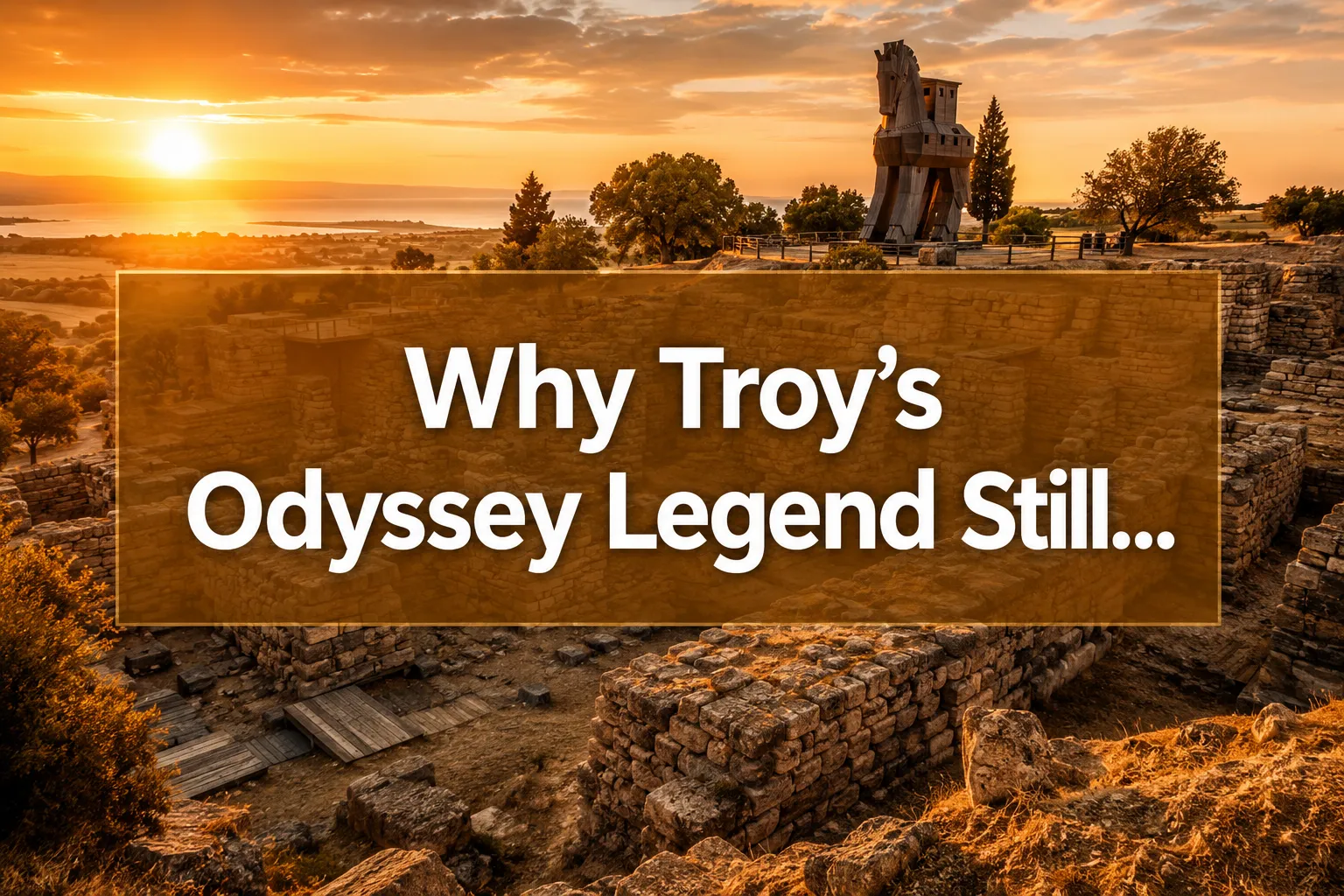

The ancient ruins of Troy continue to draw mythology enthusiasts from around the world to Türkiye every summer. Last updated: July 26, 2026
Quick Answer: Troy, located in northwestern Türkiye near the modern town of Çanakkale, is the real archaeological site believed to be Homer’s legendary city, and in July 2026, it’s drawing more visitors than ever. The combination of a UNESCO World Heritage designation, the blockbuster cultural revival of Homeric epics, and a brand-new world-class museum make this one of the most compelling ancient sites on Earth. For mythology fans, history lovers, and curious travelers alike, Troy genuinely delivers.
Key Takeaways
- Troy is a real, excavated site in Türkiye, not just a myth, archaeologists have identified at least nine distinct city layers spanning roughly 3,000 years.
- Homer’s Iliad describes the Trojan War; the Odyssey follows Odysseus’s journey home afterward, both epics have fueled centuries of fascination with this site.
- July is hot (expect 30-35°C / 86-95°F), but manageable with an early start, good sun protection, and the air-conditioned Troy Museum as your midday refuge.
- The site takes roughly 2-3 hours to explore thoroughly; combine it with the Troy Museum for a full-day experience.
- Entrance fees are affordable (approximately 200-250 Turkish lira as of 2026, subject to change, always verify at the gate).
- Troy is most easily visited as a day trip from Çanakkale, or as a longer excursion from Istanbul via ferry and bus.
- You can visit without a guide, but a licensed guide or audio guide dramatically enriches the experience.
- Troy is not just hype, it rewards visitors who arrive with context and curiosity.

What Is the Troy Odyssey Legend and Why Does It Matter?
The legend of Troy sits at the foundation of Western storytelling. Homer’s two epic poems, the Iliad and the Odyssey, describe a ten-year war between Greek forces and the city of Troy, sparked by the abduction of Helen by the Trojan prince Paris. The Odyssey picks up where the Iliad ends, following the Greek hero Odysseus on his decade-long voyage home after Troy’s fall.
Why Troy’s Odyssey legend still captivates travelers in Türkiye this July comes down to something surprisingly simple: these stories feel personal. Odysseus isn’t a flawless god-hero. He’s clever, flawed, homesick, and occasionally terrible at decision-making, which is to say, he’s relatable. Standing on the actual soil where this story is set transforms a poem you may have read in school into something visceral.
Here’s what nobody tells you: the Odyssey itself doesn’t take place at Troy, it begins there, in the aftermath of destruction. Visiting Troy is essentially visiting the starting gun of one of humanity’s greatest road-trip stories. That framing alone makes the site feel electric.
The enduring appeal of mythological sites like Troy also connects to Anatolia’s extraordinary role in the origins of civilization, this land has been generating world-changing stories for a very long time.
Is Troy in Türkiye Actually the Real Troy from Homer’s Iliad?
Yes, with appropriate scholarly nuance. The site known as Hisarlik in northwestern Türkiye is the location most archaeologists accept as the Troy of Homeric legend. German archaeologist Heinrich Schliemann began excavations here in 1871 and found multiple layers of ancient settlement. Later excavations, particularly those led by Manfred Korfmann in the 1980s and 1990s, confirmed that Troy VI or Troy VIIa (dating to roughly 1300-1180 BCE) aligns chronologically with the period Homer’s epics likely describe.
The honest caveat: Homer’s epics were oral poetry, composed and refined over centuries, not historical journalism. The “real” Trojan War, if a large-scale conflict occurred, was almost certainly messier, longer, and less glamorous than the poems suggest. But the geography, the archaeology, and the timeline all point convincingly to Hisarlik.
Common misconception to ditch immediately: Troy was not a small village. Archaeological evidence suggests the lower city extended to cover an area of roughly 200,000 square meters, making it one of the largest Bronze Age settlements in the region.
Best Time to Visit Troy, July Weather and Crowds
July is peak season at Troy, which means both maximum heat and maximum company. Daytime temperatures regularly reach 32-36°C (90-97°F), and the site is largely open and exposed. That said, July is also when the Aegean light is most dramatic, the ruins photograph beautifully, and the long days give you maximum visiting time.
Pro move: Arrive when the gates open (typically 8:00am in summer). The first two hours are cooler, less crowded, and frankly magical. By 11:00am, tour groups arrive in force and the sun becomes genuinely punishing.
- Crowds peak between 10:00am and 2:00pm
- Weekends are busier than weekdays
- The Troy Museum (climate-controlled) makes an ideal midday retreat
- Late afternoon, around 4:00-5:00pm, offers a second window of softer light and thinner crowds
Fair warning: there is almost no natural shade on the archaeological site itself. This is not a complaint, it’s a survival briefing.
How Long Does It Take to Explore Troy Archaeological Site?
Plan for 2-3 hours at the ruins alone, plus another 1.5-2 hours at the Troy Museum if you’re doing it justice. A full Troy day runs approximately 4-5 hours of active engagement, not counting travel, lunch, or the inevitable moment you sit on a stone wall and just… think about everything.
The site is organized with a marked walking path that loops through the main excavation areas, including the famous Scaean Gate, the walls of Troy VI, the Roman odeon, and the replica Trojan Horse (yes, you can climb inside, yes, it’s absolutely worth it, and yes, you will feel slightly ridiculous in the best possible way).
Choose your depth:
- Casual visitor: 1.5 hours, main path, replica horse photo
- History enthusiast: 2.5-3 hours, all nine city layers, interpretive panels
- Full mythology pilgrim: 4-5 hours including the museum, ideally with a guide
Troy Turkey vs. Other Greek Mythology Sites, Which Is Better?
Troy is genuinely different from sites like Ephesus or Delphi, and comparing them directly misses the point. The ancient city of Ephesus is visually spectacular, columns, marble streets, a library facade that photographs like a dream. Troy is more austere, more layered, and requires more imagination.
| Site | Best For | Visual Impact | Mythology Depth |
|---|---|---|---|
| Troy | Homer fans, Bronze Age history | Understated, layered | Unmatched |
| Ephesus | Roman history, architecture | Spectacular | Moderate |
| Pergamon | Hellenistic culture, medicine | Dramatic hilltop setting | Low |
The secret sauce at Troy is the emotional resonance. Ephesus wows you. Troy haunts you.
Can You Visit Troy Without a Guide, or Do You Need One?
You can absolutely visit Troy independently, the site has a well-marked walking path, interpretive signs in multiple languages, and an excellent audio guide option available at the entrance. For travelers who’ve read the epics or done some homework, self-guided visits are deeply satisfying.
That said, a licensed guide is a total game-changer here. Troy’s nine city layers are genuinely confusing without someone to orient you spatially and chronologically. A good guide will point to a crumbling wall and say “that’s Troy II, three thousand years older than what Homer describes” and suddenly the whole site reorganizes itself in your mind.
Steal this tip: If hiring a private guide feels expensive, consider joining a small-group tour from Çanakkale. These typically run 2-3 hours and cost a fraction of private rates while still delivering excellent context.
Troy Turkey Entrance Fee and Ticket Prices in 2026
As of July 2026, entrance to the Troy archaeological site costs approximately 200-250 Turkish lira per adult (roughly equivalent to a few euros or dollars at current exchange rates, always verify the exact figure at the gate, as prices adjust periodically). The Troy Museum charges a separate entrance fee of similar value.
Practical notes:
- Museum and site tickets are purchased separately
- The combined visit is worth every lira
- Student and youth discounts are typically available with valid ID
- Turkish citizens pay a reduced rate
- Cash and card are both accepted at most entry points, but carry some lira as backup
For broader travel budgeting tips, the backpacker’s guide to Türkiye on a budget is genuinely useful reading before you go.
What’s the Difference Between Troy and Gallipoli Turkey Tours?
Troy and Gallipoli are both located in the Çanakkale region and are frequently combined into multi-day itineraries, but they serve completely different emotional purposes. Troy is ancient mythology and Bronze Age archaeology. Gallipoli is World War I history, specifically the devastating 1915 Dardanelles Campaign that holds profound significance for Turkish, Australian, New Zealand, and British visitors.
- Troy: 3,000+ years old, mythological and archaeological, intellectually stimulating
- Gallipoli: approximately 110 years old, military history, emotionally intense, deeply moving
Many tour operators offer combined Troy-Gallipoli day trips from Çanakkale or Istanbul. These work logistically but can feel emotionally whiplash-inducing, you’re moving from ancient epic poetry to modern mass casualties in a single afternoon. Consider splitting them across two days if your schedule allows.
Troy Turkey Day Trip from Istanbul, or Stay Overnight Nearby?
Troy is approximately 320 km (200 miles) from Istanbul, making it a long but doable day trip, though an overnight stay in Çanakkale is strongly recommended for a more relaxed experience.
Day trip from Istanbul (doable, not ideal):
- Take an early bus from Istanbul’s Esenler terminal to Çanakkale (approximately 4-5 hours)
- Alternatively, take the ferry from Kabataş or Yenikapı to Bandırma, then bus to Çanakkale, the ferry travel guide for Türkiye covers this beautifully
- Visit Troy and the museum, return same evening, exhausting but achievable
Overnight in Çanakkale (the pro move):
- Çanakkale is a charming university town with good food, waterfront cafes, and reasonable accommodation
- Staying overnight lets you hit Troy at opening time, explore Gallipoli the next morning, and travel back relaxed
- Future you will thank you for the extra night
How Does the Troy Museum Compare to Seeing the Actual Ruins?
The Troy Museum, which opened in 2018, is one of the finest archaeological museums in Türkiye, and that’s saying something in a country where the competition is fierce. The building itself is architecturally striking, and the collection includes artifacts spanning all nine city layers, from Bronze Age ceramics to Roman-era jewelry.
Here’s the magic: the museum and the ruins are not competing experiences. They’re a two-part story. The museum gives you the objects, the timeline, and the context. The ruins give you the scale, the landscape, and the feeling. Do both, in either order (though museum-first helps you understand what you’re looking at on-site).
The museum also has excellent air conditioning, a fact that feels poetic in July and should not be underestimated.
Troy Turkey July Heat Tips, What to Bring and Prepare
July at Troy is genuinely hot. Prepare accordingly and you’ll have a wonderful time. Ignore the heat and you’ll spend the afternoon horizontal in your hotel room.
Pack this, no excuses:
- Sunscreen (SPF 50+, reapply every 90 minutes)
- A wide-brimmed hat, not a baseball cap, an actual hat with neck coverage
- At least 1.5 liters of water per person (buy more at the site entrance)
- Comfortable, closed-toe walking shoes (the ground is uneven)
- A light long-sleeved layer for sun protection
- Sunglasses
Timing strategy:
- Arrive at 8:00am, explore ruins until 10:30am
- Retreat to the Troy Museum from 11:00am to 1:30pm
- Optional: find lunch in Tevfikiye village (the small settlement adjacent to the site)
- Return to the ruins for late afternoon light around 4:30pm if energy allows
For more comprehensive health and wellness advice while traveling in Türkiye, this guide to staying healthy while traveling in Turkey covers everything from sun safety to food hygiene.
What Ancient Troy Facts Are Actually Myths or Misconceptions?
Several popular beliefs about Troy deserve a gentle reality check. Here’s what the archaeology actually says:
Misconception 1: The Trojan Horse was a real wooden horse.
Most historians believe “the horse” was likely a metaphor, possibly for a siege engine, an earthquake (Poseidon, the horse god, was associated with earthquakes), or simply a poetic device. No archaeological evidence of a giant wooden horse has been found. The replica at the site is a modern tourist attraction, not a historical artifact.
Misconception 2: Troy was a small, obscure town.
Troy was a significant Bronze Age city controlling the strategic entrance to the Dardanelles strait. Its location gave it enormous commercial and military importance.
Misconception 3: Homer wrote the Iliad and Odyssey as history.
Homer (if a single person named Homer even existed) was composing oral poetry, likely drawing on centuries of accumulated legend. The epics are literature, not documentary.
Misconception 4: The site is mostly intact.
The nine layers of Troy were excavated with 19th-century methods that, frankly, caused significant damage to the upper layers. Schliemann, in his enthusiasm to reach what he believed was Homeric Troy, bulldozed through several important strata. Modern archaeology has been more careful, but the site is fragmentary.

Is Troy Worth Visiting, or Just Hype for Mythology Fans?
Troy is absolutely worth visiting, with one condition: arrive with context. Visitors who show up expecting Ephesus-level spectacle and leave disappointed are usually the ones who didn’t read anything beforehand. Troy rewards the prepared traveler with an experience that is genuinely unlike anything else in Türkiye.
Why Troy’s Odyssey legend still captivates travelers in Türkiye this July isn’t really about the physical ruins (which are, honestly, more evocative than visually overwhelming). It’s about standing on ground where human beings have been telling the same story for three thousand years. That continuity is staggering.
Consider this your sign: if you’ve ever read the Odyssey, taught it, been moved by it, or simply wondered whether any of it was real, Troy is the place to go. The Aegean coast of Türkiye offers extraordinary context for the whole mythological world Homer inhabited, and Troy is its crown jewel.
FAQ
Q: Where exactly is Troy located in Türkiye?
Troy (Hisarlik) is located in the Çanakkale Province of northwestern Türkiye, approximately 30 km south of the city of Çanakkale, near the village of Tevfikiye.
Q: Is the Trojan Horse at Troy real or a replica?
The wooden horse at the Troy site is a modern replica built for tourists. It has no historical basis but is fun to climb inside and photograph.
Q: Do I need to book Troy tickets in advance?
Advance booking is not strictly required, but purchasing tickets online or arriving early in July avoids queues. Check the official Turkish Ministry of Culture ticketing portal before your visit.
Q: How do I get from Istanbul to Troy?
Take a bus from Istanbul’s Esenler terminal to Çanakkale (4-5 hours), then a local dolmuş (minibus) or taxi to the site (30 minutes). Alternatively, take the ferry to Bandırma and bus to Çanakkale.
Q: Can children enjoy Troy?
Yes, especially with the replica Trojan Horse to climb. Children who’ve encountered Greek myths find the site exciting. Pre-teens and teens benefit most from some background reading beforehand.
Q: Is Troy accessible for visitors with mobility limitations?
The Troy Museum is fully accessible. The archaeological site has uneven terrain and some areas are challenging for wheelchairs or limited mobility, contact site management in advance for current accessibility information.
Q: What language are the site signs in?
Interpretive panels at Troy are in both Turkish and English. The Troy Museum also offers multilingual displays.
Q: Can I combine Troy with a beach day?
Yes. The Aegean coast near Çanakkale has several beaches. Troy in the morning, a beach in the afternoon is a genuinely excellent July itinerary.
Q: Is Troy a UNESCO World Heritage Site?
Yes. Troy was inscribed on the UNESCO World Heritage List in 1998, recognized for its outstanding universal value as an archaeological site and its significance to world literature and culture.
Q: What’s the best souvenir to buy at Troy?
Replica ceramic vessels, small Trojan Horse figurines, and illustrated editions of Homer are popular. For broader souvenir inspiration across Türkiye, this guide to the best souvenirs from Turkey is a great resource.
Conclusion
Why Troy’s Odyssey legend still captivates travelers in Türkiye this July is ultimately a question about why stories matter. Troy isn’t the most visually dramatic archaeological site in the country, Türkiye has plenty of those. What Troy offers is something rarer: the vertiginous sensation of standing at the origin point of a story that shaped Western literature, philosophy, and the very way humans think about war, homecoming, and heroism.
Your actionable next steps:
- Read (or re-read) a good translation of the Odyssey before you go, Emily Wilson’s 2017 translation is ridiculously good and genuinely readable.
- Book an overnight stay in Çanakkale rather than attempting a rushed day trip from Istanbul.
- Arrive at the site by 8:00am, spend midday in the Troy Museum, and return for late afternoon light.
- Hire a guide or download the audio guide, context is everything here.
- Pair Troy with the broader off-the-beaten-path attractions Türkiye has to offer for a trip that goes well beyond the postcard version.
Troy has been waiting three thousand years. It’ll keep. But July 2026 is a particularly good time to go, and now you know exactly how to make the most of it.